VCP5-DCV Exam Details
-
Exam Code
:VCP5-DCV -
Exam Name
:VMware Certified Professional 5 - Data Center Virtualization (VCP5-DCV) -
Certification
:VMware Certifications -
Vendor
:VMware -
Total Questions
:571 Q&As -
Last Updated
:Dec 21, 2024
VMware VCP5-DCV Online Questions & Answers
-
Question 301:
An administrator is attempting to clone a running virtual machine, but receives an error that the virtual machine is using a device that prevents the operation. What two device types listed below could be causing this error? (Choose two.)
A. An independent mode virtual disk
B. A physical compatibility mode RDM
C. An LSI logic SAS adapter
D. A BusLogic Parallel adapter -
Question 302:
A vSphere administrator enables and configures a Software iSCSI Initiator, and configures an iSCSI vmkernel portgroup with Port Binding. The SAN administrator creates a few LUNs on an iSCSI server. However, when the vSphere
administrator adds the IP address of the iSCSI server in the Dynamic Discovery list, no iSCSI targets are detected.
What condition would result in this behavior?
A. The iSCSI vmkernel portgroup and the iSCSI server are on different subnets.
B. The iSCSI server IP address should be entered in the Static Discovery instead of Dynamic Discovery list.
C. The network card bound to the iSCSI portgroup is 1Gbps Ethernet instead of 10Gbps.
D. A Software iSCSI Initiator cannot use Port Binding in conjunction with Dynamic Discovery. -
Question 303:
What are two prerequisites for installing the vCenter Server application? (Choose two.)
A. The system vCenter Server is installed on must be a physical machine.
B. A valid vSphere vCenter license must be obtained before installation.
C. vCenter must be in the same network as the hosts if supporting vSphere Storage Appliance Cluster.
D. The system vCenter Server is installed on cannot be a domain controller. -
Question 304:
An administrator is responsible for enabling file access for desktop users. Many users have complained that they cannot access their files. An alert in the vSphere Client states that the storage connectivity alarm for all hosts has been triggered. The storage screen indicates that everything is connected, but the triggered alert has not been acknowledged.
Which action will correct the user access problem?
A. Rescan the storage on the file-sharing virtual machine on which the users are seeing the problem.
B. Reconnect the storage containing the user files to all hosts in the cluster, then Refresh datastores on all hosts in the cluster.
C. Tell each user to reboot their computer.
D. Reconnect the storage containing the user files to all hosts in the cluster, then Rescan datastores on all hosts in the cluster. -
Question 305:
An administrator notices that the database virtual machines fail to backup within the backup window. Each database virtual machine has 4 vCPUs, 16GB RAM and 12 virtual disks. There are 16 database virtual machines to backup using 8 backup jobs.
Which is the simplest way to improve the backup performance for these virtual machines?
A. Add a backup job for each virtual machine.
B. Set a 16GB reservation for each virtual machine.
C. Add 1MB VMDK drives at 1.0, 2.0 and 3.0 on the VDR appliance.
D. Upgrade the array to 8GB FCP and ensure multipathing is configured properly. -
Question 306:
For security reasons, an administrator removes a user from the Active Directory domain used by all ESXi hosts for authentication. At the time the user is removed they are actively logged into an ESXi 5.x host through the vSphere Client. What is true regarding this scenario?
A. The user immediately loses connectivity to and permissions on the host.
B. The user retains permissions and connectivity to the host for up to 24 hours.
C. The user retains permissions on the host until the host is rebooted.
D. The user retains permissions on the object until the next time the user logs in to vCenter Server. -
Question 307:
An administrator is unable to login to vCenter Server when using the vSphere web client. The administrator successfully accessed vCenter Server using the client earlier the same day. What is the most appropriate first step the administrator should take to resolve this issue?
A. Verify the web browser being used has Adobe Flash plugin version 11.5 or later
B. Verify the vCenter Single Sign-On service is running on the vCenter Server
C. Verify the vSphere Web Server service is running on the vCenter Server
D. Verify the administrator has permissions configured in vCenter Server -
Question 308:
A vSphere administrator needs to enable Fault Tolerance on a virtual machine. When performing a Storage vMotion migration, which setting should the vSphere administrator change in the virtual machine's disk format to ensure it meets Fault Tolerance requirements?
A. Thick Provision Eager Zeroed
B. Thick Provision Lazy Zeroed
C. Thin Provisioned
D. Thin Provision Eager Zeroed -
Question 309:
Click the Exhibit button.
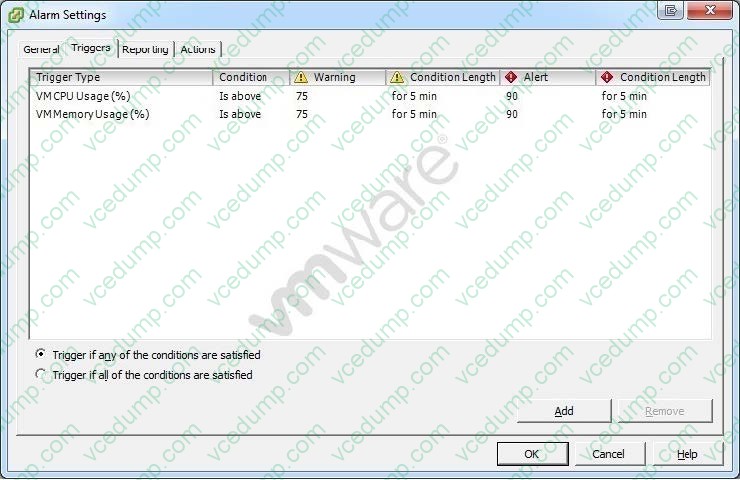
ACME Party Supplies Corporation has a requirement to monitor all virtual machines in a vSphere 5 environment for CPU and Memory usage. An administrator configures an alarm in vCenter Server to send an alert when any VM exceeds 65% memory utilization and 75% CPU utilization. The alarm should warn administrators if the virtual machine is within 20% of the defined thresholds. The alarm has been created with the default options as shown in the exhibit.
Which three modifications must be made to the default settings in the alarm definition to satisfy the stated requirements? (Choose three.)
A. Set the VM CPU Usage (%) Alert trigger to 75% and the VM Memory Usage (%) Alert trigger to 55%
B. Set the VM CPU Usage (%) Alert trigger to 75% and the VM Memory Usage (%) Warning trigger to 55%
C. Set the VM CPU Usage (%) Warning trigger to 65% and the VM Memory Usage (%) Warning trigger to 45%
D. Set the Trigger if all of the conditions are satisfied radio button
E. Set the Trigger if any of the conditions are satisfied radio button -
Question 310:
A vSphere administrator configures a preferred heartbeat datastore in an HA/DRS cluster configuration. The vCenter Server identifies an alternative preferred datastore. Why would vCenter Server identify an alternative preferred datastore over the administrator's preference?
A. The selected datastore contains powered-on virtual machines.
B. The selected datastore is formatted with a 1 MB block size.
C. The selected datastore is an NFS datastore.
D. The selected datastore is not accessible to all of the hosts.
Related Exams:
-
1V0-21.20
Associate VMware Data Center Virtualization -
1V0-31.21
Associate VMware Cloud Management and Automation -
1V0-41.20
Associate VMware Network Virtualization -
1V0-61.21
Associate VMware Digital Workspace -
1V0-71.21
Associate VMware Application Modernization -
1V0-81.20
Associate VMware Security -
2V0-11.24
VMware Cloud Foundation 5.2 Administrator -
2V0-11.25
VMware Cloud Foundation 5.2 Administrator -
2V0-13.24
VMware Cloud Foundation 5.2 Architect -
2V0-13.25
VMware Cloud Foundation 9.0 Architect
Tips on How to Prepare for the Exams
Nowadays, the certification exams become more and more important and required by more and more enterprises when applying for a job. But how to prepare for the exam effectively? How to prepare for the exam in a short time with less efforts? How to get a ideal result and how to find the most reliable resources? Here on Vcedump.com, you will find all the answers. Vcedump.com provide not only VMware exam questions, answers and explanations but also complete assistance on your exam preparation and certification application. If you are confused on your VCP5-DCV exam preparations and VMware certification application, do not hesitate to visit our Vcedump.com to find your solutions here.