SY0-601 Exam Details
-
Exam Code
:SY0-601 -
Exam Name
:CompTIA Security+ -
Certification
:CompTIA Certifications -
Vendor
:CompTIA -
Total Questions
:1334 Q&As -
Last Updated
:Jul 15, 2026
CompTIA SY0-601 Online Questions & Answers
-
Question 251:
An organization is planning to roll out a new mobile device policy and issue each employee a new laptop, These laptops would access the users' corporate operating system remotely and allow them to use the laptops for purposes outside of their job roles.
Which of the following deployment models is being utilized?
A. MDM and application management
B. BYOO and containers
C. COPE and VDI
D. CYOD and VMs -
Question 252:
During an incident, a company's CIRT determines it is necessary to observe the continued network-based transactions between a callback domain and the malware running on an enterprise PC.
Which of the following techniques would be BEST to enable this activity while reducing the nsk of lateral spread and the nsk that the adversary would notice any changes?
A. Physically move the PC to a separate Internet point of presence.
B. Create and apply microsegmentation rules,
C. Emulate the malware in a heavily monitored DMZ segment
D. Apply network blacklisting rules for the adversary domain -
Question 253:
Which of the following is required in order (or an IDS and a WAF to be effective on HTTPS traffic?
A. Hashing
B. DNS sinkhole
C. TLS inspection
D. Data masking -
Question 254:
A security administrator examines the ARP table of an access switch and sees the following output:
A. DDoS on Fa0/2 port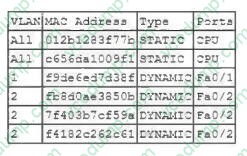
B. MAC flooding on Fa0/2 port
C. ARP poisoning on Fa0/1 port
D. DNS poisoning on port Fa0/1 -
Question 255:
A company currently uses passwords for logging in to company-owned devices and wants to add a second authentication factor. Per corporate policy, users are not allowed to have smartphones at their desks. Which of the following would meet these requirements?
A. Smart card
B. PIN code
C. Knowledge-based question
D. Secret key -
Question 256:
A commercial cyber-threat intelligence organization observes IoCs across a variety of unrelated customers.
Prior to releasing specific threat intelligence to other paid subscribers, the organization is MOST likely obligated by contracts to:
A. perform attribution to specific APTs and nation-state actors.
B. anonymize any PII that is observed within the IoC data.
C. add metadata to track the utilization of threat intelligence reports.
D. assist companies with impact assessments based on the observed data -
Question 257:
A company needs to centralize its logs to create a baseline and have visibility on its security events. Which of the following technologies will accomplish this objective?
A. Security information and event management
B. A web application firewall
C. A vulnerability scanner
D. A next-generation firewall -
Question 258:
A company is enhancing the security of the wireless network and needs to ensure only employees with a valid certificate can authenticate to the network. Which of the following should the company implement?
A. PEAP
B. PSK
C. WPA3
D. WPS -
Question 259:
Which of the following is the correct order of volatility from MOST to LEAST volatile?
A. Memory, temporary filesystems, routing tables, disk, network storage
B. Cache, memory, temporary filesystems, disk, archival media
C. Memory, disk, temporary filesystems, cache, archival media
D. Cache, disk, temporary filesystems, network storage, archival media -
Question 260:
A user recently attended an exposition and received some digital promotional materials The user later noticed blue boxes popping up and disappearing on the computer, and reported receiving several spam emails, which the user did not open Which of the following is MOST likely the cause of the reported issue?
A. There was a drive-by download of malware
B. The user installed a cryptominer
C. The OS was corrupted
D. There was malicious code on the USB drive
Related Exams:
-
220-1001
CompTIA A+ Certification: Core 1 -
220-1002
CompTIA A+ Certification: Core 2 -
220-1101
CompTIA A+ Certification: Core 1 -
220-1102
CompTIA A+ Certification: Core 2 -
220-1201
CompTIA A+ Certification: Core 1 -
220-1202
CompTIA A+ Core 2 (2026) -
220-902
CompTIA A+ Certification -
CAS-004
CompTIA Advanced Security Practitioner (CASP+) -
CAS-005
CompTIA SecurityX -
CLO-001
CompTIA Cloud Essentials+
Tips on How to Prepare for the Exams
Nowadays, the certification exams become more and more important and required by more and more enterprises when applying for a job. But how to prepare for the exam effectively? How to prepare for the exam in a short time with less efforts? How to get a ideal result and how to find the most reliable resources? Here on Vcedump.com, you will find all the answers. Vcedump.com provide not only CompTIA exam questions, answers and explanations but also complete assistance on your exam preparation and certification application. If you are confused on your SY0-601 exam preparations and CompTIA certification application, do not hesitate to visit our Vcedump.com to find your solutions here.