SOA-C02 Exam Details
-
Exam Code
:SOA-C02 -
Exam Name
:AWS Certified SysOps Administrator - Associate (SOA-C02) -
Certification
:Amazon Certifications -
Vendor
:Amazon -
Total Questions
:657 Q&As -
Last Updated
:Oct 14, 2025
Amazon SOA-C02 Online Questions & Answers
-
Question 591:
A company must migrate its applications to AWS The company is using Chef recipes for configuration management The company wants to continue to use the existing Chef recipes after the applications are migrated to AWS. What is the MOST operationally efficient solution that meets these requirements?
A. Use AWS Cloud Format ion to create an Amazon EC2 instance, install a Chef server, and add Chef recipes.
B. Use AWS CloudFormation to create a stack and add layers for Chef recipes.
C. Use AWS Elastic Beanstalk with the Docker platform to upload Chef recipes.
D. Use AWS OpsWorks to create a stack and add layers with Chef recipes. -
Question 592:
A company has an application that customers use to search for records on a website. The application's data is stored in an Amazon Aurora DB cluster. The application's usage varies by season and by day of the week.
The website's popularity is increasing, and the website is experiencing slower performance because of increased load on the DB cluster during periods of peak activity. The application logs show that the performance issues occur when users
are searching for information. The same search is rarely performed multiple times.
A SysOps administrator must improve the performance of the platform by using a solution that maximizes resource efficiency.
Which solution will meet these requirements?
A. Deploy an Amazon ElastiCache for Redis cluster in front of the DB cluster. Modify the application to check the cache before the application issues new queries to the database. Add the results of any queries to the cache.
B. Deploy an Aurora Replica for the DB cluster. Modify the application to use the reader endpoint for search operations. Use Aurora Auto Scaling to scale the number of replicas based on load. Most Voted
C. Use Provisioned IOPS on the storage volumes that support the DB cluster to improve performance sufficiently to support the peak load on the application.
D. Increase the instance size in the DB cluster to a size that is sufficient to support the peak load on the application. Use Aurora Auto Scaling to scale the instance size based on load. -
Question 593:
A SysOps administrator configuring AWS Client VPN to connect use's on a corporate network to AWS resources mat are running in a VPC According to compliance requirements, only traffic that is destined for the VPC can travel across the VPN tunnel.
How should the SysOps administrator configure Client VPN to meet these requirements?
A. Associate the Client VPN endpoint with a private subnet that has an internet route through a NAT gateway.
B. On the Client VPN endpoint, turns on the split-tunnel option.
C. On the Client VPN endpoint, specify DNS server IP addresses
D. Select a private certificate to use as the identity certificate tor the VPN client. -
Question 594:
A company has a high-performance Windows workload. The workload requires a storage volume mat provides consistent performance of 10.000 KDPS. The company does not want to pay for additional unneeded capacity to achieve this performance.
Which solution will meet these requirements with the LEAST cost?
A. Use a Provisioned IOPS SSD (lol) Amazon Elastic Block Store (Amazon EBS) volume that is configured with 10.000 provisioned IOPS
B. Use a General Purpose SSD (gp3) Amazon Elastic Block Store (Amazon EBS) volume that is configured with 10.000 provisioned IOPS.
C. Use an Amazon Elastic File System (Amazon EFS) file system w\ Max I/O mode.
D. Use an Amazon FSx for Windows Fife Server foe system that is configured with 10.000 IOPS -
Question 595:
A SysOps administrator applies the following policy to an AWS CloudFormation stack: What is the result of this policy?
A. Users that assume an IAM role with a logical ID that begins with "Production" are prevented from running the update-stack command.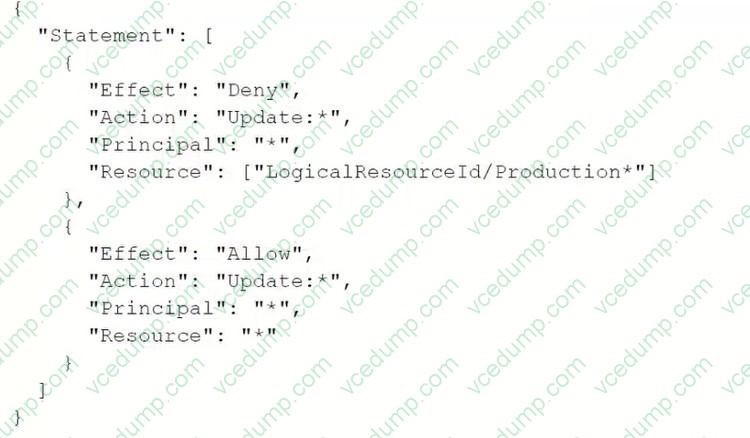
B. Users can update all resources in the stack except for resources that have a logical ID that begins with "Production".
C. Users can update all resources in the stack except for resources that have an attribute that begins with "Production".
D. Users in an IAM group with a logical ID that begins with "Production" are prevented from running the update-stack command. -
Question 596:
An organization with a large IT department has decided to migrate to AWS With different job functions in the IT department it is not desirable to give all users access to all AWS resources Currently the organization handles access via LDAP group membership
What is the BEST method to allow access using current LDAP credentials?
A. Create an AWS Directory Service Simple AD Replicate the on-premises LDAP directory to Simple AD
B. Create a Lambda function to read LDAP groups and automate the creation of IAM users
C. Use AWS CloudFormation to create IAM roles Deploy Direct Connect to allow access to the on-premises LDAP server
D. Federate the LDAP directory with IAM using SAML Create different IAM roles to correspond to different LDAP groups to limit permissions -
Question 597:
A SysOps administrator Is troubleshooting an AWS Cloud Formation template whereby multiple Amazon EC2 instances are being created The template is working In us-east-1. but it is failing In us-west-2 with the error code:
AMI [ami-12345678] does not exist
How should the administrator ensure that the AWS Cloud Formation template is working in every region?
A. Copy the source region's Amazon Machine Image (AMI) to the destination region and assign it the same ID.
B. Edit the AWS CloudFormatton template to specify the region code as part of the fully qualified AMI ID.
C. Edit the AWS CloudFormatton template to offer a drop-down list of all AMIs to the user by using the aws :: EC2:: ami :: imageiD control.
D. Modify the AWS CloudFormation template by including the AMI IDs in the "Mappings" section. Refer to the proper mapping within the template for the proper AMI ID. -
Question 598:
A company runs a website from Sydney, Australia. Users in the United States (US) and Europe are reporting that images and videos are taking a long time to load. However, local testing in Australia indicates no performance issues. The website has a large amount of static content in the form of images and videos that are stored m Amazon S3.
Which solution will result In the MOST Improvement In the user experience for users In the US and Europe?
A. Configure AWS PrivateLink for Amazon S3.
B. Configure S3 Transfer Acceleration.
C. Create an Amazon CloudFront distribution. Distribute the static content to the CloudFront edge locations
D. Create an Amazon API Gateway API in each AWS Region. Cache the content locally. -
Question 599:
A company migrated an I/O intensive application to an Amazon EC2 general purpose instance. The EC2 instance has a single General Purpose SSD Amazon Elastic Block Store (Amazon EBS) volume attached.
Application users report that certain actions that require intensive reading and writing to the disk are taking much longer than normal or are failing completely. After reviewing the performance metrics of the EBS volume, a SysOps administrator notices that the VolumeQueueLength metric is consistently high during the same times in which the users are reporting issues. The SysOps administrator needs to resolve this problem to restore full performance to the application.
Which action will meet these requirements?
A. Attach an Amazon ElastiCache cluster to the EBS volume.
B. Modify the EBS volume properties by enabling the Auto-Enabled IO attribute.
C. Modify the EBS volume properties to increase the IOPS.
D. Modify the EC2 instance to enable enhanced networking. Reboot the EC2 instance. -
Question 600:
A company needs to view a list of security groups that are open to the internet on port 3389. What should a SysOps administrator do to meet this requirement?
A. Configure Amazon GuardDuly to scan security groups and report unrestricted access on port 3389.
B. Configure a service control policy (SCP) to identify security groups that allow unrestricted access on port 3389
C. Use AWS Identity and Access Management Access Analyzer to find any instances that have unrestricted access on port 3389.
D. Use AWS Trusted Advisor to find security groups that allow unrestricted access on port 3389.
Related Exams:
-
AIF-C01
Amazon AWS Certified AI Practitioner (AIF-C01) -
AIP-C01
AWS Certified Generative AI Developer - Professional -
ANS-C00
AWS Certified Advanced Networking - Specialty (ANS-C00) -
ANS-C01
AWS Certified Advanced Networking - Specialty (ANS-C01) -
AXS-C01
AWS Certified Alexa Skill Builder - Specialty (AXS-C01) -
BDS-C00
AWS Certified Big Data - Speciality (BDS-C00) -
CLF-C02
AWS Certified Cloud Practitioner (CLF-C02) -
DAS-C01
AWS Certified Data Analytics - Specialty (DAS-C01) -
DATA-ENGINEER-ASSOCIATE
AWS Certified Data Engineer - Associate (DEA-C01) -
DBS-C01
AWS Certified Database - Specialty (DBS-C01)
Tips on How to Prepare for the Exams
Nowadays, the certification exams become more and more important and required by more and more enterprises when applying for a job. But how to prepare for the exam effectively? How to prepare for the exam in a short time with less efforts? How to get a ideal result and how to find the most reliable resources? Here on Vcedump.com, you will find all the answers. Vcedump.com provide not only Amazon exam questions, answers and explanations but also complete assistance on your exam preparation and certification application. If you are confused on your SOA-C02 exam preparations and Amazon certification application, do not hesitate to visit our Vcedump.com to find your solutions here.