SCS-C02 Exam Details
-
Exam Code
:SCS-C02 -
Exam Name
:AWS Certified Security - Specialty (SCS-C02) -
Certification
:Amazon Certifications -
Vendor
:Amazon -
Total Questions
:851 Q&As -
Last Updated
:Jul 12, 2026
Amazon SCS-C02 Online Questions & Answers
-
Question 731:
A security team must present a daily briefing to the CISO that includes a report of which of the company's thousands of EC2 instances and on-premises servers are missing the latest security patches. All instances/servers must be brought into compliance within 24 hours so they do not show up on the next day's report. How can the security team fulfill these requirements?
Please select:
A. Use Amazon QuickSight and Cloud Trail to generate the report of out of compliance instances/servers. Redeploy all out of compliance instances/servers using an AMI with the latest patches.
B. Use Systems Manger Patch Manger to generate the report of out of compliance instances/ servers. Use Systems Manager Patch Manger to install the missing patches.
C. Use Systems Manger Patch Manger to generate the report of out of compliance instances/ servers. Redeploy all out of1 compliance instances/servers using an AMI with the latest patches.
D. Use Trusted Advisor to generate the report of out of compliance instances/servers. Use Systems Manger Patch Manger to install the missing patches. -
Question 732:
An IAM user with fill EC2 permissions could bot start an Amazon EC2 instance after it was stopped for a maintenance task. Upon starting the instance, the instance state would change to "Pending", but after a few seconds, it would switch
back to "Stopped".
An inspection revealed that the instance has attached Amazon EBS volumes that were encrypted by using a Customer Master Key (CMK). When these encrypted volumes were detached, the IAM user was able to start the EC2 instances.
The IAM user policy is as follows:
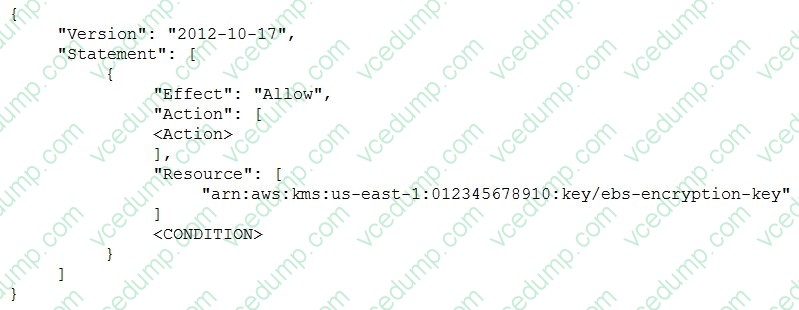
What additional items need to be added to the IAM user policy? (Choose two.)
A. kms:GenerateDataKey
B. kms:Decrypt
C. kms:CreateGrant
D. "Condition": {"Bool": {"kms:ViaService": "ec2.us-west-2.amazonIAM.com"}}
E. "Condition": {"Bool": {"kms:GrantIsForIAMResource": true}} -
Question 733:
You need to have a cloud security device which would allow to generate encryption keys based on FIPS 140-2 Level 3. Which of the following can be used for this purpose?
A. IAM KMS
B. IAM Customer Keys
C. IAM managed keys
D. IAM Cloud HSM -
Question 734:
IAM CloudTrail is being used to monitor API calls in an organization. An audit revealed that CloudTrail is failing to deliver events to Amazon S3 as expected. What initial actions should be taken to allow delivery of CloudTrail events to S3? (Select two.)
A. Verify that the S3 bucket policy allow CloudTrail to write objects.
B. Verify that the IAM role used by CloudTrail has access to write to Amazon CloudWatch Logs.
C. Remove any lifecycle policies on the S3 bucket that are archiving objects to Amazon Glacier.
D. Verify that the S3 bucket defined in CloudTrail exists.
E. Verify that the log file prefix defined in CloudTrail exists in the S3 bucket. -
Question 735:
A company is collecting IAM CloudTrail log data from multiple IAM accounts by managing individual trails in each account and forwarding log data to a centralized Amazon S3 bucket residing in a log archive account. After CloudTrail introduced support for IAM Organizations trails, the company decided to further centralize management and automate deployment of the CloudTrail logging capability across all of its IAM accounts.
The company's security engineer created an IAM Organizations trail in the master account, enabled server-side encryption with IAM KMS managed keys (SSE-KMS) for the log files, and specified the same bucket as the storage location. However, the engineer noticed that logs recorded by the new trail were not delivered to the bucket.
Which factors could cause this issue? (Select TWO.)
A. The CMK key policy does not allow CloudTrail to make encrypt and decrypt API calls against the key.
B. The CMK key policy does not allow CloudTrail to make GenerateDataKey API calls against the key.
C. The IAM role used by the CloudTrail trail does not have permissions to make PutObject API calls against a folder created for the Organizations trail.
D. The S3 bucket policy does not allow CloudTrail to make PutObject API calls against a folder created for the Organizations trail.
E. The CMK key policy does not allow the IAM role used by the CloudTrail trail to use the key for crypto graphicaI operations. -
Question 736:
A Security Engineer manages IAM Organizations for a company. The Engineer would like to restrict IAM usage to allow Amazon S3 only in one of the organizational units (OUs). The Engineer adds the following SCP to the OU:
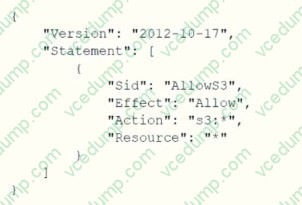
The next day. API calls to IAM IAM appear in IAM CloudTrail logs In an account under that OU. How should the Security Engineer resolve this issue?
A. Move the account to a new OU and deny IAM:* permissions.
B. Add a Deny policy for all non-S3 services at the account level.
C. Change the policy to: { "Version": "2012-10-17", "Statement": [ { "Sid": "AllowS3", "Effect": "Allow", "Action": "s3:*", "Resource": "*/*? } ] }
D. Detach the default FullIAMAccess SCP -
Question 737:
An audit reveals that a company has multiple applications that are susceptible to SQL injection attacks.
The company wants a formal penetration testing program as soon as possible to identify future risks in applications that are deployed on AWS.
The company's legal department is concerned that such testing might create AWS abuse notifications and violate the AWS Acceptable Use policy.
The company must ensure compliance in these areas.
Which testing procedures are allowed on AWS as part of a penetration testing strategy? (Select TWO.)
A. Port scanning inside the company's VPC
B. Brute force test of the Amazon S3 bucket namespace
C. Use of a SQL injection tool on the company's web application against an Amazon RDS for PostgreSQL DB instance
D. Packet flooding of the company's web application
E. DNS zone walking through Amazon Route 53 hosted zones -
Question 738:
A developer has created an AWS Lambda function in a company's development account. The Lambda function requires the use of an AWS Key Management Service (AWS KMS) customer managed key that exists in a security account that the company's security team controls. The developer obtains the ARN of the KMS key from a previous Lambda function in the development account. The previous Lambda function had been working properly with the KMS key.
When the developer uses the ARN and tests the new Lambda function an error message states that access is denied to the KMS key in the security account. The developer tests the previous Lambda function that uses the same KMS key and discovers that the previous Lambda function still can encrypt data as expected.
A security engineer must resolve the problem so that the new Lambda function in the development account can use the KMS key from the security account.
Which combination of steps should the security engineer take to meet these requirements? (Select TWO.)
A. In the security account configure an IAM role for the new Lambda function. Attach an IAM policy that allows access to the KMS key in the security account.
B. In the development account configure an IAM role for the new Lambda function. Attach a key policy that allows access to the KMS key in the security account.
C. In the development account configure an IAM role for the new Lambda function. Attach an IAM policy that allows access to the KMS key in the security account.
D. Configure a key policy for the KMS key in the security account to allow access to the IAM role of the new Lambda function in the security account.
E. Configure a key policy for the KMS key in the security account to allow access to the IAM role of the new Lambda function in the development account. -
Question 739:
A company has several workloads running on IAM. Employees are required to authenticate using on-premises ADFS and SSO to access the IAM Management
Console. Developers migrated an existing legacy web application to an Amazon EC2 instance. Employees need to access this application from anywhere on the internet, but currently, there is no authentication system built into the application.
How should the Security Engineer implement employee-only access to this system without changing the application?
A. Place the application behind an Application Load Balancer (ALB). Use Amazon Cognito as authentication for the ALB. Define a SAML-based Amazon Cognito user pool and connect it to ADFS.
B. Implement IAM SSO in the master account and link it to ADFS as an identity provider. Define the EC2 instance as a managed resource, then apply an IAM policy on the resource.
C. Define an Amazon Cognito identity pool, then install the connector on the Active Directory server. Use the Amazon Cognito SDK on the application instance to authenticate the employees using their Active Directory user names and passwords.
D. Create an IAM Lambda custom authorizer as the authenticator for a reverse proxy on Amazon EC2. Ensure the security group on Amazon EC2 only allows access from the Lambda function. -
Question 740:
You are trying to use the IAM Systems Manager run command on a set of Instances. The run command on a set of Instances. What can you do to diagnose the issue? Choose 2 answers from the options given
A. Ensure that the SSM agent is running on the target machine
B. Check the /var/log/amazon/ssm/errors.log file
C. Ensure the right AMI is used for the Instance
D. Ensure the security groups allow outbound communication for the instance
Related Exams:
-
AIF-C01
Amazon AWS Certified AI Practitioner (AIF-C01) -
AIP-C01
AWS Certified Generative AI Developer - Professional -
ANS-C00
AWS Certified Advanced Networking - Specialty (ANS-C00) -
ANS-C01
AWS Certified Advanced Networking - Specialty (ANS-C01) -
AXS-C01
AWS Certified Alexa Skill Builder - Specialty (AXS-C01) -
BDS-C00
AWS Certified Big Data - Speciality (BDS-C00) -
CLF-C02
AWS Certified Cloud Practitioner (CLF-C02) -
DAS-C01
AWS Certified Data Analytics - Specialty (DAS-C01) -
DATA-ENGINEER-ASSOCIATE
AWS Certified Data Engineer - Associate (DEA-C01) -
DBS-C01
AWS Certified Database - Specialty (DBS-C01)
Tips on How to Prepare for the Exams
Nowadays, the certification exams become more and more important and required by more and more enterprises when applying for a job. But how to prepare for the exam effectively? How to prepare for the exam in a short time with less efforts? How to get a ideal result and how to find the most reliable resources? Here on Vcedump.com, you will find all the answers. Vcedump.com provide not only Amazon exam questions, answers and explanations but also complete assistance on your exam preparation and certification application. If you are confused on your SCS-C02 exam preparations and Amazon certification application, do not hesitate to visit our Vcedump.com to find your solutions here.