SCS-C02 Exam Details
-
Exam Code
:SCS-C02 -
Exam Name
:AWS Certified Security - Specialty (SCS-C02) -
Certification
:Amazon Certifications -
Vendor
:Amazon -
Total Questions
:851 Q&As -
Last Updated
:Jul 12, 2026
Amazon SCS-C02 Online Questions & Answers
-
Question 241:
The Security Engineer has discovered that a new application that deals with highly sensitive data is storing Amazon S3 objects with the following key pattern, which itself contains highly sensitive data.
Pattern:
"randomID_datestamp_PII.csv"
Example:
"1234567_12302017_000-00-0000 csv"
The bucket where these objects are being stored is using server-side encryption (SSE).
Which solution is the most secure and cost-effective option to protect the sensitive data?
A. Remove the sensitive data from the object name, and store the sensitive data using S3 user-defined metadata.
B. Add an S3 bucket policy that denies the action s3:GetObject
C. Use a random and unique S3 object key, and create an S3 metadata index in Amazon DynamoDB using client-side encrypted attributes.
D. Store all sensitive objects in Binary Large Objects (BLOBS) in an encrypted Amazon RDS instance. -
Question 242:
A security engineer needs to suppress AWS. Security Hub findings automatically for resources that have a specific tag attached. Which solution will meet this requirement?
A. Create a Security Hub automation rule Edit the rule to include the specific resource tag and the specific tag value as the criteria. Select the automated action to change the workflow status to SUPPRESSED.
B. Select each Security Hub control that needs to be suppressed. Add an exception to each control to suppress any findings that contain the specific tag value if the resource contains the specific resource tag.
C. Send each Security Hub finding to Amazon Detective Create an automated rule in Detective to suppress any findings that contain the specific resource tag and the specific tag value
D. Send each Security Hub finding to Amazon Inspector. Configure a suppression rule to suppress any findings that contain the specific resource tag and the specific tag value. -
Question 243:
There is a requirement for a company to transfer large amounts of data between IAM and an on-premise location. There is an additional requirement for low latency and high consistency traffic to IAM. Given these requirements how would you design a hybrid architecture? Choose the correct answer from the options below
A. Provision a Direct Connect connection to an IAM region using a Direct Connect partner.
B. Create a VPN tunnel for private connectivity, which increases network consistency and reduces latency.
C. Create an iPSec tunnel for private connectivity, which increases network consistency and reduces latency.
D. Create a VPC peering connection between IAM and the Customer gateway. -
Question 244:
A company uses Amazon GuardDuty.
The company's security engineer needs lo receive an email notification for every GuardDuty finding that is a High severity level.
Which solution will meet this requirement?
A. Create a verified identity for the email address in Amazon Simple Email Service (Amazon SES) Create an Amazon EventBridge rule that has the SES verified identity as the target Specify GuardDuty as the event source Configure the EventBridge event pattern to match High seventy findings.
B. Create an Amazon Simple Notification Service (Amazon SNS) topic Subscribe the email address to the SNS topic. Create an Amazon EventBridge rule that has the SNS topic as the target Specify GuardDuty as the event source Configure the EventBridge event pattern to match High severity findings.
C. Create an Amazon Simple Notification Service (Amazon SNS) topic Subscribe the email address to the SNS topic. Enable AWS Security Hub Integrate Security Hub with GuardDuty. Use Security Hub automation rules to publish High severity GuardDuty findings to the SNS topic.
D. Enable AWS Security Hub Integrate Security Hub with GuardDuty. Use Secunty Hub automation rules to create a custom rule. Configure the custom rule to detect High seventy GuardDuty findings and to send a notification to the email address. -
Question 245:
A company has an application on Amazon EC2 instances that store confidential customer data. The company must restrict access to customer data. A security engineer requires secure access to the instances that host the application. According to company policy, users must not open any inbound ports, maintain bastion hosts, or manage SSH keys for the EC2 instances.
The security engineer wants to monitor, store, and access all session activity logs. The logs must be encrypted.
Which solution will meet these requirements?
A. Use AWS Control Tower to connect to the EC2 instances. Configure Amazon CloudWatch logging for the sessions. Select the upload session logs option and allow only encrypted CloudWatch Logs log groups.
B. Use AWS Security Hub to connect to the EC2 instances. Configure Amazon CloudWatch logging for the sessions. Select the upload session logs option and allow only encrypted CloudWatch Logs log groups.
C. Use AWS Systems Manager Session Manager to connect to the EC2 instances. Configure Amazon CloudWatch monitoring to record the sessions. Select the store session logs option for the desired CloudWatch Logs log groups.
D. Use AWS Systems Manager Session Manager to connect to the EC2 instances. Configure Amazon CloudWatch logging. Select the upload session logs option and allow only encrypted CloudWatch Logs log groups. -
Question 246:
A company has several petabytes of data. The company must preserve this data for 7 years to comply with regulatory requirements. The company's compliance team asks a security officer to develop a strategy that will prevent anyone from changing or deleting the data.
Which solution will meet this requirement MOST cost-effectively?
A. Create an Amazon S3 bucket. Configure the bucket to use S3 Object Lock in compliance mode. Upload the data to the bucket. Create a resource-based bucket policy that meets all the regulatory requirements.
B. Create an Amazon S3 bucket. Configure the bucket to use S3 Object Lock in governance mode. Upload the data to the bucket. Create a user-based IAM policy that meets all the regulatory requirements.
C. Create a vault in Amazon S3 Glacier. Create a Vault Lock policy in S3 Glacier that meets all the regulatory requirements. Upload the data to the vault.
D. Create an Amazon S3 bucket. Upload the data to the bucket. Use a lifecycle rule to transition the data to a vault in S3 Glacier. Create a Vault Lock policy that meets all the regulatory requirements. -
Question 247:
Your company use IAM KMS for management of its customer keys. From time to time, there is a requirement to delete existing keys as part of housekeeping activities. What can be done during the deletion process to verify that the key is no longer being used?
A. Use CloudTrail to see if any KMS API request has been issued against existing keys
B. Use Key policies to see the access level for the keys
C. Rotate the keys once before deletion to see if other services are using the keys
D. Change the IAM policy for the keys to see if other services are using the keys -
Question 248:
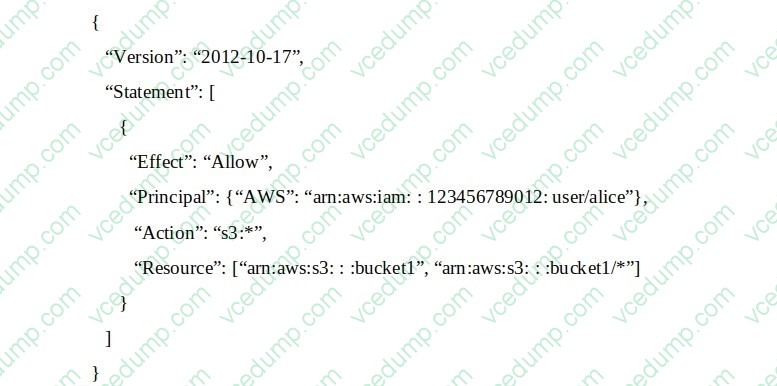
An IAM account includes two S3 buckets: bucket1 and bucket2. The bucket2 does not have a policy defined, but bucket1 has the following bucket policy:
In addition, the same account has an IAM User named "alice", with the following IAM policy.
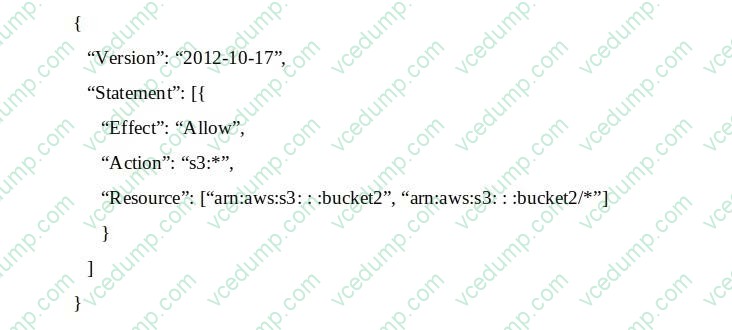
Which buckets can user "alice" access?
A. Bucket1 only
B. Bucket2 only
C. Both bucket1 and bucket2
D. Neither bucket1 nor bucket2 -
Question 249:
A website currently runs on Amazon EC2, wan mostly statics content on the site. Recently the site was subjected to a DDoS attack a security engineer was (asked was redesigning the edge security to help Mitigate this risk in the future.
What are some ways the engineer could achieve this (Select THREE)?
A. Use IAM X-Ray to inspect the trafc going to the EC2 instances.
B. Move the static content to Amazon S3, and front this with an Amazon Cloud Front distribution.
C. Change the security group conguration to block the source of the attack trafc
D. Use IAM WAF security rules to inspect the inbound trafc.
E. Use Amazon Inspector assessment templates to inspect the inbound traffic.
F. Use Amazon Route 53 to distribute trafc. -
Question 250:
A company operates a web application that runs on Amazon EC2 instances. The application listens on port 80 and port 443. The company uses an Application Load Balancer (ALB) with AWS WAF to terminate SSL and to forward traffic to the application instances only on port 80.
The ALB is in public subnets that are associated with a network ACL that is named NACL1. The application instances are in dedicated private subnets that are associated with a network ACL that is named NACL2. An Amazon RDS for PostgreSQL DB instance that uses port 5432 is in a dedicated private subnet that is associated with a network ACL that is named NACL3. All the network ACLs currently allow all inbound and outbound traffic.
Which set of network ACL changes will increase the security of the application while ensuring functionality?
A. Make the following changes to NACL3: Add a rule that allows inbound traffic on port 5432 from NACL2. Add a rule that allows outbound traffic on ports 1024-65536 to NACL2. Remove the default rules that allow all inbound and outbound traffic.
B. Make the following changes to NACL3: Add a rule that allows inbound traffic on port 5432 from the CIDR blocks of the application instance subnets. Add a rule that allows outbound traffic on ports 1024-65536 to the application instance subnets. Remove the default rules that allow all inbound and outbound traffic.
C. Make the following changes to NACL2: Add a rule that allows outbound traffic on port 5432 to the CIDR blocks of the RDS subnets. Remove the default rules that allow all inbound and outbound traffic.
D. Make the following changes to NACL2: Add a rule that allows inbound traffic on port 5432 from the CIDR blocks of the RDS subnets. Add a rule that allows outbound traffic on port 5432 to the RDS subnets.
Related Exams:
-
AIF-C01
Amazon AWS Certified AI Practitioner (AIF-C01) -
AIP-C01
AWS Certified Generative AI Developer - Professional -
ANS-C00
AWS Certified Advanced Networking - Specialty (ANS-C00) -
ANS-C01
AWS Certified Advanced Networking - Specialty (ANS-C01) -
AXS-C01
AWS Certified Alexa Skill Builder - Specialty (AXS-C01) -
BDS-C00
AWS Certified Big Data - Speciality (BDS-C00) -
CLF-C02
AWS Certified Cloud Practitioner (CLF-C02) -
DAS-C01
AWS Certified Data Analytics - Specialty (DAS-C01) -
DATA-ENGINEER-ASSOCIATE
AWS Certified Data Engineer - Associate (DEA-C01) -
DBS-C01
AWS Certified Database - Specialty (DBS-C01)
Tips on How to Prepare for the Exams
Nowadays, the certification exams become more and more important and required by more and more enterprises when applying for a job. But how to prepare for the exam effectively? How to prepare for the exam in a short time with less efforts? How to get a ideal result and how to find the most reliable resources? Here on Vcedump.com, you will find all the answers. Vcedump.com provide not only Amazon exam questions, answers and explanations but also complete assistance on your exam preparation and certification application. If you are confused on your SCS-C02 exam preparations and Amazon certification application, do not hesitate to visit our Vcedump.com to find your solutions here.