SCS-C02 Exam Details
-
Exam Code
:SCS-C02 -
Exam Name
:AWS Certified Security - Specialty (SCS-C02) -
Certification
:Amazon Certifications -
Vendor
:Amazon -
Total Questions
:851 Q&As -
Last Updated
:Jul 12, 2026
Amazon SCS-C02 Online Questions & Answers
-
Question 211:
A company uses Amazon GuardDuty. The company's security team wants all High severity findings to automatically generate a ticket in a third-party ticketing system through email integration.
Which solution will meet this requirement?
A. Create a verified identity for the third-party ticketing email system in Amazon Simple Email Service (Amazon SES). Create an Amazon EventBridge rule that includes an event pattern that matches High severity GuardDuty findings. Specify the SES identity as the target for the EventBridge rule.
B. Create an Amazon Simple Notification Service (Amazon SNS) topic. Subscribe the third- party ticketing email system to the SNS topic. Create an Amazon EventBridge rule that includes an event pattern that matches High severity GuardDuty findings. Specify the SNS topic as the target for the EventBridge rule.
C. Use the GuardDuty CreateFilter API operation to build a filter in GuardDuty to monitor for High severity findings. Export the results of the filter to an Amazon Simple Notification Service (Amazon SNS) topic. Subscribe the third-party ticketing email system to the SNS topic.
D. Use the GuardDuty CreateFilter API operation to build a filter in GuardDuty to monitor for High severity findings. Create an Amazon Simple Notification Service (Amazon SNS) topic. Subscribe the third-party ticketing email system to the SNS topic. Create an Amazon EventBridge rule that includes an event pattern that matches GuardDuty findings that are selected by the filter. Specify the SNS topic as the target for the EventBridge rule. -
Question 212:
A company hosts a web application on an Apache web server. The application runs on Amazon EC2 instances that are in an Auto Scaling group. The company configured the EC2 instances to send the Apache web server logs to an Amazon CloudWatch Logs group that the company has configured to expire after 1 year.
Recently, the company discovered in the Apache web server logs that a specific IP address is sending suspicious requests to the web application. A security engineer wants to analyze the past week of Apache web server logs to determine how many requests that the IP address sent and the corresponding URLs that the IP address requested.
What should the security engineer do to meet these requirements with the LEAST effort?
A. Export the CloudWatch Logs group data to Amazon S3. Use Amazon Macie to query the logs for the specific IP address and the requested URLs.
B. Configure a CloudWatch Logs subscription to stream the log group to an Am-azon OpenSearch Service cluster. Use OpenSearch Service to analyze the logs for the specific IP address and the requested URLs.
C. Use CloudWatch Logs Insights and a custom query syntax to analyze the CloudWatch logs for the specific IP address and the requested URLs.
D. Export the CloudWatch Logs group data to Amazon S3. Use AWS Glue to crawl the S3 bucket for only the log entries that contain the specific IP ad-dress. Use AWS Glue to view the results. -
Question 213:
Your company has many IAM accounts defined and all are managed via IAM Organizations. One IAM account has a S3 bucket that has critical data. How can we ensure that all the users in the IAM organisation have access to this bucket?
A. Ensure the bucket policy has a condition which involves IAM:PrincipalOrglD
B. Ensure the bucket policy has a condition which involves IAM:AccountNumber
C. Ensure the bucket policy has a condition which involves IAM:PrincipaliD
D. Ensure the bucket policy has a condition which involves IAM:OrglD -
Question 214:
A company is using AWS Organizations to manage multiple accounts. The company needs to allow an IAM user to use a role to access resources that are in another organization's AWS account.
Which combination of steps must the company perform to meet this requirement? (Select TWO.)
A. Create an identity policy that allows the sts: AssumeRole action in the AWS account that contains the resources. Attach the identity policy to the IAM user.
B. Ensure that the sts: AssumeRole action is allowed by the SCPs of the organization that owns the resources that the IAM user needs to access.
C. Create a role in the AWS account that contains the resources. Create an entry in the role's trust policy that allows the IAM user to assume the role. Attach the trust policy to the role.
D. Establish a trust relationship between the IAM user and the AWS account that contains the resources.
E. Create a role in the IAM user's AWS account. Create an identity policy that allows the sts: AssumeRole action. Attach the identity policy to the role. -
Question 215:
A company wants to deny a specific federated user named Bob access to an Amazon S3 bucket named DOC-EXAMPLE-BUCKET. The company wants to meet this requirement by using a bucket policy. The company also needs to ensure that this bucket policy affects Bob's S3 permissions only. Any other permissions that Bob has must remain intact.
Which policy should the company use to meet these requirements?
A. Option A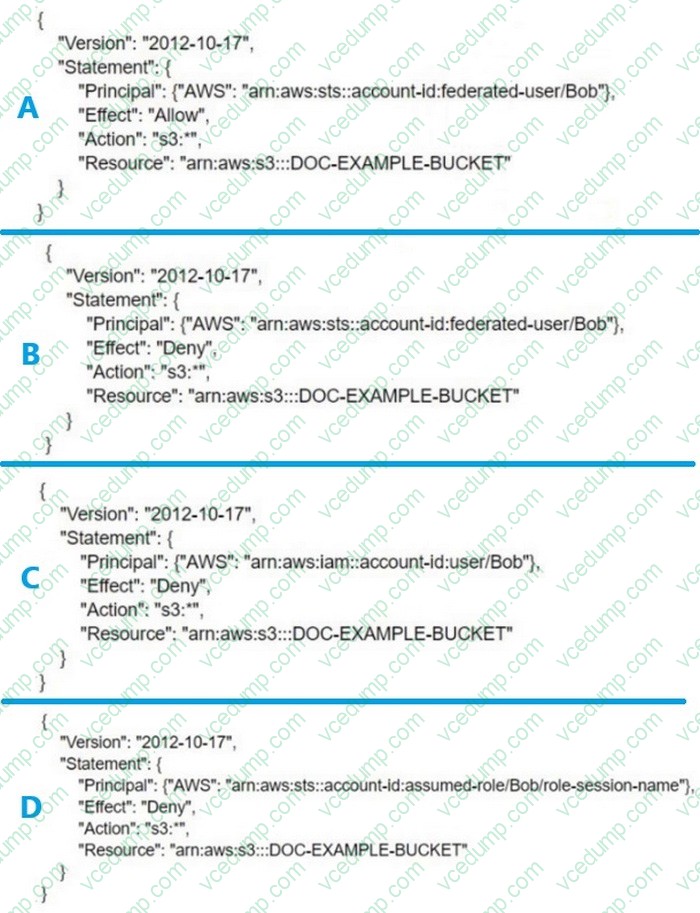
B. Option B
C. Option C
D. Option D -
Question 216:
A company has a VPC with an IPv6 address range and a public subnet with an IPv6 address block. The VPC currently hosts some public Amazon EC2 instances but a Security Engineer needs to migrate a second application into the VPC
that also requires IPv6 connectivity.
This new application will occasionally make API requests to an external, internet-accessible endpoint to receive updates However, the Security team does not want the application's EC2 instance exposed directly to the internet The Security Engineer intends to create a private subnet with a custom route table and to associate the route table with the private subnet
What else does the Security Engineer need to do to ensure the application will not be exposed directly to the internet, but can still communicate as required?
A. Launch a NAT instance in the public subnet Update the custom route table with a new route to the NAT instance
B. Remove the internet gateway, and add IAM PrivateLink to the VPC Then update the custom route table with a new route to IAM PrivateLink
C. Add a managed NAT gateway to the VPC Update the custom route table with a new route to the gateway
D. Add an egress-only internet gateway to the VPC. Update the custom route table with a new route to the gateway -
Question 217:
A company must retain backup copies of Amazon RDS DB instances and Amazon Elastic Block Store (Amazon EBS) volumes. The company must retain the backup copies in data centers that are several hundred miles apart.
Which solution will meet these requirements with the LEAST operational overhead?
A. Configure AWS Backup to create the backups according to the needed schedule. In the backup plan, specify multiple Availability Zones as backup destinations.
B. Configure Amazon Data Lifecycle Manager to create the backups. Configure the Amazon Data Lifecycle Manager policy to copy the backups to an Amazon S3 bucket. Enable replication on the S3 bucket.
C. Configure AWS Backup to create the backups according to the needed schedule. Create a destination backup vault in a different AWS Region. Configure AWS Backup to copy the backups to the destination backup vault.
D. Configure Amazon Data Lifecycle Manager to create the backups. Create an AWS Lambda function to copy the backups to a different AWS Region. Use Amazon EventBridge to invoke the Lambda function on a schedule. -
Question 218:
A company that uses AWS Organizations wants to see AWS Security Hub findings for many AWS accounts and AWS Regions. Some of the accounts are in the company's organization, and some accounts are in organizations that the company manages for customers. Although the company can see findings in the Security Hub administrator account for accounts in the company's organization, there are no findings from accounts in other organizations.
Which combination of steps should the company take to see findings from accounts that are outside the organization that includes the Security Hub administrator account? (Select TWO.)
A. Use a designated administration account to automatically set up member accounts.
B. Create the AWS Service Role ForSecurrty Hub service-linked rote for Security Hub.
C. Send an administration request from the member accounts.
D. Enable Security Hub for all member accounts.
E. Send invitations to accounts that are outside the company's organization from the Security Hub administrator account. -
Question 219:
A security engineer discovers that a company’s user passwords have no required minimum length. The company is using the following two identity providers (IdPs):
1.
AWS Identity and Access Management (IAM) federated with on-premises Active Directory
2.
Amazon Cognito user pools that contain the user database for an AWS Cloud application that the company developed
Which combination of actions should the security engineer take to implement a required minimum length for the passwords? (Choose two.)
A. Update the password length policy in the IAM configuration.
B. Update the password length policy in the Cognito configuration.
C. Update the password length policy in the on-premises Active Directory configuration
D. Create an SCP in AWS Organizations. Configure the SCP to enforce a minimum password length for IAM and Cognito.
E. Create an IAM policy that includes a condition for minimum password length. Enforce the policy for IAM and Cognito. -
Question 220:
A company uses AWS Organizations. The company has more than 100 AWS accounts and will increase the number of accounts. The company also uses an external corporate identity provider (IdP).
The company needs to provide users with role-based access to the accounts. The solution must maximize scalability and operational efficiency.
Which solution will meet these requirements?
A. In each account, create a set of dedicated IAM users. Ensure that all users assume these IAM users through federation with the existing IdP.
B. Deploy an IAM role in a central identity account. Allow users to assume the role through federation with the existing IdP. In each account, deploy a set of IAM roles that match the desired access patterns. Include a trust policy that allows access from the central identity account. Edit the permissions policy for the role in each account to match user access requirements.
C. Enable AWS IAM Identity Center. Integrate IAM Identity Center with the company's existing IdP. Create permission sets that match the desired access patterns. Assign permissions to match user access requirements.
D. In each account, deploy a set of IAM roles that match the desired access patterns. Create a trust policy with the existing IdP. Update each role's permissions policy to use SAML-based IAM condition keys that are based on user access requirements.
Related Exams:
-
AIF-C01
Amazon AWS Certified AI Practitioner (AIF-C01) -
AIP-C01
AWS Certified Generative AI Developer - Professional -
ANS-C00
AWS Certified Advanced Networking - Specialty (ANS-C00) -
ANS-C01
AWS Certified Advanced Networking - Specialty (ANS-C01) -
AXS-C01
AWS Certified Alexa Skill Builder - Specialty (AXS-C01) -
BDS-C00
AWS Certified Big Data - Speciality (BDS-C00) -
CLF-C02
AWS Certified Cloud Practitioner (CLF-C02) -
DAS-C01
AWS Certified Data Analytics - Specialty (DAS-C01) -
DATA-ENGINEER-ASSOCIATE
AWS Certified Data Engineer - Associate (DEA-C01) -
DBS-C01
AWS Certified Database - Specialty (DBS-C01)
Tips on How to Prepare for the Exams
Nowadays, the certification exams become more and more important and required by more and more enterprises when applying for a job. But how to prepare for the exam effectively? How to prepare for the exam in a short time with less efforts? How to get a ideal result and how to find the most reliable resources? Here on Vcedump.com, you will find all the answers. Vcedump.com provide not only Amazon exam questions, answers and explanations but also complete assistance on your exam preparation and certification application. If you are confused on your SCS-C02 exam preparations and Amazon certification application, do not hesitate to visit our Vcedump.com to find your solutions here.