SCS-C02 Exam Details
-
Exam Code
:SCS-C02 -
Exam Name
:AWS Certified Security - Specialty (SCS-C02) -
Certification
:Amazon Certifications -
Vendor
:Amazon -
Total Questions
:851 Q&As -
Last Updated
:Jul 12, 2026
Amazon SCS-C02 Online Questions & Answers
-
Question 171:
Your company has created a set of keys using the IAM KMS service. They need to ensure that each key is only used for certain services. For example , they want one key to be used only for the S3 service. How can this be achieved?
A. Create an IAM policy that allows the key to be accessed by only the S3 service.
B. Create a bucket policy that allows the key to be accessed by only the S3 service.
C. Use the kms:ViaService condition in the Key policy
D. Define an IAM user, allocate the key and then assign the permissions to the required service -
Question 172:
A company is running an Amazon RDS for MySQL DB instance in a VPC. The VPC must not send or receive network traffic through the internet.
A security engineer wants to use AWS Secrets Manager to rotate the DB instance credentials automatically. Because of a security policy, the security engineer cannot use the standard AWS Lambda function that Secrets Manager provides to rotate the credentials.
The security engineer deploys a custom Lambda function in the VPC. The custom Lambda function will be responsible for rotating the secret in Secrets Manager. The security engineer edits the DB instance's security group to allow connections from this function. When the function is invoked, the function cannot communicate with Secrets Manager to rotate the secret properly.
What should the security engineer do so that the function can rotate the secret?
A. Add an egress-only internet gateway to the VPC. Allow only the Lambda function's subnet to route traffic through the egress-only internet gateway.
B. Add a NAT gateway to the VPC. Configure only the Lambda function's subnet with a default route through the NAT gateway.
C. Configure a VPC peering connection to the default VPC for Secrets Manager. Configure the Lambda function's subnet to use the peering connection for routes.
D. Configure a Secrets Manager interface VPC endpoint. Include the Lambda function's private subnet during the configuration process. -
Question 173:
A company has a strict policy against using root credentials. The company's security team wants to be alerted as soon as possible when root credentials are used to sign in to the AWS Management Console. How should the security team achieve this goal?
A. Use AWS Lambda to periodically query AWS CloudTrail for console login events and send alerts using Amazon Simple Notification Service (Amazon SNS).
B. Use Amazon EventBridge to monitor console logins and direct them to Amazon Simple Notification Service (Amazon SNS).
C. Use Amazon Athena to query AWS IAM Identity Center logs and send alerts using Amazon Simple Notification Service (Amazon SNS) for root login events.
D. Configure AWS Resource Access Manager to review the access logs and send alerts using Amazon Simple Notification Service (Amazon SNS). -
Question 174:
A company uses infrastructure as code (IaC) to create AWS infrastructure. The company writes the code as AWS CloudFormation templates to deploy the infrastructure. The company has an existing CI/CD pipeline that the company can use to deploy these templates.
After a recent security audit, the company decides to adopt a policy-as-code approach to improve the company's security posture on AWS. The company must prevent the deployment of any infrastructure that would violate a security policy, such as an unencrypted Amazon Elastic Block Store (Amazon EBS) volume.
Which solution will meet these requirements?
A. Turn on AWS Trusted Advisor. Configure security notifications as webhooks in the preferences section of the CI/CD pipeline.
B. Turn on AWS Config. Use the prebuilt rules or customized rules. Subscribe the CI/CD pipeline to an Amazon Simple Notification Service (Amazon SNS) topic that receives notifications from AWS Config.
C. Create rule sets in AWS CloudFormation Guard. Run validation checks for CloudFormation templates as a phase of the CI/CD process.
D. Create rule sets as SCPs. Integrate the SCPs as a part of validation control in a phase of the CI/CD process. -
Question 175:
A development team is using an IAM Key Management Service (IAM KMS) CMK to try to encrypt and decrypt a secure string parameter from IAM Systems Manager Parameter Store. However, the development team receives an error message on each attempt.
Which issues that are related to the CMK could be reasons for the error? (Select TWO.)
A. The CMK that is used in the attempt does not exist.
B. The CMK that is used in the attempt needs to be rotated.
C. The CMK that is used in the attempt is using the CMK's key ID instead of the CMK ARN.
D. The CMK that is used in the attempt is not enabled.
E. The CMK that is used in the attempt is using an alias. -
Question 176:
A security engineer must ensure that all infrastructure launched in the company IAM account be monitored for deviation from compliance rules, specifically that all EC2 instances are launched from one of a specified list of AM Is and that all attached EBS volumes are encrypted. Infrastructure not in compliance should be terminated. What combination of steps should the Engineer implement? Select 2 answers from the options given below.
A. Set up a CloudWatch event based on Trusted Advisor metrics
B. Trigger a Lambda function from a scheduled CloudWatch event that terminates non- compliant infrastructure.
C. Set up a CloudWatch event based on Amazon inspector findings
D. Monitor compliance with IAM Config Rules triggered by configuration changes
E. Trigger a CLI command from a CloudWatch event that terminates the infrastructure -
Question 177:
A company has a web-based application that runs behind an Application Load Balancer (ALB). The application is experiencing a credential stuffing attack that is producing many failed login attempts. The attack is coming from many IP addresses. The login attempts are using a user agent string of a known mobile device emulator.
A security engineer needs to implement a solution to mitigate the credential stuffing attack. The solution must still allow legitimate logins to the application.
Which solution will meet these requirements?
A. Create an Amazon CloudWatch alarm that reacts to login attempts that contain the specified user agent string. Add an Amazon Simple Notification Service (Amazon SNS) topic to the alarm.
B. Modify the inbound security group on the ALB to deny traffic from the IP addresses that are involved in the attack.
C. Create an AWS WAF web ACL for the ALB. Create a custom rule that blocks requests that contain the user agent string of the device emulator.
D. Create an AWS WAF web ACL for the ALB Create a custom rule that allows requests from legitimate user agent strings -
Question 178:
An company is using IAM Secrets Manager to store secrets that are encrypted using a CMK and are stored in the security account 111122223333. One of the company's production accounts. 444455556666, must to retrieve the secret values
from the security account 111122223333. A security engineer needs to apply a policy to the secret in the security account based on least privilege access so the production account can retrieve the secret value only.
Which policy should the security engineer apply?
A. Option A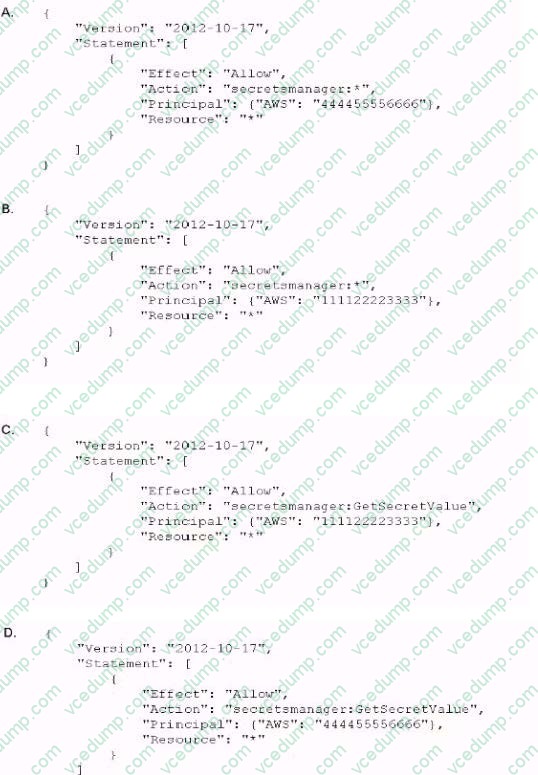
B. Option B
C. Option C
D. Option D -
Question 179:
A corporate cloud security policy states that communications between the company's VPC and KMS must travel entirely within the IAM network and not use public service endpoints.
Which combination of the following actions MOST satisfies this requirement? (Choose two.)
A. Add the IAM:sourceVpce condition to the IAM KMS key policy referencing the company's VPC endpoint ID.
B. Remove the VPC internet gateway from the VPC and add a virtual private gateway to the VPC to prevent direct, public internet connectivity.
C. Create a VPC endpoint for IAM KMS with private DNS enabled.
D. Use the KMS Import Key feature to securely transfer the IAM KMS key over a VPN.
E. Add the following condition to the IAM KMS key policy: "IAM:SourceIp": "10.0.0.0/16". -
Question 180:
A Developer reported that IAM CloudTrail was disabled on their account. A Security Engineer investigated the account and discovered the event was undetected by the current security solution. The Security Engineer must recommend a solution that will detect future changes to the CloudTrail configuration and send alerts when changes occur.
What should the Security Engineer do to meet these requirements?
A. Use IAM Resource Access Manager (IAM RAM) to monitor the IAM CloudTrail configuration. Send notifications using Amazon SNS.
B. Create an Amazon CloudWatch Events rule to monitor Amazon GuardDuty findings. Send email notifications using Amazon SNS.
C. Update security contact details in IAM account settings for IAM Support to send alerts when suspicious activity is detected.
D. Use Amazon Inspector to automatically detect security issues. Send alerts using Amazon SNS.
Related Exams:
-
AIF-C01
Amazon AWS Certified AI Practitioner (AIF-C01) -
AIP-C01
AWS Certified Generative AI Developer - Professional -
ANS-C00
AWS Certified Advanced Networking - Specialty (ANS-C00) -
ANS-C01
AWS Certified Advanced Networking - Specialty (ANS-C01) -
AXS-C01
AWS Certified Alexa Skill Builder - Specialty (AXS-C01) -
BDS-C00
AWS Certified Big Data - Speciality (BDS-C00) -
CLF-C02
AWS Certified Cloud Practitioner (CLF-C02) -
DAS-C01
AWS Certified Data Analytics - Specialty (DAS-C01) -
DATA-ENGINEER-ASSOCIATE
AWS Certified Data Engineer - Associate (DEA-C01) -
DBS-C01
AWS Certified Database - Specialty (DBS-C01)
Tips on How to Prepare for the Exams
Nowadays, the certification exams become more and more important and required by more and more enterprises when applying for a job. But how to prepare for the exam effectively? How to prepare for the exam in a short time with less efforts? How to get a ideal result and how to find the most reliable resources? Here on Vcedump.com, you will find all the answers. Vcedump.com provide not only Amazon exam questions, answers and explanations but also complete assistance on your exam preparation and certification application. If you are confused on your SCS-C02 exam preparations and Amazon certification application, do not hesitate to visit our Vcedump.com to find your solutions here.