SCS-C02 Exam Details
-
Exam Code
:SCS-C02 -
Exam Name
:AWS Certified Security - Specialty (SCS-C02) -
Certification
:Amazon Certifications -
Vendor
:Amazon -
Total Questions
:851 Q&As -
Last Updated
:Jul 12, 2026
Amazon SCS-C02 Online Questions & Answers
-
Question 91:
A Security Engineer is looking for a way to control access to data that is being encrypted under a CMK. The Engineer is also looking to use additional authenticated data (AAD) to prevent tampering with ciphertext. Which action would provide the required functionality?
A. Pass the key alias to IAM KMS when calling Encrypt and Decrypt API actions.
B. Use IAM policies to restrict access to Encrypt and Decrypt API actions.
C. Use kms:EncryptionContext as a condition when defining IAM policies for the CMK.
D. Use key policies to restrict access to the appropriate IAM groups. -
Question 92:
A web application runs in a VPC on EC2 instances behind an ELB Application Load Balancer. The application stores data in an RDS MySQL DB instance. A Linux bastion host is used to apply schema updates to the database - administrators connect to the host via SSH from a corporate workstation. The following security groups are applied to the infrastructure
1.
sgLB - associated with the ELB
2.
sgWeb - associated with the EC2 instances.
3.
sgDB - associated with the database
4.
sgBastion - associated with the bastion host
Which security group configuration will allow the application to be secure and functional?
A. sgLB :allow port 80 and 443 traffic from 0.0.0.0/0 sgWeb :allow port 80 and 443 traffic from 0.0.0.0/0 sgDB :allow port 3306 traffic from sgWeb and sgBastion sgBastion: allow port 22 traffic from the corporate IP address range
B. sgLB :aIlow port 80 and 443 traffic from 0.0.0.0/0 sgWeb :allow port 80 and 443 traffic from sgLB sgDB :allow port 3306 traffic from sgWeb and sgLB sgBastion: allow port 22 traffic from the VPC IP address range
C. sgLB :allow port 80 and 443 traffic from 0.0.0.0/0 sgWeb :allow port 80 and 443 traffic from sgLB sgDB :allow port 3306 traffic from sgWeb and sgBastion sgBastion: allow port 22 traffic from the VPC IP address range
D. sgLB :allow port 80 and 443 traffic from 0.0.0.0/0 sgWeb :allow port 80 and 443 traffic from sgLB sgDB :allow port 3306 traffic from sgWeb and sgBastion sgBastion: allow port 22 traffic from the corporate IP address range -
Question 93:
Your company has just started using IAM and created an IAM account. They are aware of the potential issues when root access is enabled. How can they best safeguard the account when it comes to root access? Choose 2 answers fro the options given below
A. Delete the root access account
B. Create an Admin IAM user with the necessary permissions
C. Change the password for the root account.
D. Delete the root access keys -
Question 94:
A company's security team has defined a set of IAM Config rules that must be enforced globally in all IAM accounts the company owns. What should be done to provide a consolidated compliance overview for the security team?
A. Use IAM Organizations to limit IAM Config rules to the appropriate Regions, and then consolidate the Amazon CloudWatch dashboard into one IAM account.
B. Use IAM Config aggregation to consolidate the views into one IAM account, and provide role access to the security team.
C. Consolidate IAM Config rule results with an IAM Lambda function and push data to Amazon SQS. Use Amazon SNS to consolidate and alert when some metrics are triggered.
D. Use Amazon GuardDuty to load data results from the IAM Config rules compliance status, aggregate GuardDuty findings of all IAM accounts into one IAM account, and provide role access to the security team. -
Question 95:
A company uses AWS Config rules to identify Amazon S3 buckets that are not compliant with the company's data protection policy. The S3 buckets are hosted in several AWS Regions and several AWS accounts. The accounts are in an organization in AWS Organizations.
The company needs a solution to remediate the organization's existing noncompliant S3 buckets and any noncompliant S3 buckets that are created in the future.
Which solution will meet these requirements?
A. Deploy an AWS Config aggregator with organization-wide resource data aggregation. Create an AWS Lambda function that responds to AWS Config findings of noncompliant S3 buckets by deleting or reconfiguring the S3 buckets.
B. Deploy an AWS Config aggregator with organization-wide resource data aggregation. Create an SCP that contains a Deny statement that prevents the creation of new noncompliant S3 buckets. Apply the SCP to all OUs in the organization.
C. Deploy an AWS Config aggregator that scopes only the accounts and Regions that the company currently uses. Create an AWS Lambda function that responds to AWS Config findings of noncompliant S3 buckets by deleting or reconfiguring the S3 buckets.
D. Deploy an AWS Config aggregator that scopes only the accounts and Regions that the company currently uses. Create an SCP that contains a Deny statement that prevents the creation of new noncompliant S3 buckets. Apply the SCP to all OUs in the organization. -
Question 96:
A company has an organization in AWS Organizations. The organization consists of multiple OUs. The company must prevent IAM principals from outside the organization from accessing the organization's Amazon S3 buckets. The solution must not affect the existing access that the OUs have to the S3 buckets.
Which solution will meet these requirements?
A. Configure S3 Block Public Access for all S3 buckets.
B. Configure S3 Block Public Access for all AWS accounts.
C. Deploy an SCP that includes the "aws:ResourceOrgPaths": "${aws:PrincipalOrgPaths}" condition.
D. Deploy an SCP that includes the "aws:ResourceOrgID": "${aws:PrincipalOrgID}" condition. -
Question 97:
An application developer is using an IAM Lambda function that must use IAM KMS to perform encrypt and decrypt operations for API keys that are less than 2 KB Which key policy would allow the application to do this while granting least privilege?
A. Option A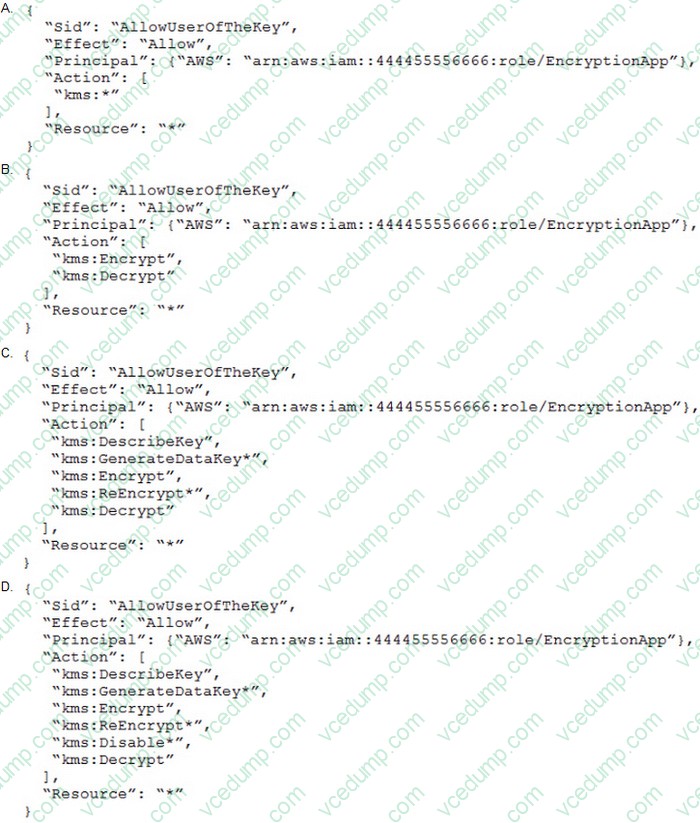
B. Option B
C. Option C
D. Option D -
Question 98:
You have enabled Cloudtrail logs for your company's IAM account. In addition, the IT Security department has mentioned that the logs need to be encrypted. How can this be achieved?
Please select:
A. Enable SSL certificates for the Cloudtrail logs
B. There is no need to do anything since the logs will already be encrypted
C. Enable Server side encryption for the trail
D. Enable Server side encryption for the destination S3 bucket -
Question 99:
A company uses Amazon EC2 Linux instances in the AWS Cloud. A member of the company's security team recently received a report about common vulnerability identifiers on the instances.
A security engineer needs to verify patching and perform remediation if the instances do not have the correct patches installed. The security engineer must determine which EC2 instances are at risk and must implement a solution to
automatically update those instances with the applicable patches.
What should the security engineer do to meet these requirements?
A. Use AWS Systems Manager Patch Manager to view vulnerability identifiers for missing patches on the instances. Use Patch Manager also to automate the patching process.
B. Use AWS Shield Advanced to view vulnerability identifiers for missing patches on the instances. Use AWS Systems Manager Patch Manager to automate the patching process.
C. Use Amazon GuardDuty to view vulnerability identifiers for missing patches on the instances. Use Amazon Inspector to automate the patching process.
D. Use Amazon Inspector to view vulnerability identifiers for missing patches on the instances. Use Amazon Inspector also to automate the patching process. -
Question 100:
You have an EC2 instance with the following security configured:
1.
ICMP inbound allowed on Security Group
2.
ICMP outbound not configured on Security Group
3.
ICMP inbound allowed on Network ACL
4.
ICMP outbound denied on Network ACL
If Flow logs is enabled for the instance, which of the following flow records will be recorded? Choose 3 answers from the options give below
A. An ACCEPT record for the request based on the Security Group
B. An ACCEPT record for the request based on the NACL
C. A REJECT record for the response based on the Security Group
D. A REJECT record for the response based on the NACL
Related Exams:
-
AIF-C01
Amazon AWS Certified AI Practitioner (AIF-C01) -
AIP-C01
AWS Certified Generative AI Developer - Professional -
ANS-C00
AWS Certified Advanced Networking - Specialty (ANS-C00) -
ANS-C01
AWS Certified Advanced Networking - Specialty (ANS-C01) -
AXS-C01
AWS Certified Alexa Skill Builder - Specialty (AXS-C01) -
BDS-C00
AWS Certified Big Data - Speciality (BDS-C00) -
CLF-C02
AWS Certified Cloud Practitioner (CLF-C02) -
DAS-C01
AWS Certified Data Analytics - Specialty (DAS-C01) -
DATA-ENGINEER-ASSOCIATE
AWS Certified Data Engineer - Associate (DEA-C01) -
DBS-C01
AWS Certified Database - Specialty (DBS-C01)
Tips on How to Prepare for the Exams
Nowadays, the certification exams become more and more important and required by more and more enterprises when applying for a job. But how to prepare for the exam effectively? How to prepare for the exam in a short time with less efforts? How to get a ideal result and how to find the most reliable resources? Here on Vcedump.com, you will find all the answers. Vcedump.com provide not only Amazon exam questions, answers and explanations but also complete assistance on your exam preparation and certification application. If you are confused on your SCS-C02 exam preparations and Amazon certification application, do not hesitate to visit our Vcedump.com to find your solutions here.