SC-100 Exam Details
-
Exam Code
:SC-100 -
Exam Name
:Microsoft Cybersecurity Architect -
Certification
:Microsoft Certifications -
Vendor
:Microsoft -
Total Questions
:350 Q&As -
Last Updated
:Jul 12, 2026
Microsoft SC-100 Online Questions & Answers
-
Question 61:
You have a Microsoft 365 subscription.
You are designing a user access solution that follows the Zero Trust principles of the Microsoft Cybersecurity Reference Architectures (MCRA).
You need to recommend a solution that automatically restricts access to Microsoft Exchange Online, SharePoint Online, and Teams in near-real-time (NRT) in response to the following Azure AD events:
1. A user account is disabled or deleted.
2. The password of a user is changed or reset.
3. All the refresh tokens for a user are revoked.
4. Multi-factor authentication (MFA) is enabled for a user.
Which two features should you include in the recommendation? Each correct answer presents part of the solution.
NOTE: Each correct selection is worth one point.
A. continuous access evaluation
B. Azure AD Application Proxy
C. a sign-in risk policy
D. Azure AD Privileged Identity Management (PIM)
E. Conditional Access -
Question 62:
Your company finalizes the adoption of Azure and is implementing Microsoft Defender for Cloud.
You receive the following recommendations in Defender for Cloud
1. Access to storage accounts with firewall and virtual network configurations should be restricted.
2. Storage accounts should restrict network access using virtual network rules.
3. Storage account should use a private link connection.
4. Storage account public access should be disallowed.
You need to recommend a service to mitigate identified risks that relate to the recommendations.
What should you recommend?
A. Azure Policy
B. Azure Network Watcher
C. Azure Storage Analytics
D. Microsoft Sentinel -
Question 63:
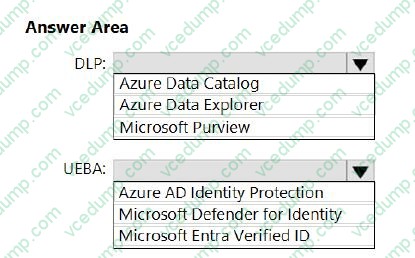
HOTSPOT
You are designing the security architecture for a cloud-only environment.
You are reviewing the integration point between Microsoft 365 Defender and other Microsoft cloud services based on Microsoft Cybersecurity Reference Architectures (MCRA).
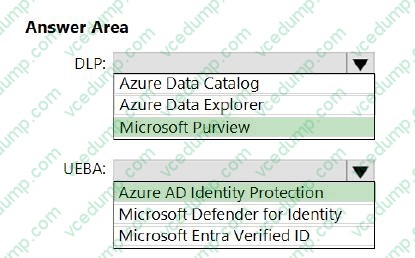
You need to recommend which Microsoft cloud services integrate directly with Microsoft 365 Defender and meet the following requirements:
1. Enforce data loss prevention (DLP) policies that can be managed directly from the Microsoft 365 Defender portal.
2. Detect and respond to security threats based on User and Entity Behavior Analytics (UEBA) with unified alerting.
What should you include in the recommendation for each requirement? To answer, select the appropriate options in the answer area.
NOTE: Each correct selection is worth one point.
-
Question 64:
You have an Azure subscription with multiple Azure Blob Storage accounts.
You are tasked with recommending a solution to detect threats in files after they have been uploaded to a blob container.
What should be included in your recommendation?
A. sensitive data threat detection in Microsoft Defender for Storage
B. runtime threat protection in Microsoft Defender for Containers
C. vulnerability assessment in Microsoft Defender for Containers
D. malware scanning in Microsoft Defender for Storage -
Question 65:
You have a Microsoft 365 tenant.
Your company uses a third-party software as a service (SaaS) app named App1 that is integrated with an Azure AD tenant.
You need to design a security strategy to meet the following requirements:
1. Users must be able to request access to App1 by using a self-service request.
2. When users request access to App1, they must be prompted to provide additional information about their request.
3. Every three months, managers must verify that the users still require access to App1.
What should you include in the design?
A. Microsoft Entra Identity Governance
B. connected apps in Microsoft Defender for Cloud Apps
C. access policies in Microsoft Defender for Cloud Apps
D. Azure AD Application Proxy -
Question 66:
HOTSPOT
You have an Azure subscription.
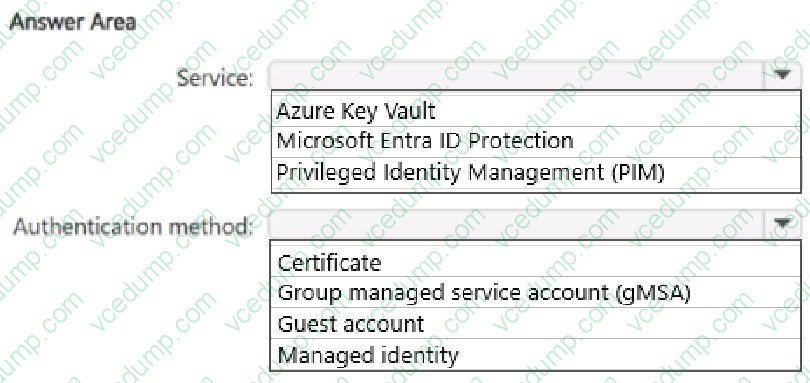
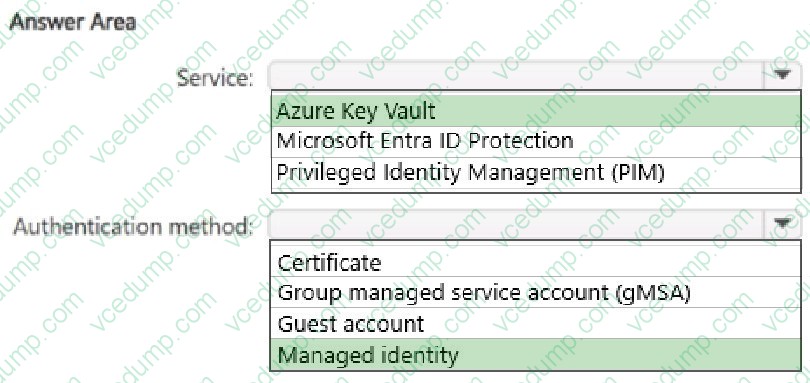
You plan to deploy an Azure App Service app named App1 that will access an external web service by using a username and password.
You need to recommend a password storage solution for App1 that meets the following requirements:
1. Ensures that the password is stored securely.
2. Ensures that App1 can authenticate to the service that will store the password.
Which service should you use to store the password, and which authentication method should App1 use to access the service? To answer, select the appropriate options in the answer area.
NOTE: Each correct selection is worth one point.
-
Question 67:
Your company has an Azure subscription that has enhanced security enabled for Microsoft Defender for Cloud.
The company signs a contract with the United States government.
You need to review the current subscription for NIST 800-53 compliance.
What should you do first?
A. From Defender for Cloud, review the Azure security baseline for audit report.
B. From Defender for Cloud, review the secure score recommendations.
C. From Defender for Cloud, enable Defender for Cloud plans.
D. From Azure Policy, assign a built-in initiative that has a scope of the subscription. -
Question 68:
DRAG DROP
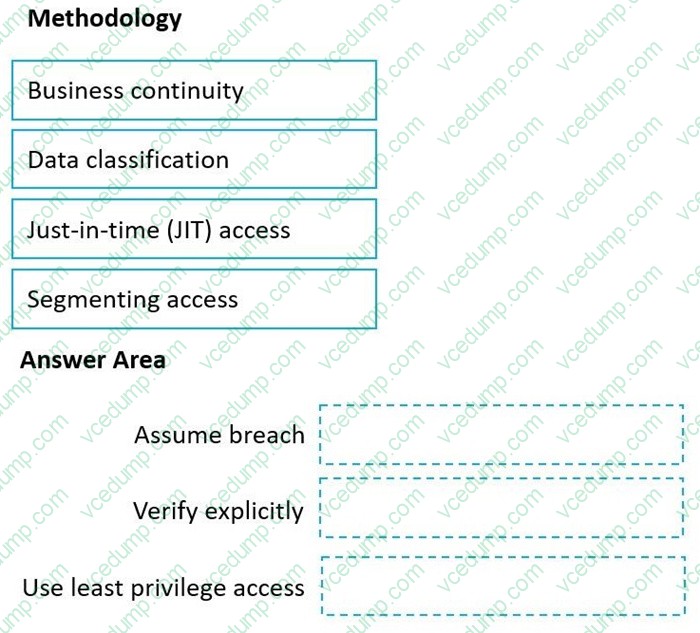
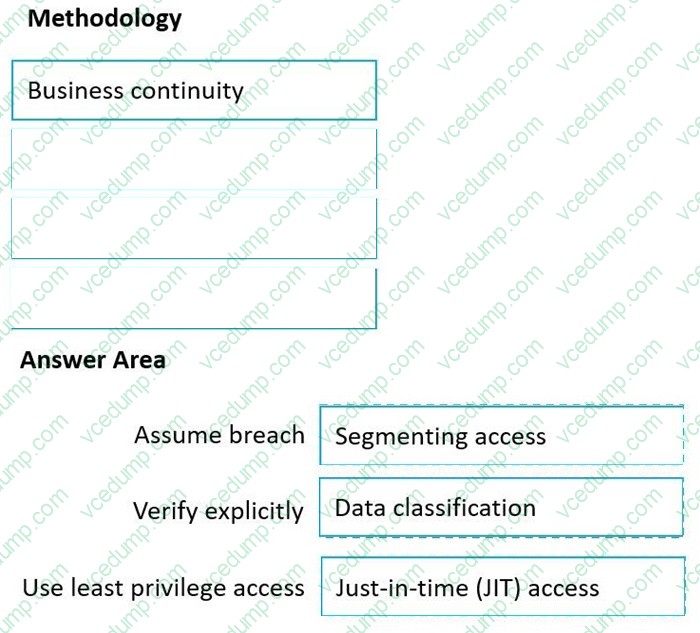
For a Microsoft cloud environment, you need to recommend a security architecture that follows the Zero Trust principles of the Microsoft Cybersecurity Reference Architectures (MCRA).
Which security methodologies should you include in the recommendation? To answer, drag the appropriate methodologies to the correct principles. Each methodology may be used once, more than once, or not at all. You may need to drag the split bar between panes or scroll to view content.
NOTE: Each correct selection is worth one point.
Select and Place:
-
Question 69:
You have a Microsoft Entra tenant named contoso.com and are using Microsoft Intune. Each user in contoso.com holds a Microsoft Entra ID P1 license and has a Windows 11 device with the Global Secure Access client installed.
You plan to configure Microsoft Entra Internet Access with the following setup:
1. Enable a baseline profile.
2. Create a security profile called Profile1, with a priority of
300. This profile contains a single web content filtering policy, WCFPolicy1.
WCFPolicy1 will be configured as follows:
1. Set the Action to Allow.
2. Include a rule targeting the fully qualified domain name (FQDN) adatum.com.
3. Link Profile1 to a Conditional Access policy named CAPolicy1, which is applied to all users. The policy grants access unless a user's device is noncompliant.
You need to assess the impact of this deployment on traffic to the following resources:
1. https://www.adatum.com:8433
2. https://www.fabrikam.com
What two traffic scenarios will occur?
A. Traffic to https://www.fabrikam.com will be allowed from all the devices.
B. Traffic to https://www.adatum.com:8433 will be blocked from all the devices.
C. Traffic to https://www.adatum.com:8433 will be allowed from all the devices.
D. Traffic to https://www.fabrikam.com will be allowed from compliant devices only.
E. Traffic to https://www.adatum.com:8433 will be allowed from compliant devices only.
F. Traffic to https://www.fabrikam.com will be blocked from noncompliant devices only. -
Question 70:
You have a Microsoft 365 subscription and an Azure subscription. Microsoft 365 Defender and Microsoft Defender for Cloud are enabled.
The Azure subscription contains 50 virtual machines. Each virtual machine runs different applications on Windows Server 2019.
You need to recommend a solution to ensure that only authorized applications can run on the virtual machines. If an unauthorized application attempts to run or be installed, the application must be blocked automatically until an administrator authorizes the application.
Which security control should you recommend?
A. app registrations in Azure AD
B. application control policies in Microsoft Defender for Endpoint
C. app discovery anomaly detection policies in Microsoft Defender for Cloud Apps
D. Azure AD Conditional Access App Control policies
Related Exams:
-
62-193
Technology Literacy for Educators -
70-243
Administering and Deploying System Center 2012 Configuration Manager -
70-355
Universal Windows Platform – App Data, Services, and Coding Patterns -
77-420
Excel 2013 -
77-427
Excel 2013 Expert Part One -
77-725
Word 2016 Core Document Creation, Collaboration and Communication -
77-726
Word 2016 Expert Creating Documents for Effective Communication -
77-727
Excel 2016 Core Data Analysis, Manipulation, and Presentation -
77-728
Excel 2016 Expert: Interpreting Data for Insights -
77-731
Outlook 2016 Core Communication, Collaboration and Email Skills
Tips on How to Prepare for the Exams
Nowadays, the certification exams become more and more important and required by more and more enterprises when applying for a job. But how to prepare for the exam effectively? How to prepare for the exam in a short time with less efforts? How to get a ideal result and how to find the most reliable resources? Here on Vcedump.com, you will find all the answers. Vcedump.com provide not only Microsoft exam questions, answers and explanations but also complete assistance on your exam preparation and certification application. If you are confused on your SC-100 exam preparations and Microsoft certification application, do not hesitate to visit our Vcedump.com to find your solutions here.