SALESFORCE-MULESOFT-DEVELOPER-II Exam Details
-
Exam Code
:SALESFORCE-MULESOFT-DEVELOPER-II -
Exam Name
:Salesforce Certified MuleSoft Developer II (Mule-Dev-301) -
Certification
:Salesforce Certifications -
Vendor
:Salesforce -
Total Questions
:60 Q&As -
Last Updated
:Jul 12, 2026
Salesforce SALESFORCE-MULESOFT-DEVELOPER-II Online Questions & Answers
-
Question 31:
A Mule application need to invoice an API hosted by an external system to initiate a process. The external API takes anywhere between one minute and 24 hours to compute its process. Which implementation should be used to get response data from the external API after it completes processing?
A. Use an HTTP Connector to invoke the API and wait for a response
B. Use a Scheduler to check for a response every minute
C. Use an HTTP Connector inside Async scope to invoice the API and wait for a response
D. Expose an HTTP callback API in Mule and register it with the external system -
Question 32:
Refer to the exhibit.
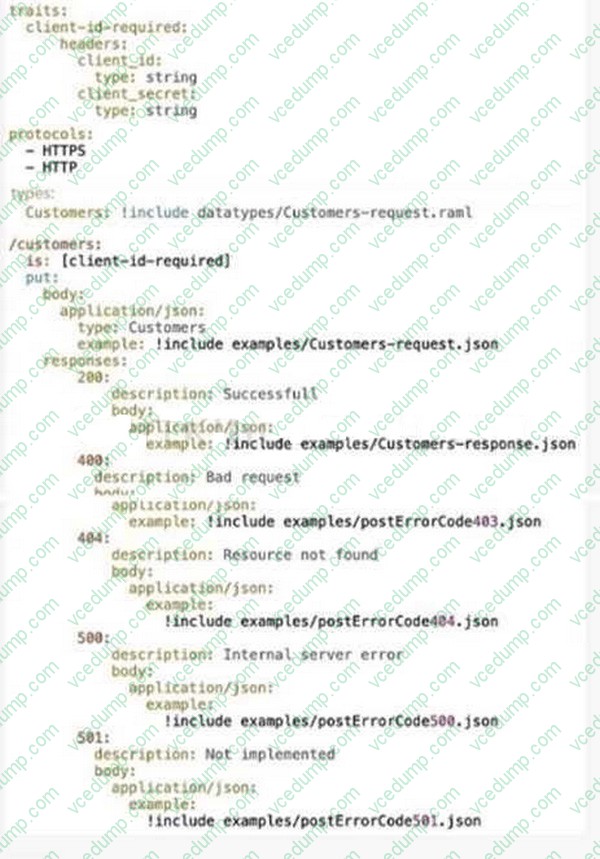
A developer generates the base scaffolding for an API in Anypoint Studio. Which HTTP status code is returned while testing using the API Kit console if no values are entered in client-secret?
A. HTTP status code:200
B. HTTP status code:403
C. HTTP status code:400
D. HTTP status code:500 -
Question 33:
What is the MuleSoft recommended method to encrypt sensitive property data?
A. The encryption key and sensitive data should be different for each environment
B. The encryption key should be identical for all environments
C. The encryption key should be identical for all environments and the sensitive data should be different for each environment
D. The encryption key should be different for each environment and the sensitive data should be the same for all environments -
Question 34:
Which configurations are required for HTTP Listener to enable mTLS authentication?
A. Set an appropriate reconnection strategy and use persistent connections for the listener
B. Set an appropriate keystore configuration and use persistent connections for the listener
C. Set an appropriate keystore and truststore configuration for the listener
D. Set an appropriate truststore configuration and reconnection strategy for the listener -
Question 35:
A heathcare customer wants to use hospital system data, which includes code that was developed using legacy tools and methods. The customer has created reusable Java libraries in order to read the data from the system. What is the most effective way to develop an API retrieve the data from the hospital system?
A. Refer to JAR files in the code
B. Include the libraries writes deploying the code into the runtime
C. Create the Java code in your project and invoice the data from the code
D. Install libraries in a local repository and refer to it in the pm.xml file -
Question 36:
A company deploys 10 public APIs to CloudHub. Each API has its individual health endpoint defined. The platform operation team wants to configure API Functional Monitoring to monitor the health of the APIs periodically while minimizing
operational overhead and cost.
How should API Functional Monitoring be configured?
A. From one public location with each API in its own schedule
B. From one private location with all 10 APIs in a single schedule
C. From one public location with all 10 APIs in a single schedule
D. From 10 public locations with each API in its own schedule -
Question 37:
Which plugin or dependency is required to unit test modules created with XML SDK?
A. XMLUnit
B. Junit
C. MUnit Extensions Maven plugin
D. MUnit Maven plugin -
Question 38:
Which statement is true when using XML SDK for creating custom message processors?
A. Properties are fields defined by an end user of the XML SDK component and serve as a global configuration for the entire Mule project in which they are used
B. An XML SDK provides both inbound and outbound operations
C. Operations can be reused in recursive calls
D. All operations are public -
Question 39:
When a client and server are exchanging messages during the mTLS handshake, what is being agreed on during the cipher suite exchange?
A. A protocol
B. The TLS version
C. An encryption algorithm
D. The Public key format -
Question 40:
Which statement is true when working with correlation IDS?
A. The HTTP Listener regenerates correlation IDs regardless of the HTTP request
B. The Anypoint MQ Connector automatically propagates correlation IDS
C. The HTTP Listener generates correlation IDS unless a correlation ID is received in the HTTP request
D. The VM Connector does not automatically propagate correction IDs
Related Exams:
-
201-COMMERCIAL-BANKING-FUNCTIONAL
Salesforce enCino 201 Commercial Banking Functional -
ADM-201
Salesforce Certified Platform Administrator (Plat-Admn-201) -
ADM-211
Administration Essentials for Experienced Admin (ADM-211) -
ADM-261
Service Cloud Administration (SU24) -
ADVANCED-ADMINISTRATOR
Salesforce Certified Advanced Administrator -
ADVANCED-CROSS-CHANNEL
Marketing Cloud Advanced Cross Channel Accredited Professional -
ADX-201
Administrative Essentials for New Admins in Lightning Experience -
ADX-271
Salesforce Certified Community Cloud Consultant (ADX-271) -
AGENTFORCE-SPECIALIST
Salesforce Certified Agentforce Specialist (AI-201) -
ALS-CON-201
Salesforce Certified Agentforce Life Sciences Consultant
Tips on How to Prepare for the Exams
Nowadays, the certification exams become more and more important and required by more and more enterprises when applying for a job. But how to prepare for the exam effectively? How to prepare for the exam in a short time with less efforts? How to get a ideal result and how to find the most reliable resources? Here on Vcedump.com, you will find all the answers. Vcedump.com provide not only Salesforce exam questions, answers and explanations but also complete assistance on your exam preparation and certification application. If you are confused on your SALESFORCE-MULESOFT-DEVELOPER-II exam preparations and Salesforce certification application, do not hesitate to visit our Vcedump.com to find your solutions here.