SALESFORCE-MULESOFT-DEVELOPER-II Exam Details
-
Exam Code
:SALESFORCE-MULESOFT-DEVELOPER-II -
Exam Name
:Salesforce Certified MuleSoft Developer II (Mule-Dev-301) -
Certification
:Salesforce Certifications -
Vendor
:Salesforce -
Total Questions
:60 Q&As -
Last Updated
:Jul 12, 2026
Salesforce SALESFORCE-MULESOFT-DEVELOPER-II Online Questions & Answers
-
Question 21:
A Mule application includes a subflow containing a Scatter.Gather scope. Within each log of the Scatter.Gatter. an HTTP connector calls a PUT endpoint to modify records in different upstream system. The subflow is called inside an Unit successful scope to retry if a transitory exception is raised. A technical spike is being performed to increase reliability of the Mule application. Which steps should be performed within the Mule flow above the ensure idempontent behavior?
A. Change the PUT requests inside the Scatter-Gather to POST requests
B. Ensure an error-handling flow performs corrective actions to roll back all changes if any leg of the Scatter- Gather fails
C. Remove the Put requests from the Scatter-Getter and perform them sequentially
D. None, the flow already exhibits idempotent behavior -
Question 22:
A company has been using CI/CD. Its developers use Maven to handle build and deployment activities. What is the correct sequence of activities that takes place during the Maven build and deployment?
A. Initialize, validate, compute, test, package, verify, install, deploy
B. Validate, initialize, compile, package, test, install, verify, verify, deploy
C. Validate, initialize, compile, test package, verify, install, deploy
D. Validation, initialize, compile, test, package, install verify, deploy -
Question 23:
A Mule application for processing orders must log the order ID for every log message output. What is a best practice to enrich every log message with the order ID?
A. Use flow variables within every logger processor to log the order ID
B. Set a flow variable and edit the log4.xml file to output the variable as part of the message pattern
C. Create a custom XML SDK component to wrap the logger processor and automatically add the order ID within the connector
D. Use the Tracing module to set logging variables with a Mapped Diagnostic Context -
Question 24:
Refer to the exhibit.
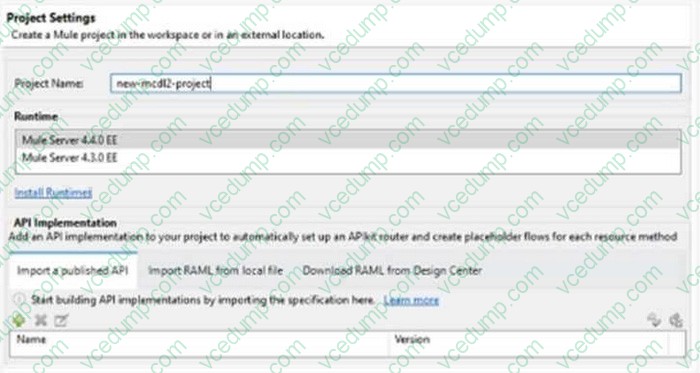
When creating a new project, which API implementation allows for selecting the correct API version and scaffolding the flows from the API specification?
A. Import a published API
B. Generate a local RAML from anypoint Studio
C. Download RAML from Design Center
D. Import RAML from local file -
Question 25:
An API has been built to enable scheduling email provider. The front-end system does very little data entry validation, and problems have started to appear in the email that go to patients. A validatecustomer'' flow is added validate the data.
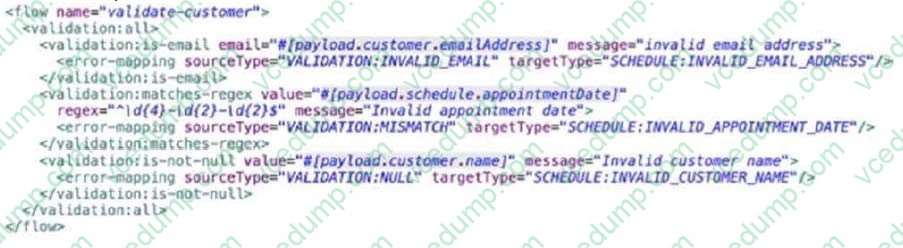
What is he expected behavior of the "validate-customer'' flow?
A. If only the email address Is invalid a VALIDATION.INVALID_EMAIL error is raised
B. If the email address is invalid, processing continues to see if the appointment data and customer name are also invalid
C. If the appointment date and customer name are invalid, a SCHEDULE:INVALID_APPOINTMENT_DATE error is raised
D. If all of the values are invalid the last validation error is raised:SCHEDULE:INVALID_CUSTOMER_NAME -
Question 26:
A Mule application contain two policies Policy A and Policy A has order1, and Policy B has order 2. Policy A Policy B, and a flow are defined by he configuration below.
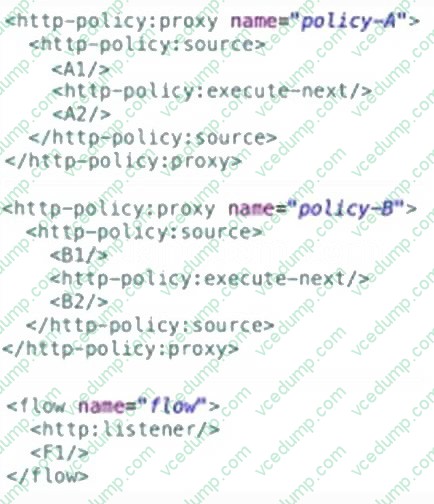
When a HTTP request arrives at the Mule application's endpoint, what will be the execution order?
A. A1, B1, F1, B2, A2
B. B1, A1, F1, A2, B2
C. F1, A1, B1, B2, A2
D. F1, B1, A1, A2, B2 -
Question 27:
When implementing a synchronous API where the event source is an HTTP Listener, a developer needs to return the same correlation ID back to the caller in the HTTP response header. How can this be achieved?
A. Enable the auto-generate CorrelationID option when scaffolding the flow
B. Enable the CorrelationID checkbox in the HTTP Listener configuration
C. Configure a custom correlation policy
D. NO action is needed as the correlation ID is returned to the caller in the response header by default -
Question 28:
Refer to the exhibit.

What is the result of the Mule Maven Plugin configuration of the value of property its,keystorePassoword in CloudHub 2.0?
A. CloudHub encrypts the value
B. The Mule server encrypts the value
C. Anypoint Studio secures the value
D. Runtime Manager masks the value -
Question 29:
A Flight Management System publishes gate change notification events whenever a flight's arrival gate changes. Other systems, including Baggage Handler System. Inflight Catering System and Passenger Notifications System, must each
asynchronously receive the same gate change notification to process the event according.
Which configuration is required in Anypoint MQ to achieve this publish/subscribe model?
A. Publish each client subscribe directly to the exchange.Have each client subscribe directly to the queue.
B. Publish the gate change notification to an Anypoint MC queue Have each client subscribe directly to the queue
C. Publish the gate change notification to an Anypoint MQ queue. Create different anypoint MQ exchange meant for each of the other subscribing systems Bind the queue with each of the exchanges
D. Publish the gate change notification to an Anypoint MQ exchanhe. Create different Anypoint MQ queues meant for each of the other subscribing systems. Bind the exchange with each of the queues. -
Question 30:
A developer is working on a project that requires encrypting all data before sending it to a backend application. To accomplish this, the developer will use PGP encryption in the Mule 4 Cryptography module. What is required to encrypt the data before sending it to the backend application?
A. The application needs to configure HTTPS TLS context information to encrypt the data
B. The application needs to both the private and public keys to encrypt the data
C. The application needs the public key from the backend service to encrypt the data
D. The application needs the private key from the backend service to encrypt the data
Related Exams:
-
201-COMMERCIAL-BANKING-FUNCTIONAL
Salesforce enCino 201 Commercial Banking Functional -
ADM-201
Salesforce Certified Platform Administrator (Plat-Admn-201) -
ADM-211
Administration Essentials for Experienced Admin (ADM-211) -
ADM-261
Service Cloud Administration (SU24) -
ADVANCED-ADMINISTRATOR
Salesforce Certified Advanced Administrator -
ADVANCED-CROSS-CHANNEL
Marketing Cloud Advanced Cross Channel Accredited Professional -
ADX-201
Administrative Essentials for New Admins in Lightning Experience -
ADX-271
Salesforce Certified Community Cloud Consultant (ADX-271) -
AGENTFORCE-SPECIALIST
Salesforce Certified Agentforce Specialist (AI-201) -
ALS-CON-201
Salesforce Certified Agentforce Life Sciences Consultant
Tips on How to Prepare for the Exams
Nowadays, the certification exams become more and more important and required by more and more enterprises when applying for a job. But how to prepare for the exam effectively? How to prepare for the exam in a short time with less efforts? How to get a ideal result and how to find the most reliable resources? Here on Vcedump.com, you will find all the answers. Vcedump.com provide not only Salesforce exam questions, answers and explanations but also complete assistance on your exam preparation and certification application. If you are confused on your SALESFORCE-MULESOFT-DEVELOPER-II exam preparations and Salesforce certification application, do not hesitate to visit our Vcedump.com to find your solutions here.