SAA-C03 Exam Details
-
Exam Code
:SAA-C03 -
Exam Name
:AWS Certified Solutions Architect - Associate (SAA-C03) -
Certification
:Amazon Certifications -
Vendor
:Amazon -
Total Questions
:1524 Q&As -
Last Updated
:Jul 11, 2026
Amazon SAA-C03 Online Questions & Answers
-
Question 1351:
A large financial services company uses Amazon ElastiCache (Redis OSS) for its new application that has a global user base. A solutions architect must develop a caching solution that will be available across AWS Regions and include low-latency replication and failover capabilities for disaster recovery (DR). The company's security team requires the encryption of cross-Region data transfers.
Which solution meets these requirements with the LEAST amount of operational effort?
A. Enable cluster mode in ElastiCache (Redis OSS). Then create multiple clusters across Regions and replicate the cache data by using AWS Database Migration Service (AWS DMS). Promote a cluster in the failover Region to handle production traffic when DR is required.
B. Create a global data store in ElastiCache (Redis OSS). Then create replica clusters in two other Regions. Promote one of the replica clusters as primary when DR is required.
C. Disable cluster mode in ElastiCache (Redis OSS). Then create multiple replication groups across Regions and replicate the cache data by using AWS Database Migration Service (AWS DMS). Promote a replication group in the failover Region to primary when DR is required.
D. Create a snapshot of ElastiCache (Redis OSS) in the primary Region and copy it to the failover Region.Use the snapshot to restore the cluster from the failover Region when DR is required. -
Question 1352:
A company has a business system that generates hundreds of reports each day. The business system saves the reports to a network share in CSV format. The company needs to store this data in the AWS Cloud in near-real time for analysis.
Which solution will meet these requirements with the LEAST administrative overhead?
A. Use AWS DataSync to transfer the files to Amazon S3. Create a scheduled task that runs at the end of each day.
B. Create an Amazon S3 File Gateway. Update the business system to use a new network share from the S3 File Gateway.
C. Use AWS DataSync to transfer the files to Amazon S3. Create an application that uses the DataSync API in the automation workflow.
D. Deploy an AWS Transfer for SFTP endpoint. Create a script that checks for new files on the network share and uploads the new files by using SFTP. -
Question 1353:
A large media company hosts a web application on AWS. The company wants to start caching confidential media files so that users around the world will have reliable access to the files. The content is stored in Amazon S3 buckets. The company must deliver the content quickly, regardless of where the requests originate geographically.
Which solution will meet these requirements?
A. Use AWS DataSync to connect the S3 buckets to the web application.
B. Deploy AWS Global Accelerator to connect the S3 buckets to the web application.
C. Deploy Amazon CloudFront to connect the S3 buckets to CloudFront edge servers.
D. Use Amazon Simple Queue Service (Amazon SQS) to connect the S3 buckets to the web application. -
Question 1354:
A company has an application that runs on Amazon EC2 instances and uses an Amazon Aurora database.
The EC2 instances connect to the Aurora database by using user names and passwords that the company stores locally in a file. The company changes the user names and passwords every month. The company wants to minimize the operational overhead of credential management.
Which solution will meet these requirements?
A. Store the credentials as a secret within AWS Secrets Manager. Assign IAM permissions to the secret. Reconfigure the application to call the secret. Enable rotation on the secret and configure rotation to occur on a monthly schedule.
B. Use AWS Systems Manager Parameter Store to create a new parameter for the credentials. Use IAM policies to restrict access to the parameter. Reconfigure the application to access the parameter.
C. Create an Amazon S3 bucket to store objects. Use an AWS Key Management Service (AWS KMS) key to encrypt the objects. Migrate the credentials file to the S3 bucket. Update the application to retrieve the credentials file from the S3 bucket.
D. Create an encrypted Amazon Elastic Block Store (Amazon EBS) volume for each EC2 instance. Attach the encrypted EBS volumes to the EC2 instances. Migrate the credentials file to the new EBS volumes. -
Question 1355:
A company has an application that runs on several Amazon EC2 instances. Each EC2 instance has multiple Amazon Elastic Block Store (Amazon EBS) data volumes attached to it. The application's EC2 instance configuration and data need to be backed up nightly. The application also needs to be recoverable in a different AWS Region.
Which solution will meet these requirements in the MOST operationally efficient way?
A. Write an AWS Lambda function that schedules nightly snapshots of the application's EBS volumes and copies the snapshots to a different Region.
B. Create a backup plan by using AWS Backup to perform nightly backups. Copy the backups to another Region. Add the application's EC2 instances as resources.
C. Create a backup plan by using AWS Backup to perform nightly backups. Copy the backups to another Region. Add the application's EBS volumes as resources.
D. Write an AWS Lambda function that schedules nightly snapshots of the application's EBS volumes and copies the snapshots to a different Availability Zone. -
Question 1356:
A company needs to allow a vendor to access CloudWatch Logs in the company's AWS account by using IAM roles for cross-account access.
Which solution will meet these requirements?
A. Create roles in both accounts and trust the company role.
B. Create a role in the vendor account and trust the company role.
C. Create a role in the company account and trust the company role.
D. Create a role in the company account with permissions and trust the vendor role. -
Question 1357:
A company uses Amazon EC2 instances to host its internal systems. As part of a deployment operation, an administrator tries to use the AWS CLI to terminate an EC2 instance. However, the administrator receives a 403 (Access Denied) error message. The administrator is using an IAM role that has the following IAM policy attached:
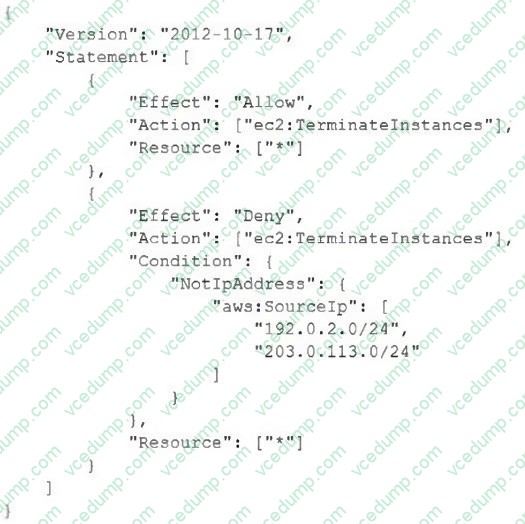
What is the cause of the unsuccessful request?
A. The EC2 instance has a resource-based policy with a Deny statement.
B. The principal has not been specified in the policy statement.
C. The "Action" field does not grant the actions that are required to terminate the EC2 instance.
D. The request to terminate the EC2 instance does not originate from the CIDR blocks 192.0.2.0/24 or 203.0.113.0/24. -
Question 1358:
A company manages an application that stores data on an Amazon RDS for PostgreSQL Multi-AZ DB instance. Increases in traffic are causing performance problems. The company determines that database queries are the primary reason for the slow performance.
What should a solutions architect do to improve the application's performance?
A. Serve read traffic from the Multi-AZ standby replica.
B. Configure the DB instance to use Transfer Acceleration.
C. Create a read replica from the source DB instance. Serve read traffic from the read replica.
D. Use Amazon Kinesis Data Firehose between the application and Amazon RDS to increase the concurrency of database requests. -
Question 1359:
A company runs an application on Microsoft SQL Server databases in an on-premises data center. The company wants to migrate to AWS and optimize costs for its infrastructure on AWS.
Which solution will meet these requirements?
A. Migrate the databases to Amazon EC2 instances that use SQL Server Amazon Machine Images (AMIs) provided by AWS.
B. Migrate to Amazon Aurora PostgreSQL by using Babelfish for Aurora PostgreSQL.
C. Migrate the databases to a PostgreSQL database that runs on Amazon EC2 instances.
D. Migrate the databases to Amazon RDS for Microsoft SQL Server. -
Question 1360:
A company wants to ingest customer payment data into the company's data lake in Amazon S3. The company receives payment data every minute on average. The company wants to analyze the payment data in real time. Then the company wants to ingest the data into the data lake.
Which solution will meet these requirements with the MOST operational efficiency?
A. Use Amazon Kinesis Data Streams to ingest data. Use AWS Lambda to analyze the data in real time.
B. Use AWS Glue to ingest data. Use Amazon Kinesis Data Analytics to analyze the data in real time.
C. Use Amazon Kinesis Data Firehose to ingest data. Use Amazon Kinesis Data Analytics to analyze the data in real time.
D. Use Amazon API Gateway to ingest data. Use AWS Lambda to analyze the data in real time.
Related Exams:
-
AIF-C01
Amazon AWS Certified AI Practitioner (AIF-C01) -
AIP-C01
AWS Certified Generative AI Developer - Professional -
ANS-C00
AWS Certified Advanced Networking - Specialty (ANS-C00) -
ANS-C01
AWS Certified Advanced Networking - Specialty (ANS-C01) -
AXS-C01
AWS Certified Alexa Skill Builder - Specialty (AXS-C01) -
BDS-C00
AWS Certified Big Data - Speciality (BDS-C00) -
CLF-C02
AWS Certified Cloud Practitioner (CLF-C02) -
DAS-C01
AWS Certified Data Analytics - Specialty (DAS-C01) -
DATA-ENGINEER-ASSOCIATE
AWS Certified Data Engineer - Associate (DEA-C01) -
DBS-C01
AWS Certified Database - Specialty (DBS-C01)
Tips on How to Prepare for the Exams
Nowadays, the certification exams become more and more important and required by more and more enterprises when applying for a job. But how to prepare for the exam effectively? How to prepare for the exam in a short time with less efforts? How to get a ideal result and how to find the most reliable resources? Here on Vcedump.com, you will find all the answers. Vcedump.com provide not only Amazon exam questions, answers and explanations but also complete assistance on your exam preparation and certification application. If you are confused on your SAA-C03 exam preparations and Amazon certification application, do not hesitate to visit our Vcedump.com to find your solutions here.