RHIA Exam Details
-
Exam Code
:RHIA -
Exam Name
:Registered Health Information Administrator -
Certification
:AHIMA Certifications -
Vendor
:AHIMA -
Total Questions
:1826 Q&As -
Last Updated
:Jul 20, 2026
AHIMA RHIA Online Questions & Answers
-
Question 731:
What is the chief criterion for determining record inactivity?
A. Medicare's definition of inactivity
B. amount of space available for storage of newer records
C. efficiency of microfilming
D. preference of the medical staff -
Question 732:
Dr. Brown has just approved the patient's request to amend the medical record. Dr. Brown has routed the request with his approval to the HIM Department. What should the HIM Department do?
A. File the request where the erroneous information is located.
B. File the request where the erroneous information is located and send a copy of the amendment to anyone who has a copy of the erroneous information.
C. File in the front of the chart.
D. File the request where the erroneous information is located and send a copy of the amendment to anyone who has a copy of the erroneous information plus anyone the patient requests. -
Question 733:
Laws that limit the period during which legal action may be brought against another party are known as
A. case law.
B. summons.
C. statutes of limitations.
D. common law. -
Question 734:
IV infusion of chemotherapy for 3 hours
A. 96422, 96423, 96423
B. 96409, 96411
C. 96413, 96415, 96415
D. 96413, 96413, 96413 -
Question 735:
Under which of the following conditions can an original patient health record by physically removed from the hospital?
A. when the patient is brought to the hospital emergency department following a motor vehicle accident and, after assessment, is transferred with his health record to a trauma designated emergency department at another hospital
B. when the directory of health records is acting in response to a subpoena duces tecum and takes the health record to court
C. when the patient is discharged by the physician and at the time of discharge is transported to a long-term care facility with his health record
D. when the record is taken to a physician's private office for a follow-up patient visit postdischarge -
Question 736:
The physician has documented the final diagnoses as acute myocardial infarction, COPD, CHF, hypertension, atrial fibrillation and status-post cholecystectomy. The following conditions should he reported
A. 410.9, 496, 402.91, 427.31, V45.79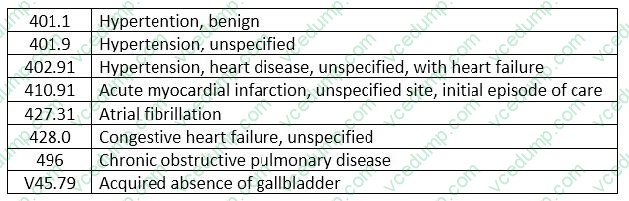
B. 410.91, 496, 428.0, 401.9, 427.31
C. 410.91, 496, 428.0, 401.9, 427.31, V45.79
D. 410.91, 496, 428.0, 401.1, 427.31 -
Question 737:
The drug commonly used to treat bipolar mood swings is
A. Lanoxin.
B. Lasix.
C. lithium carbonate.
D. lorazepam. -
Question 738:
In an acute care hospital, a complete history and physical may not be dictated for a new admission when
A. the patient is readmitted for a similar problem within 1 year.
B. the patient's stay is less than 24 hours.
C. the patient has an uneventful course in the hospital.
D. a legible copy of a recent HandP performed in the attending physician's office is available. -
Question 739:
In your new position as Director of Health Information Services, you have noticed that department supervisors arbitrarily allow employees to make up missed time due to absences. You decide that you need a policy to reinforce the attendance policy and cut down on tardiness and absences. Which policy statement would support your overall departmental goals?
A. Make-up time is allowed only with approval from the director.
B. Sick days can be used in lieu of time missed due to tardiness or absences.
C. No make-up time for absences and tardiness is allowed.
D. Changes in work schedules must be approved in advance and depend upon departmental operations. -
Question 740:
The best example of point-of-care service and documentation is
A. using an automated tracking system to locate a record.
B. using occurrence screens to identify adverse events.
C. doctors using voice recognition systems to dictate radiology reports.
D. nurses using bedside terminals to record vital signs.
Tips on How to Prepare for the Exams
Nowadays, the certification exams become more and more important and required by more and more enterprises when applying for a job. But how to prepare for the exam effectively? How to prepare for the exam in a short time with less efforts? How to get a ideal result and how to find the most reliable resources? Here on Vcedump.com, you will find all the answers. Vcedump.com provide not only AHIMA exam questions, answers and explanations but also complete assistance on your exam preparation and certification application. If you are confused on your RHIA exam preparations and AHIMA certification application, do not hesitate to visit our Vcedump.com to find your solutions here.