RHIA Exam Details
-
Exam Code
:RHIA -
Exam Name
:Registered Health Information Administrator -
Certification
:AHIMA Certifications -
Vendor
:AHIMA -
Total Questions
:1826 Q&As -
Last Updated
:Jul 12, 2026
AHIMA RHIA Online Questions & Answers
-
Question 611:
Case Study #5
Upon employment at your facility, all new employees read, demonstrate understanding, and sign Confidentiality Statements. Disclosure of confidential information is grounds for immediate dismissal. Each year, during the annual performance evaluation, every employee again reads, demonstrates understanding, and signs the Confidentiality Statement.
You are the Director of the Quality Department. Your Department has found that the femoral-popliteal bypass failure rate of one of your vascular surgeons, Dr. Z., is twice that of the national average. Members of the surgery department have reviewed that vascular surgeon's performance both by reading the medical records and by watching videos of her surgery. The Surgery Department and the Executive Committee have decided to deny reappointment for this surgeon.
Lucille X, the mother of one of your quality coordinators, has severe peripheral vascular disease. She was admitted to your facility and has an angiogram. The angiogram shows that she should have a femoral-popliteal bypass. She had told you that she would be in your facility and asked you to visit her. You are now fulfilling that promise and are also bringing her flowers. While pausing to knock on her door, you hear your employee, Mary
A. , vehemently state to her mother, "Mom, Dr. Z is z quack; half of her bypass surgeries fail. You must have Dr. DoGood!" Referring to Case Study #5, what do you do as Director of the Quality Department?
B. Seek the advice of the facility's legal counsel.
C. Immediately dismiss Mary G upon her arrival back in the department.
D. Walk into Lucille's room and state that Dr. Z is a fine surgeon and also advise Mary G to lower her voice.
E. Upon Mary G's arrival back in the department, give her a written warning. -
Question 612:
A patient authorizes Hospital A to send a copy of a discharge summary for the latest hospitalization to Hospital B. Hospital B uses the discharge summary in the patient's care and files it in the medical record. When Hospital B receives a request for records, a copy of Hospital A's discharge summary is sent. This is an example of:
A. a privacy violation
B. redisclosure
C. satisfactory assurance
D. inappropriate release -
Question 613:
All of the following statements are true of MS-DRGs, EXCEPT
A. A patient claim may have multiple MS-DRGs.
B. The MS-DRG payment received by the hospital may be lower than the actual cost of providing the services.
C. Special circumstances can result in an outlier payment to the hospital.
D. There are several types of hospitals that are excluded from the Medicare inpatient PPS. -
Question 614:
Eighty (80) requests for records to be pulled for the emergency room were processed in January. From the histogram provided, what was the most frequent amount of time taken to process a request?
A. 1-10 minutes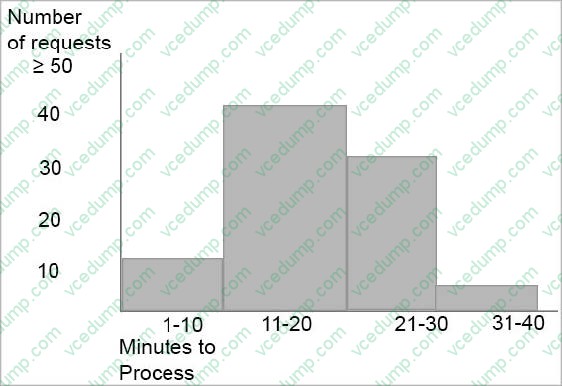
B. 11-20 minutes
C. 21-30 minutes
D. 31-40 minutes -
Question 615:
Based on the information displayed in the decision matrix below, which
A. Vendor A
B. Vendor B
C. Vendor C
D. Vendor D -
Question 616:
Infant with clubfoot. Correction by Evans operation
A. 754.70, 83.84
B. 754.71, 83.84
C. 736.71, 83.84
D. 736.79, 83.84 -
Question 617:
A patient is admitted for a total hip replacement because of rheumatoid arthritis. Following admission, but prior to surgery, the patient develops congestive heart failure, which necessitates transfer to ICU. The hip replacement is canceled and the patient is treated for the heart failure. What is the principal diagnosis?
A. congestive heart failure
B. rheumatoid arthritis
C. hip replacement
D. canceled surgical procedure -
Question 618:
The first step is
A. cases are differentiated based on the presence or absence of complications/comorbidites (CCs) or major complications/comorbidites (MCCs).
B. cases are divided into either a surgical partition or a medical partition.
C. the principal diagnosis determines the MDC assignment.
D. diagnoses and procedures are coded using ICD-9-CM. -
Question 619:
Case Study #5 Upon employment at your facility, all new employees read, demonstrate understanding, and sign Confidentiality Statements. Disclosure of confidential information is grounds for immediate dismissal. Each year, during the annual performance evaluation, every employee again reads, demonstrates understanding, and signs the Confidentiality Statement.
You are the Director of the Quality Department. Your Department has found that the femoral-popliteal bypass failure rate of one of your vascular surgeons, Dr. Z., is twice that of the national average. Members of the surgery department have reviewed that vascular surgeon's performance both by reading the medical records and by watching videos of her surgery. The Surgery Department and the Executive Committee have decided to deny reappointment for this surgeon.
Lucille X, the mother of one of your quality coordinators, has severe peripheral vascular disease. She was admitted to your facility and has an angiogram. The angiogram shows that she should have a femoral-popliteal bypass. She had told you that she would be in your facility and asked you to visit her. You are now fulfilling that promise and are also bringing her flowers. While pausing to knock on her door, you hear your employee, Mary
A. , vehemently state to her mother, "Mom, Dr. Z is z quack; half of her bypass surgeries fail. You must have Dr. DoGood!" Referring to Case Study #5, are the meeting minutes about the decisions regarding Dr. Z of Department of Surgery and of the Executive Committee admissible in court?
B. Yes, federal amendments to the Medicare Act require release of peer review.
C. Yes, state laws allow discovery of medical review committee records.
D. No, the federal Freedom of Information Act and state "sunshine laws" protect peer review.
E. No, under state laws, records of medical review committees are not subject to introduction into evidence. -
Question 620:
HIM professionals are bound to protect the confidentiality of patient information under the
A. Patient Bill of Rights.
B. AHIMA's Code of Ethics.
C. Hippocratic oath.
D. JCAHO standards.
Tips on How to Prepare for the Exams
Nowadays, the certification exams become more and more important and required by more and more enterprises when applying for a job. But how to prepare for the exam effectively? How to prepare for the exam in a short time with less efforts? How to get a ideal result and how to find the most reliable resources? Here on Vcedump.com, you will find all the answers. Vcedump.com provide not only AHIMA exam questions, answers and explanations but also complete assistance on your exam preparation and certification application. If you are confused on your RHIA exam preparations and AHIMA certification application, do not hesitate to visit our Vcedump.com to find your solutions here.