PW0-104 Exam Details
-
Exam Code
:PW0-104 -
Exam Name
:Wireless LAN Administration Exam -
Certification
:CWNP Certifications -
Vendor
:CWNP -
Total Questions
:125 Q&As -
Last Updated
:Dec 08, 2021
CWNP PW0-104 Online Questions & Answers
-
Question 61:
Given: In a single channel architecture (SCA) WLAN system, 802.11n (HT) APs should not share an SSID with 802.11g (ERP) APs.
What is the reason for this recommendation?
A. Client stations would see two different sets of AP capabilities as they roam between APs with the same BSSID.
B. The added range of 802.11n APs would cause additional co-channel interference.
C. The additional beacon material in 802.11n beacons would confuse 802.11b/g client stations.
D. Beacons from 802.11n APs use 40 MHz channels, while beacons from 802.11g APs use 20 MHz channels. -
Question 62:
Which antenna types are commonly used by indoor Wi-Fi devices in a MIMO diversity implementation? (Choose two)
A. Dipole
B. Patch
C. Dish
D. Grid
E. Sector -
Question 63:
What factors influence the distance that an RF signal can be effectively received? (Choose 4)
A. Transmitting station's antenna type
B. Receiving station's radio sensitivity
C. Free Space Path Loss
D. MAC layer encryption
E. Transmitting station's output power
F. Temperature in the Fresnel zone -
Question 64:
What statement about the IEEE 802.11e QoS facility is true?
A. 802.11 QoS is achieved by giving high priority queues a statistical advantage at winning contention.
B. Four 802.1p user priorities are mapped to eight 802.11 transmit queues.
C. When the Voice queue has frames awaiting transmission, no data will be transmitted from the Best Effort queue.
D. To improve efficiency, Block Acknowledgments are required for Voice and Video WMM queues.
E. 802.11 control frames are assigned to the 802.11 EF priority queue. -
Question 65:
When planning an access point deployment that utilizes Power over Ethernet (PoE) switches at the network edge, what design decision could adversely affect the operation of 802.3af APs?
A. All ports on the Ethernet switch will be supporting Class 3 PoE powered devices.
B. Some APs are connected to a PoE switch and are also receiving power from an AC outlet.
C. The Ethernet switch's uplink ports are not connected to an 802.3af-compliant core or distribution Ethernet switch.
D. A gigabit Ethernet switch port supporting an 802.11a/g AP auto-negotiates to 100 Mbps.
E. The installation team is not informed that PoE support will reduce the recommended maximum UTP cabling length from 100m to 50m. -
Question 66:
The IEEE 802.11a/n physical layer technologies utilize the 5 GHz frequency band. What is true of the two lower bands (UNII-1 and UNII-2) in this frequency spectrum? (Choose two)
A. The frequency range of these bands is 5000 MHz - 5200 MHz
B. Each of these two bands contain five 20 MHz channels.
C. Regulatory domains worldwide require DFS and TPC in these bands.
D. These bands have a total combined bandwidth of 200 MHz.
E. 20 MHz in each of these bands is reserved as a guard band. -
Question 67:
What word describes the bending of an RF signal as it passes from one medium to another medium of a different density?
A. Diffraction
B. Reflection
C. Refraction
D. Diffusion
E. Scattering -
Question 68:
When a client moves to a new BSS within an ESS, what steps are part of the 802.11 reassociation process? (Choose two)
A. The client station transmits a Reassociation Request frame to its current access point.
B. The current access point informs the IP gateway of the reassociation.
C. The current access point triggers the client's reassociation service.
D. The new access point transmits a Reassociation Response to the client station with a status value.
E. The client and new access point create unicast encryption keys.
F. The client station transmits a deauthentication frame to the current access point. -
Question 69:
Given: As you prepare for a site survey in a hospital, you have learned about several wireless devices that support connection-oriented, real-time applications. These applications are sensitive to service interruptions and require excellent signal quality, low latency, and low loss. For that reason, it is important to identify sources of RF interference as well as building characteristics that would cause RF blockage or dead spots.
What systems or environmental characteristics are most likely to cause interference or RF blockage and disrupt service for these applications? (Choose two)
A. Microwave ovens
B. Long hallways
C. Elevator shafts
D. RFID chokepoints
E. Drywall offices -
Question 70:
Given the Wi-Fi certification shown in the exhibit, what statement is FALSE about this device?
A. This client device supports protection mechanisms such as RTS/CTS and/or CTS-to-Self.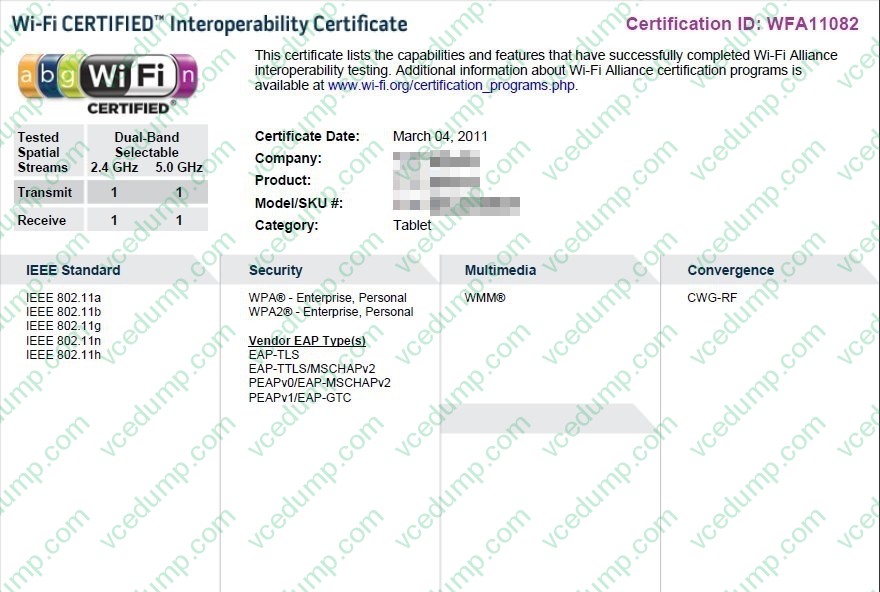
B. This client device supports both TKIP and CCMP cipher suites.
C. 300 Mbps is the maximum supported data rate for this device.
D. This client device supports the ERP, OFDM, and HT physical layer specifications.
E. This client device supports X.509 certificates for EAP authentication.
Related Exams:
-
CWAP-402
Certified Wireless Analysis Professional -
CWAP-403
Certified Wireless Analysis Professional -
CWAP-404
Certified Wireless Analysis Professional -
CWAP-405
Certified Wireless Analysis Professional -
CWDP-303
Certified Wireless Design Professional -
CWDP-304
Certified Wireless Design Professional -
CWDP-305
Certified Wireless Design Professional -
CWISA-102
Certified Wireless IoT Solutions Administrator -
CWISA-103
Social Media Strategist -
CWNA-106
Certified Wireless Network Administrator
Tips on How to Prepare for the Exams
Nowadays, the certification exams become more and more important and required by more and more enterprises when applying for a job. But how to prepare for the exam effectively? How to prepare for the exam in a short time with less efforts? How to get a ideal result and how to find the most reliable resources? Here on Vcedump.com, you will find all the answers. Vcedump.com provide not only CWNP exam questions, answers and explanations but also complete assistance on your exam preparation and certification application. If you are confused on your PW0-104 exam preparations and CWNP certification application, do not hesitate to visit our Vcedump.com to find your solutions here.