PW0-100 Exam Details
-
Exam Code
:PW0-100 -
Exam Name
:Certified wireless network administrator(cwna) -
Certification
:CWNP Certifications -
Vendor
:CWNP -
Total Questions
:125 Q&As -
Last Updated
:Dec 14, 2021
CWNP PW0-100 Online Questions & Answers
-
Question 61:
When performing a site survey for a Multiple Channel Architecture (MCA) system in a multi-tenant building with six floors, what aspect should you, as the site surveyor, keep in mind?
A. All doors and windows in the building should be open during the site survey to assess maximum coverage range.
B. The omni-directional antennas of the access points should be oriented parallel to the floor to maximize the coverage pattern across as many floors as possible.
C. The channel reuse pattern should be three dimensional with the RF cell extending coverage of each access point to other floors.
D. The Fresnel Zone is completely blocked between floors so each floor is considered a separate site survey. -
Question 62:
What statement is true concerning the use of Orthogonal Frequency Division Multiplexing (OFDM) in IEEE 802.11 WLANs?
A. 802.11a and 11n use six (6) "pilot" subcarriers as a reference for the receiver to detect frequency and phase shifts of the signal.
B. 802.11a/g/n OFDM includes several combinations of modulation and coding to achieve data rates from 1-600 Mbps.
C. With 802.11a OFDM, 16-QAM provides either 48 or 54 Mbps data rates, depending upon coding rates.
D. 802.11n HT-OFDM utilizes 256-QAM, which increases the data rate from 54 Mbps (with 64-QAM) up to 65 Mbps.
E. In 802.11a OFDM, forty-eight (48) subcarriers are used as parallel symbol transmission paths to carry data. -
Question 63:
What type of RF transmitter is shown in both of the spectrum analysis exhibits?
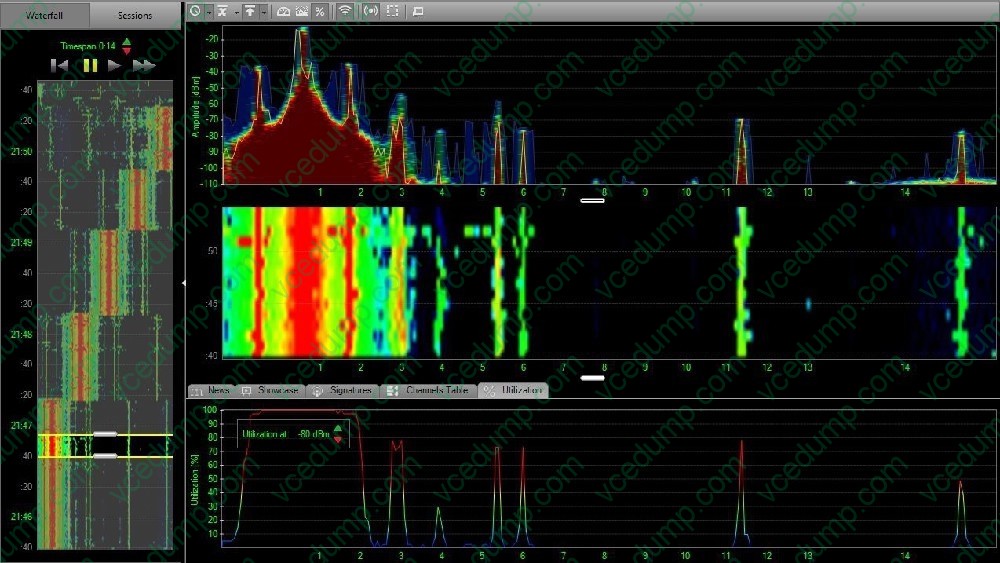
A. Military radar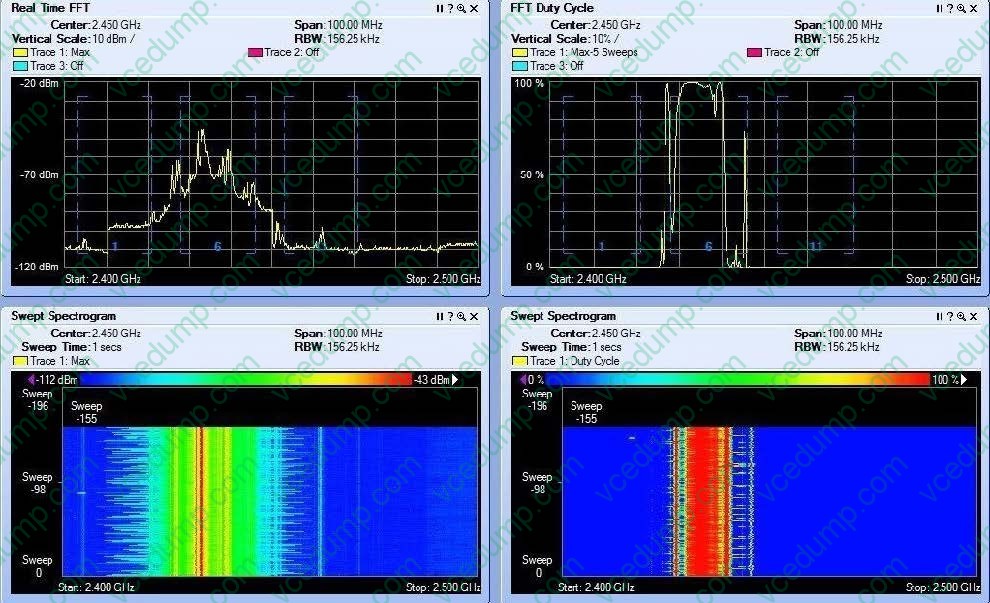
B. Bluetooth mouse
C. Microwave oven
D. Wireless video camera
E. WIPS sensor -
Question 64:
Which unit of measurement is a relative unit that is used to quantify power level changes?
A. dBm
B. dBW
C. dB
D. mW
E. VSWR -
Question 65:
Given: As a station moves away from the access point to which it is associated, it changes its data rate from 54 Mbps to 48 Mbps and then to 36 Mbps. What IEEE 802.11 term is used to describe this functionality?
A. Dynamic Rate Switching
B. Multirate Control
C. Modulation and Coding Selection
D. Rate Set Selectivity
E. Adaptive Rate Management -
Question 66:
What distinguishes an independent basic service set (IBSS) from an infrastructure basic service set (BSS)?
A. An IBSS does not have a distribution system (DS), but a BSS does.
B. An IBSS does not require beacon frames, but a BSS does.
C. An IBSS does not support 802.11 authentication or association, but a BSS does.
D. An IBSS can only operate on a single channel, but a BSS can operate on multiple channels. -
Question 67:
The IEEE 802.11-2007 standard requires ERP capable devices to be backward compatible with devices using which other 802.11 physical layer specifications (PHYs)? (Choose two)
A. DSSS
B. FHSS
C. HR/DSSS
D. ERP-PBCC
E. DSSS-OFDM -
Question 68:
Given: As defined in the 802.11 specification, legacy Power Save requires an inefficient back-and-forth frame exchange process. Due to this inefficiency, many WLAN device implementations use a variation of 802.11 Power Save to accomplish the same function.
What non-standard power save behavior is used by most Wi-Fi devices in actual implementations?
A. Client devices ignore the TIM field and automatically send PS-Poll frames after every beacon.
B. After each beacon, the AP attempts to empty its frame buffer by sending Wake-on-WLAN frames to wake each dozing client.
C. Request-to-Send and Clear-to-Send frame exchanges are used to trigger the delivery of buffered data.
D. The Beacon interval is changed from the default 100 time units to 10 or less time units.
E. Clients send null data frames to the AP and switch the power management bit from 1 to 0 to receive queued data.
F. Stations send a CTS-to-self frame to the AP with a very long duration period so they can receive all of their buffered data at once. -
Question 69:
What statement describes the authorization component of a AAA implementation?
A. Verifying that a user is who he says he is
B. Validating client device credentials against a database
C. Logging the details of user network behavior in order to review it at a later time
D. Granting access to specific network services according to a user profile
E. Implementing a WIPS as a full-time monitoring solution to enforce policies -
Question 70:
Given: When designing a WLAN infrastructure implementation for high client density at a public venue such as a conference or stadium, what are common best practices? (Choose 2)
A. Use high-gain omnidirectional antennas to improve SNR
B. Use directional antennas to isolate the RF propagation
C. Configure APs to transmit at or near their maximum power setting
D. Use WPA2-Personal security for ease of deployment
E. Disable 802.11n MCS rates to prevent high overhead protection mechanisms
F. Implement a band steering feature for dual-band clients
Related Exams:
-
CWAP-402
Certified Wireless Analysis Professional -
CWAP-403
Certified Wireless Analysis Professional -
CWAP-404
Certified Wireless Analysis Professional -
CWAP-405
Certified Wireless Analysis Professional -
CWDP-303
Certified Wireless Design Professional -
CWDP-304
Certified Wireless Design Professional -
CWDP-305
Certified Wireless Design Professional -
CWISA-102
Certified Wireless IoT Solutions Administrator -
CWISA-103
Social Media Strategist -
CWNA-106
Certified Wireless Network Administrator
Tips on How to Prepare for the Exams
Nowadays, the certification exams become more and more important and required by more and more enterprises when applying for a job. But how to prepare for the exam effectively? How to prepare for the exam in a short time with less efforts? How to get a ideal result and how to find the most reliable resources? Here on Vcedump.com, you will find all the answers. Vcedump.com provide not only CWNP exam questions, answers and explanations but also complete assistance on your exam preparation and certification application. If you are confused on your PW0-100 exam preparations and CWNP certification application, do not hesitate to visit our Vcedump.com to find your solutions here.