PDII Exam Details
-
Exam Code
:PDII -
Exam Name
:Salesforce Certified Platform Developer II (Plat-Dev-301) -
Certification
:Salesforce Certifications -
Vendor
:Salesforce -
Total Questions
:445 Q&As -
Last Updated
:Jul 30, 2026
Salesforce PDII Online Questions & Answers
-
Question 71:
The SOAP API_________.
A. Is based on REST principles and is optimized for loading or deleting large sets of data. You can use it to query, queryAII, insert, update, upsert, or delete many records asynchronously by submitting batches
B. Provides a powerful, convenient, and simple REST-based web services interface for interacting with Salesforce. Its advantages include ease of integration and development, and it's an excellent choice of technology for use with mobile applications and web projects
C. Is used to create, retrieve, update or delete records, such as accounts, leads, and custom objects, and allows you to allows you to maintain passwords, perform searches, and much more
D. Is used to retrieve, deploy, create, update, or delete customizations for your org. The most common use is to migrate changes from a sandbox or testing org to your production environment -
Question 72:
What is a valid request for the following REST method? (Choose two.)
global static void myPostMethod(String s1, Integer i1, Boolean b1, String s2)
A. <request><s1>my first string</s1><i1>123</i1><s2>my second string</s2><b1>false</b1></request>
B. <request><s1>"my first string"</s1><i1>123</i1><s2>"my second string"</s2><b1>false</b1></request>
C. {"s1": "my first string","i1": "123","b1": "false","s2": "my second string"}
D. {"i1": 123,"s1": "my first string","s2": "my second string","b1": false} -
Question 73:
What Visualforce tag can be used to display custom messages in pages using the Salesforce Ul styling for errors, warnings, and other types of messages?
A. <apex:customMessage>
B. <apex:error>
C. <apex:message>
D. <apex:pageMessage> -
Question 74:
A company represents their customers as Accounts that have an External ID field called Customer_Number__c. They have a custom Order (Order__c) object, with a Lookup to Account, to represent Orders that are placed in their external order management system (OMS). When an order is fulfilled in the OMS, a REST call to Salesforce should be made that creates an Order record in Salesforce and relates it to the proper Account.
What is the optimal way to implement this?
A. Perform a REST GET on the Account and a REST POST to update the Order__c with the Account's record ID.
B. Perform a REST PATCH to upsert the Order__c and specify the Account's Customer_Number__c in it.
C. Perform a REST GET on the Account and a REST PATCH to upsert the Order__c with the Accounts record ID.
D. Perform a REST POST to update the Order__c and specify the Account's Customer_Number__c in it. -
Question 75:
A developer is writing a Jest for a Lightning web component that conditionally displays child components based on a user's checkbox selections.
What should the developer do to property test that the correct components display and hide for each scenario?
A. Reset the DOM after each test with the afterEach() method.
B. Add a teardown block to reset the DOM after each test.
C. Create a new describe block for each test
D. Create a new j.sdom instance for each test. -
Question 76:
Which three Visualforce components can be used to initiate Ajax behavior to perform partial page updates? (Choose Three)
A. <apex:actionSupport>
B. <apex:commandLink>
C. <apex:actionStatus>
D. <apex:commandButton>
E. <apex:form> -
Question 77:
A company has the Lightning Component above that allows users to click a button to save their changes and redirects them to a different page. Currently, when the user hits the Save button the records are getting saved, but they are not redirected.
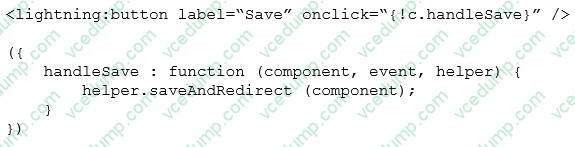
Which three techniques can a developer use to debug the JavaScript? (Choose three.)
A. Use Developer Console to view checkpoints.
B. Use Developer Console to view the debug log.
C. Use consde.log() messages in the JavaScript.
D. Enable Debug Mode for Lightning components for the user.
E. Use the browser's dev tools to debug the JavaScript. -
Question 78:
Universal Containers develops a Visualforce page that requires the inclusion of external JavaScript and CSS files. They want to ensure efficient loading and caching of the page.
Which feature should be utilized to achieve this goal?
A. Static resources
B. RemoteAction
C. PageBlockTable
D. ActionFunction -
Question 79:
In a previous data audit, It was determined that close to 5 million Opportunity records are stored within the Salesforce environment. The organization-wide default for the object are set to Public Read-Only and most opportunities are related to an external case.
The method is called from a Lightning web component. Some end users do not provide a cased value and experience low performance while running the query.
Which two techniques should the developer implement to avoid low performance queries from executing? (Choose Two)
A. Implement a LIMIT clause within the SOQL query to restrict the result set.
B. Ensure the user-provided input is not null before executing the SOQL query.
C. Implement the with sharing keyword on the Apex class.
D. Use SOSL instead of SOQL queries to perform text-based searches. -
Question 80:
A developer is building a Visualforce page that interacts with external services. Which interface should the developer implement to test this functionality? (Choose two.)
A. HTTPCalloutMock
B. HTTPRequestMock
C. HTTPResponseMock
D. StaticResourceCalloutMock
Related Exams:
-
201-COMMERCIAL-BANKING-FUNCTIONAL
Salesforce enCino 201 Commercial Banking Functional -
ADM-201
Salesforce Certified Platform Administrator (Plat-Admn-201) -
ADM-211
Administration Essentials for Experienced Admin (ADM-211) -
ADM-261
Service Cloud Administration (SU24) -
ADVANCED-ADMINISTRATOR
Salesforce Certified Advanced Administrator -
ADVANCED-CROSS-CHANNEL
Marketing Cloud Advanced Cross Channel Accredited Professional -
ADX-201
Administrative Essentials for New Admins in Lightning Experience -
ADX-271
Salesforce Certified Community Cloud Consultant (ADX-271) -
AGENTFORCE-SPECIALIST
Salesforce Certified Agentforce Specialist (AI-201) -
ALS-CON-201
Salesforce Certified Agentforce Life Sciences Consultant
Tips on How to Prepare for the Exams
Nowadays, the certification exams become more and more important and required by more and more enterprises when applying for a job. But how to prepare for the exam effectively? How to prepare for the exam in a short time with less efforts? How to get a ideal result and how to find the most reliable resources? Here on Vcedump.com, you will find all the answers. Vcedump.com provide not only Salesforce exam questions, answers and explanations but also complete assistance on your exam preparation and certification application. If you are confused on your PDII exam preparations and Salesforce certification application, do not hesitate to visit our Vcedump.com to find your solutions here.