PDII Exam Details
-
Exam Code
:PDII -
Exam Name
:Salesforce Certified Platform Developer II (Plat-Dev-301) -
Certification
:Salesforce Certifications -
Vendor
:Salesforce -
Total Questions
:445 Q&As -
Last Updated
:Jul 30, 2026
Salesforce PDII Online Questions & Answers
-
Question 421:
Universal Containers (UC) currently does not development in its full copy sandbox.
Recently, UC has projects that require multiple developers to develop concurrently. UC is running into issues with developers making changes that cause errors In work done by other developers.
Additionally, when they are ready to deploy, many unit tests fail which prevents the deployment.
Which three types of orgs should be recommended to UC to eliminate these problems? (Choose Three)
A. Data Migration org
B. Development org
C. Staging org
D. Systems Integration org
E. Continuous Integration (CI) Org -
Question 422:
A developer receives an error when trying to call a global server-side method using the @remoteAction decorator.
How can the developer resolve the error?
A. Add static to the server-side method signature.
B. Decorate the server-side method with (static=true).
C. Change the function signature to be private static.
D. Decorate the server-side method with (static=false) -
Question 423:
Which SELECT statement should be used to retrieve Task records that are between 12 and 24 months old, including archived tasks, and excluding deleted tasks?
Date initialDate = System.today().addMonths(-24);
Date endDate = System.today().addMonths(-12);
A. [SELECT IdFROM TaskWHERE What.Type = 'Account'AND IsArchived = trueAND CreatedDate >= :initialDateAND CreatedDate <= :endDate];
B. [SELECT IdFROM TaskWHERE What.Type = 'Account'AND CreatedDate >= :initialDateAND CreatedDate <= :endDateALL ROWS];
C. [SELECT IdFROM TaskWHERE What.Type = 'Account'AND IsDeleted = falseAND CreatedDate >= :initialDateAND CreatedDate <= :endDateALL ROWS];
D. [SELECT IdFROM TaskWHERE What.Type = 'Account'AND IsArchived = trueAND CreatedDate >= :initialDateAND CreatedDate <= :endDateALL ROWS]; -
Question 424:
When calling a RESTful web service, a developer receives a JSON payload that has a data hierarchy that is nested three levels deep. How can the developer describe the external data?
A. Deserialize the data untyped and then process it.
B. Declare a class with three levels and deserialize the JSON typed with this class.
C. Use the ANT migration tool, the custom metadata API, or the Dataloader.
D. Use middleware to flatten the JSON and consume it as a new custom object. -
Question 425:
Which code snippet processes records in the most memory-efficient manner, avoiding governor limits such as "Apex heap size too large"?
A. JavaMap<Id, Opportunity> opportunities = new Map<Id, Opportunity>([SELECT Id, Amount FROM Opportunity]);for (Id oppId : opportunities.keySet()) {// perform operation here}
B. Javafor (Opportunity opp : [SELECT Id, Amount FROM Opportunity]) {// perform operation here}
C. JavaList<Opportunity> opportunities = Database.query('SELECT Id, Amount FROM Opportunity');for (Opportunity opp : opportunities) {// perform operation here}
D. JavaList<Opportunity> opportunities = [SELECT Id, Amount FROM Opportunity];for (Opportunity opp : opportunities) {// perform operation here} -
Question 426:
A developer needs to add code to a Lightning web component's configuration file so the component only renders for a desktop size form factor when on a record page.
What should the developer add to the component's record page target configuration to meet this requirement?
A. <supportedFormFactors> <supportedFormFactor type="Large"/> </supportedFormFactors>
B. <lightningLayout> </lightningLayout>
C. <design> ...
D. <property name="formFactor" value="Large"> ... -
Question 427:
A developer must create a custom pagination solution for accessing approximately 2000 records and displaying 50 records on each page. Data from Salesforce will be accessed via an API and not via Apex.
How can the developer meet these requirements? (Choose two.)
A. Use a StandardSetController
B. Use CURSOR 50 in SOQL queries
C. Use OFFSET in SOQL queries
D. Use LIMIT 50 in SOQL queries -
Question 428:
Consider the following code snippet:
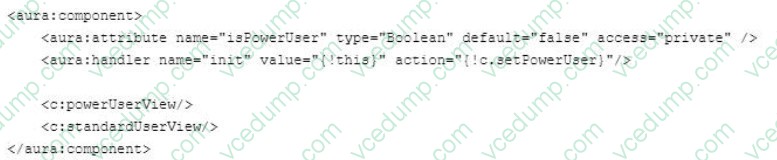
A developer needs to built an interactive Aura component that responds to the user's input by hiding or showing sections according the user preferences.
What are two best practices the developer can implement to hide or show the powerVserView and s-rar.daraVserView inner components, based on the value of the attribute isPowexUser? (Choose Two)
A. Option A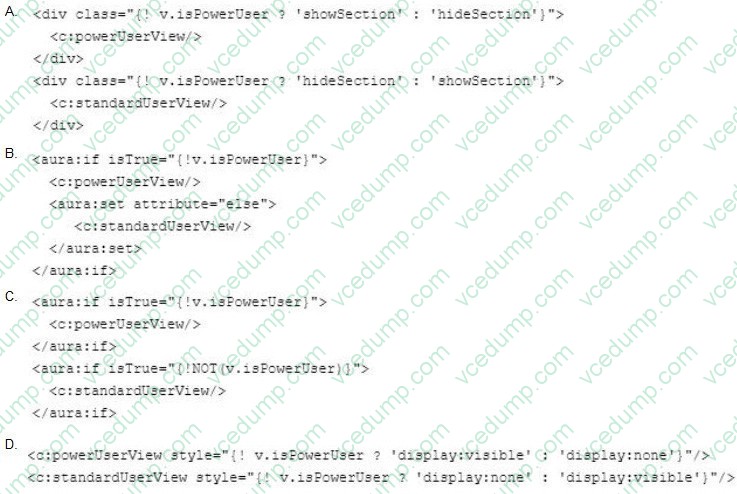
B. Option B
C. Option C
D. Option D -
Question 429:
A developer receives complaints that the component loads slowly.
Which change can the developer implement to make the component perform faster?
A. Change the default for showContacrlnfo to "false".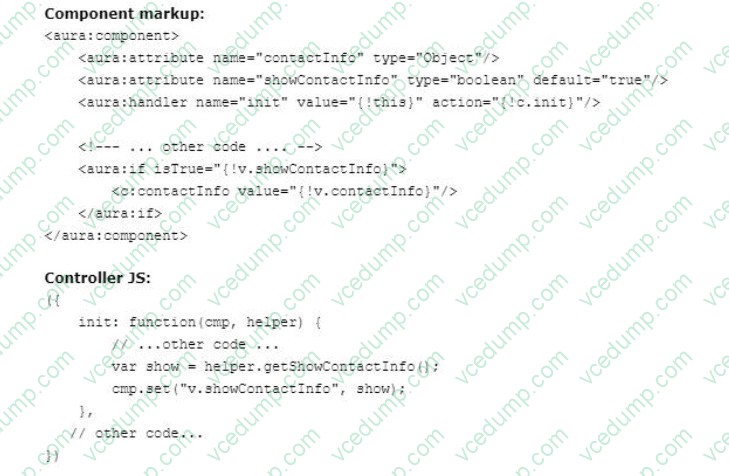
B. Move the contents of <c: concacclnfo into the component.
C. Change the type of contactlnfo to "Map".
D. Add a change event handler for showContactinfo -
Question 430:
A customer requires that when the billing address field on an Account gets updated, the address field on all its related contact records should reflect the same update.
How can this requirement be met with minimal customizations?
A. Create an After Trigger on Account to upd|ate its related contact records on update
B. Create a Workflow Rule on Account to update related child Contact records
C. Create a Lightning Process on Account to update related child Contact records
D. Create a scheduled batch job that updates all contact address fields based on the related account record.
Related Exams:
-
201-COMMERCIAL-BANKING-FUNCTIONAL
Salesforce enCino 201 Commercial Banking Functional -
ADM-201
Salesforce Certified Platform Administrator (Plat-Admn-201) -
ADM-211
Administration Essentials for Experienced Admin (ADM-211) -
ADM-261
Service Cloud Administration (SU24) -
ADVANCED-ADMINISTRATOR
Salesforce Certified Advanced Administrator -
ADVANCED-CROSS-CHANNEL
Marketing Cloud Advanced Cross Channel Accredited Professional -
ADX-201
Administrative Essentials for New Admins in Lightning Experience -
ADX-271
Salesforce Certified Community Cloud Consultant (ADX-271) -
AGENTFORCE-SPECIALIST
Salesforce Certified Agentforce Specialist (AI-201) -
ALS-CON-201
Salesforce Certified Agentforce Life Sciences Consultant
Tips on How to Prepare for the Exams
Nowadays, the certification exams become more and more important and required by more and more enterprises when applying for a job. But how to prepare for the exam effectively? How to prepare for the exam in a short time with less efforts? How to get a ideal result and how to find the most reliable resources? Here on Vcedump.com, you will find all the answers. Vcedump.com provide not only Salesforce exam questions, answers and explanations but also complete assistance on your exam preparation and certification application. If you are confused on your PDII exam preparations and Salesforce certification application, do not hesitate to visit our Vcedump.com to find your solutions here.