PDII Exam Details
-
Exam Code
:PDII -
Exam Name
:Salesforce Certified Platform Developer II (Plat-Dev-301) -
Certification
:Salesforce Certifications -
Vendor
:Salesforce -
Total Questions
:445 Q&As -
Last Updated
:Jun 19, 2026
Salesforce PDII Online Questions & Answers
-
Question 221:
What is the transaction limit for the number of records using QueryLocator?
A. 50,000
B. 50,000,000
C. 100,000
D. 5,000,000
E. There is no limit -
Question 222:
Which two objects can be inserted in the same transaction? (Choose two.)
A. Opportunity and User
B. Account and AccountShare
C. Case and CaseComment
D. Account and Group -
Question 223:
A developer wants to integrate invoice and invoice line data into Salesforce from a custom billing system. The developer decides to make real-time callouts from the billing system using the SOAP API. Unfortunately, the developer is getting a lot of errors when inserting the invoice line data because the invoice header record doesn't exist yet.
What will help ensure the transactional integrity of the integration?
A. Create the invoice header and the related invoice lines in the same create() call leveraging External Ids.
B. Develop a custom Apex web service to handle a custom JSON data structure with both invoice header and related invoice lines.
C. Use an ETL tool and the Bulk API running nightly, thus ensuring all of the data is handled at the same time.
D. Set the AIIOrNoneHeader to true when calling each of create() for invoice headers and create() for invoice lines. -
Question 224:
Choose the correct definition for <apex:pageMessage>.
A. Standard Salesforce formatting, throws a specific message on a page
B. Standard Salesforce formatting, shows all errors that occur on page. Can add more messages through the "ApexPages.addMessage" function
C. A single message, without formatting, that can be associated with a specific component on the page
D. No formatting; displays all errors on a page -
Question 225:
After a Platform Event is defined in a Salesforce org, events can be published via which two mechanisms? (Choose Two)
A. internal Apps can use Outbound Messages
B. Internal Apps can use Process Builder.
C. External Apps require a custom Apex web service.
D. External Apps can use the standard Streaming API. -
Question 226:
The head of recruiting at Universal Containers wants to provide all internal users the ability to search for open positions by role, department, and location via a new recruiting app. In addition to search, users of the app should be able to refer a friend, apply for a position, and review the status of their current submissions. The app should be made available in Salesforce Mobile, but offline access is not required.
Given these requirement, what is the recommended approach to develop the app?
A. Lightning Experience Builder
B. Salesforce SDK
C. Visualforce
D. Lightning Web Components -
Question 227:
A company accepts orders for customers in their enterprise resource planning (ERP) system that must be integrated into Salesforce as Order__c records with a lookup field to Account. The Account object has an external ID field, ERP_Customer_ID__c.
What should the integration use to create new Order__c records that will automatically be related to the correct Account?
A. Upsert on the Order__c object and specify the ERP_Customer_ID__c for the Account relationship.
B. Merge on the Order__c object and specify the ERP_Customer_ID__c for the Account relationship.
C. Insert on the Order__c object followed by an update on the Order__c object.
D. Upsert on the Account and specify the ERP_Customer_ID__c for the relationship. -
Question 228:
What is a potential design issue with the following code?
trigger AccountTrigger on Account (before update) { Boolean processOpportunity = false;
List<Opportunity> opptysClosedLost = new List<Opportunity>();
List<Opportunity> lstAllOpp = [ SELECT StageName FROM Opportunity WHERE AccountId IN :Trigger.newMap.keySet() ];
if (!lstAllOpp.isEmpty()) { processOpportunity = true;
}
while (processOpportunity) {
for (Opportunity o : lstAllOpp) {
if (o.StageName == 'Closed - Lost') { opptysClosedLost.add(o);
}
} processOpportunity = false;
if (!opptysClosedLost.isEmpty()) { delete opptysClosedLost;
}
}
}
A. SOQL could be avoided by creating a formula field for StageName in Account from the related Opportunity
B. The code will result in a System.LimitException: Too many script statements error
C. The code will result in a System.DmlException: Entity is deleted error
D. The code will result in a System.LimitException: Apex CPU time limit exceeded error -
Question 229:
A lead developer for a Salesforce organization needs to develop a page-centric application that allows the user to interact with multiple objects related to a Contact.
The application needs to implement a third-party JavaScript framework such as Angular, and must be made available in both Classic and Lightning Experience.
Given these requirements, what is the recommended solution to develop the application?
A. Aura Components
B. Lightning Web Components
C. Visualforce
D. Lightning Experience Builder -
Question 230:
Consider the code above.
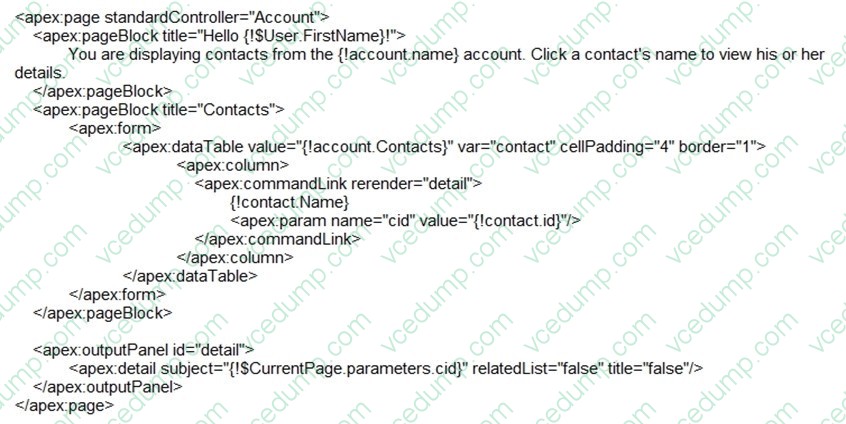
When a user clicks on the Link of a Contact's name, what happens?
A. The outputPanel refreshes, showing the Contacts details.
B. A new page opens, showing the Contact's details.
C. The page refreshes, showing the Contact's details.
D. Nothing happens: the commandLink is missing an action attribute.
Related Exams:
-
201-COMMERCIAL-BANKING-FUNCTIONAL
Salesforce enCino 201 Commercial Banking Functional -
ADM-201
Salesforce Certified Platform Administrator (Plat-Admn-201) -
ADM-211
Administration Essentials for Experienced Admin (ADM-211) -
ADM-261
Service Cloud Administration (SU24) -
ADVANCED-ADMINISTRATOR
Salesforce Certified Advanced Administrator -
ADVANCED-CROSS-CHANNEL
Marketing Cloud Advanced Cross Channel Accredited Professional -
ADX-201
Administrative Essentials for New Admins in Lightning Experience -
ADX-271
Salesforce Certified Community Cloud Consultant (ADX-271) -
AGENTFORCE-SPECIALIST
Salesforce Certified Agentforce Specialist (AI-201) -
ALS-CON-201
Salesforce Certified Agentforce Life Sciences Consultant
Tips on How to Prepare for the Exams
Nowadays, the certification exams become more and more important and required by more and more enterprises when applying for a job. But how to prepare for the exam effectively? How to prepare for the exam in a short time with less efforts? How to get a ideal result and how to find the most reliable resources? Here on Vcedump.com, you will find all the answers. Vcedump.com provide not only Salesforce exam questions, answers and explanations but also complete assistance on your exam preparation and certification application. If you are confused on your PDII exam preparations and Salesforce certification application, do not hesitate to visit our Vcedump.com to find your solutions here.