PDII Exam Details
-
Exam Code
:PDII -
Exam Name
:Salesforce Certified Platform Developer II (Plat-Dev-301) -
Certification
:Salesforce Certifications -
Vendor
:Salesforce -
Total Questions
:445 Q&As -
Last Updated
:Jul 30, 2026
Salesforce PDII Online Questions & Answers
-
Question 101:
The Contact object in an org is configured with workflow rules that trigger field updates. The fields are not updating, even though the end user expects them to. The developer creates a debug log to troubleshoot the problem.
What should the developer specify in the debug log to see the values of the workflow rule conditions and debug the problem?
A. INFO level for the Database log category
B. ERROR level for the Workflow log category
C. ERROR level for the Database log category
D. INFO level for the Workflow log category -
Question 102:
A company recently deployed a Visualforce page with a custom controller that has a data grid of information about Opportunities in the org. Users report that they receive a "Maximum view state size limit" error message under certain conditions.
According to Visualforce best practice, which three actions should the developer take to reduce the view state? (Choose three.)
A. Use the transient keyword in the Apex controller for variables that do not maintain state
B. Use the final keyword in the controller for variables that will not change
C. Use the private keyword in the controller for variables
D. Refine any SOQL queries to return only data relevant to the page
E. Use filters and pagination to reduce the amount of data -
Question 103:
The test method above calls an @future method that increments the Number_of_Times_Viewed__c value. The assertion is failing because the Number_of_Times_Viewed__c equals 0. What is the optimal way to fix this?
@isTest
static void testIncrement() {
Account acct = new Account(Name = 'Test', Number_Of_Times_Viewed__c = 0);
insert acct;
AuditUtil.incrementViewed(acct.Id); // This is the @future method
Account acctAfter = [SELECT Number_Of_Times_Viewed__c FROM Account WHERE Id = :acct.Id][0];
System.assertEquals(1, acctAfter.Number_Of_Times_Viewed__c);
}
A. Change the initialization to acct.Number_Of_Times_Viewed__c = 1.
B. Change the assertion to System.assertEquals(0, acctAfter.Number_Of_Times_Viewed__c).
C. Add Test.startTest() before and Test.stopTest() after AuditUtil.incrementViewed.
D. Add Test.startTest() before and Test.stopTest() after insert acct -
Question 104:
Universal Containers needs to integrate with their own, existing, internal custom web application. The web application accepts JSON payloads, resizes product images, and sends the resized images back to Salesforce.
What should the developer use to implement this integration?
A. A workflow rule with an outbound message that contains a session ID
B. An Apex trigger that calls an @future method that allows callouts
C. A platform event that makes a callout to the web application
D. A flow that calls an @future method that allows callouts -
Question 105:
A developer is creating a page in App Builder that will be used in the Salesforce mobile app.
Which two practices should the developer follow to ensure the page operates with optimal performance? (Choose Two)
A. Limit five visible components on the page.
B. Limit 25 fields on the record detail page.
C. Limit the number of Tabs and Accordion components.
D. Analyze the page with Performance Analysis for App Builder. -
Question 106:
An Aura component has a section that displays some information about an Account and it works well on the desktop, but users have to scroll horizontally to see the description field output on their mobile devices and tablets.
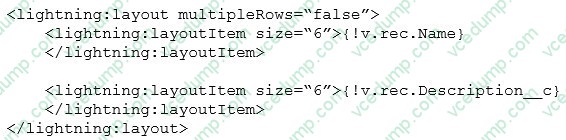
Which option has the changes to make the component responsive for mobile and tablet devices?
A. Option A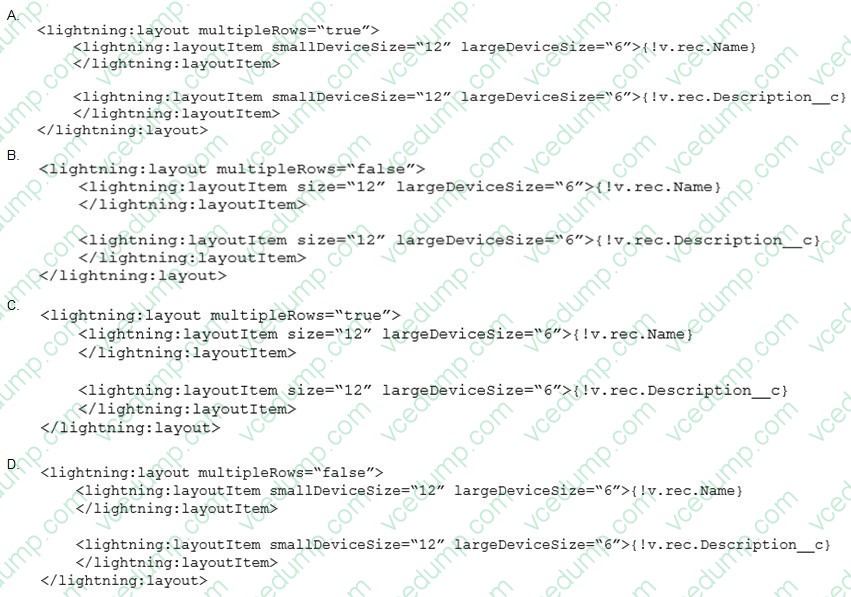
B. Option B
C. Option C
D. Option D -
Question 107:
A developer is creating unit tests for code that makes SOAP web service callouts. The developer needs to insert some test data as a part of the unit tests setup.
What are three actions to enable this functionality? (Choose three.)
A. Surround the callout with TeststartTest(), Test.stopTest()
B. Surround the data insertion with Test.startTest(), Test.stopTest()
C. Implement the WebServiceMock interface
D. Update code to call Test.setMock()
E. Implement the HttpCalloutMock interface -
Question 108:
Consider the following code snippet:
HTML
<apex:page docType="html-5.0" controller="FindOpportunities">
<apex:form >
<apex:pageBlock >
<apex:pageBlockSection title="find opportunity">
<apex:input label="opportunity name"/>
<apex:commandButton value="search" action="{!search}"/> </
apex:pageBlockSection>
<apex:pageBlockSection title="Opportunity List" id="opportunityList">
</apex:pageBlockSection>
</apex:pageBlock>
</apex:form>
</apex:page>
Users of this Visualforce page complain that the page does a full refresh every time the Search button is pressed.
What should the developer do to ensure that a partial refresh is made so that only the section identified with opportunity List is re-drawn on the screen?
A. Ensure the lotion method search returns null.
B. Implement the rerendered attribute on the <apex:commandButton>tag.
C. Enclose the DATA table within the <apex:actionRegion> tag.
D. Implement the <apex:actionFunction> tag with immediate = true. -
Question 109:
Which statement is true regarding both Flow and Lightning Process? (Choose two.)
A. Can use Apex methods with the @InvocableMethod annotation
B. Are both server-side considerations in the Order of Execution
C. Can use Apex that implements the Process.Plugin interface
D. Are able to be embedded directly into Visualforce pages -
Question 110:
For compliance purposes, a company is required to track long-term product usage in their org. The information that they need to log will be collected from more than one object and, over time, they predict they will have hundreds of millions of records.
What should a developer use to implement this?
A. Field Audit Trail
B. Setup Audit Trail
C. Field History Tracking
D. Big objects
Related Exams:
-
201-COMMERCIAL-BANKING-FUNCTIONAL
Salesforce enCino 201 Commercial Banking Functional -
ADM-201
Salesforce Certified Platform Administrator (Plat-Admn-201) -
ADM-211
Administration Essentials for Experienced Admin (ADM-211) -
ADM-261
Service Cloud Administration (SU24) -
ADVANCED-ADMINISTRATOR
Salesforce Certified Advanced Administrator -
ADVANCED-CROSS-CHANNEL
Marketing Cloud Advanced Cross Channel Accredited Professional -
ADX-201
Administrative Essentials for New Admins in Lightning Experience -
ADX-271
Salesforce Certified Community Cloud Consultant (ADX-271) -
AGENTFORCE-SPECIALIST
Salesforce Certified Agentforce Specialist (AI-201) -
ALS-CON-201
Salesforce Certified Agentforce Life Sciences Consultant
Tips on How to Prepare for the Exams
Nowadays, the certification exams become more and more important and required by more and more enterprises when applying for a job. But how to prepare for the exam effectively? How to prepare for the exam in a short time with less efforts? How to get a ideal result and how to find the most reliable resources? Here on Vcedump.com, you will find all the answers. Vcedump.com provide not only Salesforce exam questions, answers and explanations but also complete assistance on your exam preparation and certification application. If you are confused on your PDII exam preparations and Salesforce certification application, do not hesitate to visit our Vcedump.com to find your solutions here.