PDI Exam Details
-
Exam Code
:PDI -
Exam Name
:Salesforce Certification for Platform Developer I (Plat-Dev-201) -
Certification
:Salesforce Certifications -
Vendor
:Salesforce -
Total Questions
:270 Q&As -
Last Updated
:Jul 13, 2026
Salesforce PDI Online Questions & Answers
-
Question 201:
What is a considerations for running a flow in debug mode?
A. When debugging a schedule-triggered flow, the flow starts only for one record.
B. Clicking Pause allows an element to be replaced in the flow.
C. DML operations will be rolled back when the debugging ends.
D. Callouts to external are not when debugging a flow. -
Question 202:
A developer wants to improve runtime performance of Apex calls by caching result on the client.
What is the most efficient way to implement this and follow best practices?
A. Decorate the server-side method with @AuraEnabled (total-true).
B. Call the setStoeable () method on the action in the javaScript client-sidecode.
C. Decorate the server-side method with @AuraEnabled (cacheable-true.
D. Set a ciikie in the browser for use upon return to the page. -
Question 203:
Which two scenarios require an Apex method to be called imperatively from a Lightning web component? Choose 2 answer
A. Calling a method that makes a web service callout
B. Calling a method that is not annotated with cacheable-true
C. Calling a method with the click of a button
D. Calling a method that is external to the main controller for the Lightning web component -
Question 204:
If Apex code executes inside the execute() method of an Apex class when implementing the Batchable interface, which two statements are true regarding governor limits? Choose 2 answers
A. The Apex governor limits are reset for each iteration of the execute () method.
B. The Apex governor limits cannot be exceeded due to the asynchronaus nature of the transaction.
C. The Apex governor limits will use the asynchronous limit levels.
D. The Apex governor limits are omitted while calling the constructor of the Apex class. -
Question 205:
A developer wrote the following two classes:
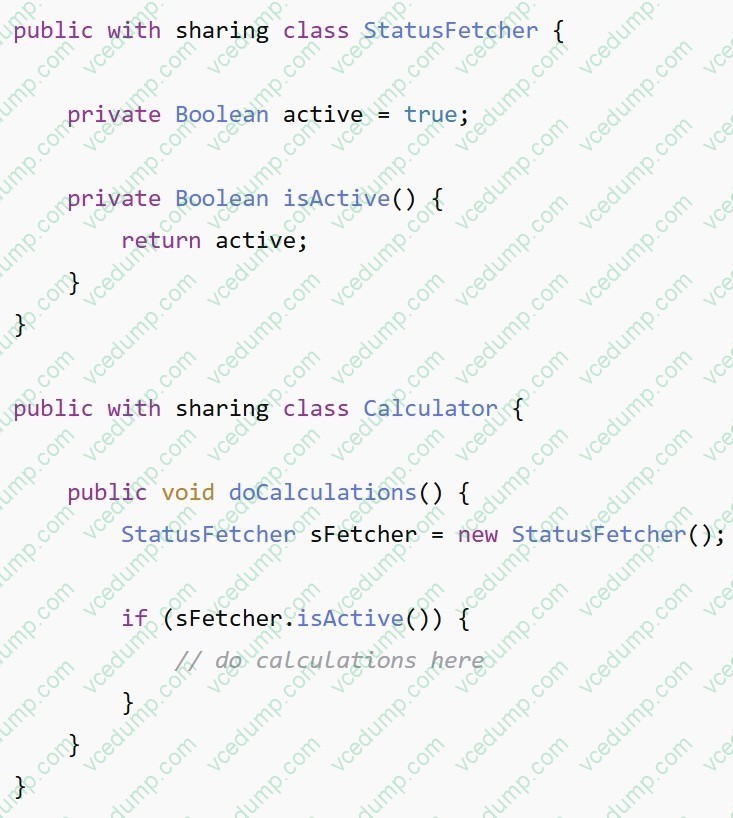
The StatusFetcher class successfully compiled and saved. However, the Calculator class has a compile time error.
How should the developer fix this code?
A. Change the class declaration for the statusFetcher class to public with inherited sharing.
B. Make the is Active method in the StatusFetcher class public.
C. Make the doCalculations method in the Calculation class private.
D. Change the class declaration for the Calculator class to public with inherited sharing. -
Question 206:
Developers at Universal Containers (UC) use version control to share their code changes, but they notice that when they deploy their code to different environments they often have failures. They decide to set up Continuous Integration (CI).
What should the UC development team use to automatically run tests as part of their CI process?
A. Salesforce CLI
B. Visual Studio Code
C. Force.com Toolkit
D. Developer Console -
Question 207:
A developer is alerted to an issue with a custom Apex trigger that is causing records to be duplicated.
What is the most appropriate debugging approach to troubleshoot the issue?
A. Review the Historical Event logs to identify the source of the issue.
B. Add system.debug statements to the code to track the execution flow and identify the issue.
C. Use the Apex Interactive Debugger to step through the code and identify the issue.
D. Disable the trigger in production and test to see if the issue still occurs. -
Question 208:
A developer wants to prevent recursive trigger execution within a single transaction.
What is the best practice?
A. Disable the trigger temporarily
B. Use a static Boolean variable
C. Use a custom metadata type
D. Use an after trigger only -
Question 209:
Universal Containers has created a unique process for tracking container repairs. A custom field, status_c, has been created within the container_c custom object. A developer is tasked with sending notifications to multiple external systems every time the value of the status_picklist changes.
Which two tools should the developer use to meet the business requirement and ensure low maintenance of the solution? Choose 2 answers
A. Record-Triggered flow
B. Apex trigger
C. Apex callouts
D. Platform event -
Question 210:
Refer to the following Apex code:
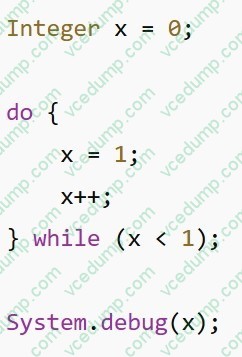
What is the value of ?when it is written to the debug log?
B. 1
C. 2
D. 3
Related Exams:
-
201-COMMERCIAL-BANKING-FUNCTIONAL
Salesforce enCino 201 Commercial Banking Functional -
ADM-201
Salesforce Certified Platform Administrator (Plat-Admn-201) -
ADM-211
Administration Essentials for Experienced Admin (ADM-211) -
ADM-261
Service Cloud Administration (SU24) -
ADVANCED-ADMINISTRATOR
Salesforce Certified Advanced Administrator -
ADVANCED-CROSS-CHANNEL
Marketing Cloud Advanced Cross Channel Accredited Professional -
ADX-201
Administrative Essentials for New Admins in Lightning Experience -
ADX-271
Salesforce Certified Community Cloud Consultant (ADX-271) -
AGENTFORCE-SPECIALIST
Salesforce Certified Agentforce Specialist (AI-201) -
ALS-CON-201
Salesforce Certified Agentforce Life Sciences Consultant
Tips on How to Prepare for the Exams
Nowadays, the certification exams become more and more important and required by more and more enterprises when applying for a job. But how to prepare for the exam effectively? How to prepare for the exam in a short time with less efforts? How to get a ideal result and how to find the most reliable resources? Here on Vcedump.com, you will find all the answers. Vcedump.com provide not only Salesforce exam questions, answers and explanations but also complete assistance on your exam preparation and certification application. If you are confused on your PDI exam preparations and Salesforce certification application, do not hesitate to visit our Vcedump.com to find your solutions here.