PCNSA Exam Details
-
Exam Code
:PCNSA -
Exam Name
:Palo Alto Networks Certified Network Security Administrator (PCNSA) -
Certification
:Palo Alto Networks Certifications -
Vendor
:Palo Alto Networks -
Total Questions
:443 Q&As -
Last Updated
:Mar 24, 2026
Palo Alto Networks PCNSA Online Questions & Answers
-
Question 391:
All users from the internal zone must be allowed only HTTP access to a server in the DMZ zone.
Complete the empty field in the Security policy using an application object to permit only this type of access. Source Zone: Internal Destination Zone: DMZ Zone Application: __________ Service: application-default Action: allow
A. Application = "any"
B. Application = "web-browsing"
C. Application = "ssl"
D. Application = "http" -
Question 392:
The PowerBall Lottery has reached a high payout amount and a company has decided to help employee morale by allowing employees to check the number, but doesn't want to unblock the gambling URL category. Which two methods will allow the employees to get to the PowerBall Lottery site without the company unlocking the gambling URL category? (Choose two.)
A. Add all the URLs from the gambling category except powerball.com to the block list and then set the action for the gambling category to allow.
B. Manually remove powerball.com from the gambling URL category.
C. Add *.powerball.com to the allow list
D. Create a custom URL category called PowerBall and add *.powerball.com to the category and set the action to allow. -
Question 393:
Which list of actions properly defines the order of steps needed to add a local database user account and create a new group to which this user will be assigned?
A. 1. Navigate to Device > Local User Database > Users and click Add. 2. Enter a Name for the user. 3. Enter and Confirm a Password or Hash. 4. Enable the account and click OK. 5. Navigate to Device > Local User Database > User Groups and click Add. 6. Enter a Name for the group. 7. Add the user to the group and click OK.
B. 1. Navigate to Device > Authentication Profile > Users and click Add. 2. Enter a Name for the user. 3. Enter and Confirm a Password or Hash. 4. Enable the account and click OK. 5. Navigate to Device > Local User Database > User Groups and click Add. 6. Enter a Name for the group. 7. Add the user to the group and click OK.
C. 1. Navigate to Device > Users and click Add. 2. Enter a Name for the user. 3. Enter and Confirm a Password or Hash. 4. Enable the account and click OK. 5. Navigate to Device > User Groups and click Add. 6. Enter a Name for the group. 7. Add the user to the group and click OK.
D. 1. Navigate to Device > Admins and click Add. 2. Enter a Name for the user. 3. Enter and Confirm a Password or Hash. 4. Enable the account and click OK. 5. Navigate to Device > User Groups and click Add. 6. Enter a Name for the group. 7. Add the user to the group and click OK. -
Question 394:
Which three configuration settings are required on a Palo Alto networks firewall management interface?
A. default gateway
B. netmask
C. IP address
D. hostname
E. auto-negotiation -
Question 395:
Which three management interface settings must be configured for functional dynamic updates and administrative access on a Palo Alto Networks firewall? (Choose three.)
A. NTP
B. IP address
C. MTU
D. DNS server
E. service routes -
Question 396:
Which firewall plane provides configuration, logging, and reporting functions on a separate processor?
A. control
B. network processing
C. data
D. security processing -
Question 397:
What must be configured for the firewall to access multiple authentication profiles for external services to authenticate a non-local account?
A. authentication sequence
B. LDAP server profile
C. authentication server list
D. authentication list profile -
Question 398:
Given the scenario, which two statements are correct regarding multiple static default routes when they are configured as shown in the image? (Choose two.)
A. Path monitoring does not determine if route is useable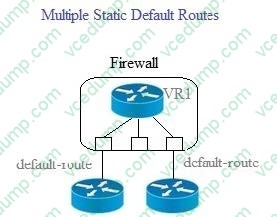
B. Route with highest metric is actively used
C. Path monitoring determines if route is useable
D. Route with lowest metric is actively used -
Question 399:
What are the two types of Administrator accounts? (Choose two.)
A. Role Based
B. Superuser
C. Dynamic
D. Local -
Question 400:
Which security profile should be used to classify malicious web content?
A. URL Filtering
B. Web Content
C. Antivirus
D. Vulnerability Protection
Related Exams:
-
PAN-CSP
Palo Alto Networks Cloud Security Professional -
PAN-NGFE
Palo Alto Networks Network Next-Generation Firewall Engineer -
PAN-NSA
Palo Alto Networks Network Security Analyst -
PAN-NSG
Palo Alto Networks Network Security Professional -
PAN-NSP
Palo Alto Networks Network Security Professional -
PAN-SDWE
Palo Alto Networks SD-WAN Engineer -
PAN-SOP
Palo Alto Networks Security Operations Professional -
PAN-SSEE
Palo Alto Networks Security Service Edge Engineer -
PAN-XDRA
Palo Alto Networks XDR Analyst -
PAN-XDRE
Palo Alto Networks XDR Engineer
Tips on How to Prepare for the Exams
Nowadays, the certification exams become more and more important and required by more and more enterprises when applying for a job. But how to prepare for the exam effectively? How to prepare for the exam in a short time with less efforts? How to get a ideal result and how to find the most reliable resources? Here on Vcedump.com, you will find all the answers. Vcedump.com provide not only Palo Alto Networks exam questions, answers and explanations but also complete assistance on your exam preparation and certification application. If you are confused on your PCNSA exam preparations and Palo Alto Networks certification application, do not hesitate to visit our Vcedump.com to find your solutions here.