P_SAPEA_2023 Exam Details
-
Exam Code
:P_SAPEA_2023 -
Exam Name
:SAP Certified Professional - SAP Enterprise Architect -
Certification
:SAP Certifications -
Vendor
:SAP -
Total Questions
:48 Q&As -
Last Updated
:Jul 07, 2026
SAP P_SAPEA_2023 Online Questions & Answers
-
Question 1:
DRAG DROP
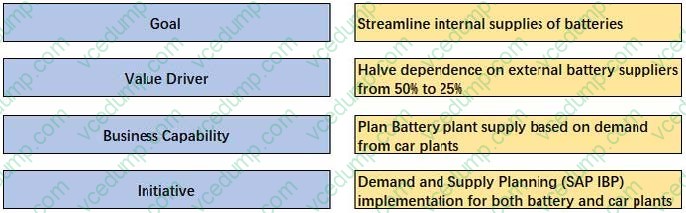
You, as the Chief Enterprise Architect of Wanderlust GmbH, have been trying to formulate the Business Strategy Map. You are currently working on the strategic objective to "Increase supply reliability of Lithium batteries". Arrange the elements of the Business Strategy Map into the right order that shows the dependencies between these elements.
Select and Place:
-
Question 2:
Why would you recommend building SAP Side-by-Side Extensions to an S/4HANA system based on SAP BTP?
A. Extensions on SAP BTP technology can easily make use of S/4HANA eventing.
B. Extensions on SAP BTP can maintain SAP user and security context and allow the use of S/4HANA eventing.
C. Extensions should be built on SAP BTP because SAP BTP is the only option for building a consistent user experience based on SAP Fiori UX styles. -
Question 3:
What are important factors of the SAP BTP, Cloud Foundry environment during runtime that you need to consider?
A. Programming language and buildpacks
B. CPU capacity and memory size of the application
C. Number of users and API calls -
Question 4:
When creating an application architecture roadmap, the WHAT and WHERE are defined in a rather straightforward way, while the WHOM may differ by context. Multiple roadmap clusters may apply a variety of WHOM dimensions. For example, procurement vs. asset management.
Which of the following definitions are correct? Note: There are 3 correct answers to this question.
A. Asset Classes / Vehicles, Production Machines, Office Equipment
B. Material Groups / Products, Raw Materials, Spare Parts / Direct Materials, Indirect Materials
C. Groups of Persons / Permanent Staff, Contracted Staff, Students / Business Expense / Operational Expenditure / Capital Expenditure
D. Working Model / Home Office, Headquarter, Affiliate -
Question 5:
In the SAP Enterprise Architecture Framework, which of the following artifacts are part of the Opportunities and Solution phase? Note: There are 3 correct answers to this question.
A. Business Architecture Roadmap
B. Work Breakdown Structure
C. Implementation Roadmap
D. Application Architecture Roadmap
E. Migration Plan -
Question 6:
Demand and Supply Planning (SAP IBP) implementation has been identified as a quick win, based on feedback from a large cross-section of Wanderlust stakeholders. As the Chief Enterprise Architect, you have now been asked to scope and contextualize the architecture project. Architecture principles have already been adopted. Which of the following activities should you initiate to conclude the Statement of Architecture Work for the intended SAP IBP implementation initiative?
Note: There are 3 correct answers to this question.
A. Conduct a Fit Gap Assessment to identify requirements that cannot be met.
B. Define the Solution Context for the architecture work.
C. Conduct a high-level Capability Assessment to identify areas of improvement (business and IT).
D. Conduct a technical Proof of Concept to understand features and functionalities of SAP IBP.
E. Outline the aspirational Solution Concept to address the stakeholders' needs and business requirements. -
Question 7:
As an Enterprise Architect, you must ensure that future extensions to the Digital Core of the enterprise guarantee stable and reliable operations. The architecture guideline demands following the clean-core strategy.
What does this demand ensure and entail?
A. Extensions do not break an upgrade, and upgrades do not break an extension. Such extensions can access SAP business objects only through well-defined, upgrade-stable interfaces.
B. Extensions may access SAP tables directly and in a well-documented, clean way. Therefore, the code of extensions can be adapted quickly to accommodate future changes.
C. Extensions are kept strictly separate from the SAP application. Extensions are developed in accordance with the SAP Application Extension Methodology. Side-by-side extensibility options are always preferable to on-stack extensibility options. -
Question 8:
As a result of solution mapping, business capabilities might require services which partners have implemented in SAP BTP.
Which SAP components and services, if any, are required to integrate such BTP partner services with an on-premise SAP S/4HANA system (hybrid scenario)?
A. SAP HANA Cloud Connection, and the corresponding SAP Data Provisioning Agent, to make the on-premises system available to applications and services in a given SAP BTP subaccount. Preferably use the SAP BTP Destination Service.
B. No other components are required to make an SAP on-premise backend system securely accessible over SAP BTP. SAP BTP automatically establishes secure connections in SAP backend systems.
C. SAP Cloud Connector to make the on-premises system available to applications and services in a given SAP BTP subaccount. Preferably use the SAP BTP Destination Service in combination with Cloud Connector. -
Question 9:
What kind of applications can you develop with SAP Business Application Studio?
A. SAPUI5 (SAP Fiori) applications and ABAP applications
B. ABAP applications
C. SAPUI5 (SAP Fiori) applications -
Question 10:
As part of the mapping of a Business Architecture to the Solution Architecture, an Environment and Location Diagram must be developed in the Technology Architecture phase. In this context, numerous architecture decisions have to be made. Among other things, you must check which SAP BTP services and which SAP SaaS solutions are available as part of the Solution Architecture in which data center of the desired hyperscaler.
How do you go about this validation?
A. I use the SAP Business Accelerator Hub (api.sap.com) because it provides all the required information regarding SAP BTP services and SAP SaaS solution availability for each hyperscaler, in a central location.
B. I use the SAP Discovery Center to check which of the selected SAP BTP services are offered by which hyperscaler. With help from the SAP Trust Center, I check in which data center the involved SAP SaaS solutions are available.
C. I use the SAP Discovery Center to check in which data centers the respective SAP BTP services and the SAP SaaS solutions are available.

Related Exams:
-
C_ABAPD_2507
SAP Certified Associate - Back-End Developer - ABAP Cloud -
C_ACDET_2506
SAP Certified Associate - Configuring SAP Ariba Strategic Sourcing Suite -
C_ACT_2403
SAP Certified Associate - Project Manager - SAP Activate -
C_ACTIVATE05
SAP Certified Associate - SAP Activate Project Manager -
C_ACTIVATE12
SAP Certified Associate - SAP Activate Project Manager -
C_ACTIVATE13
SAP Certified Associate - SAP Activate Project Manager -
C_ACTIVATE22
SAP Certified Associate - SAP Activate Project Manager -
C_ADBTP_2601
Administrating SAP Business Technology Platform(C_ADBTP_2601) -
C_AIG_2412
SAP Certified Associate - SAP Generative AI Developer -
C_ARCIG_2404
SAP Certified Associate - Implementation Consultant - Managed Gateway for Spend Management and SAP Business Network
Tips on How to Prepare for the Exams
Nowadays, the certification exams become more and more important and required by more and more enterprises when applying for a job. But how to prepare for the exam effectively? How to prepare for the exam in a short time with less efforts? How to get a ideal result and how to find the most reliable resources? Here on Vcedump.com, you will find all the answers. Vcedump.com provide not only SAP exam questions, answers and explanations but also complete assistance on your exam preparation and certification application. If you are confused on your P_SAPEA_2023 exam preparations and SAP certification application, do not hesitate to visit our Vcedump.com to find your solutions here.