OGEA-10B Exam Details
-
Exam Code
:OGEA-10B -
Exam Name
:TOGAF Enterprise Architecture Bridge -
Certification
:The Open Group Certifications -
Vendor
:The Open Group -
Total Questions
:122 Q&As -
Last Updated
:May 26, 2026
The Open Group OGEA-10B Online Questions & Answers
-
Question 71:
Consider the image showing basic architectural concepts.
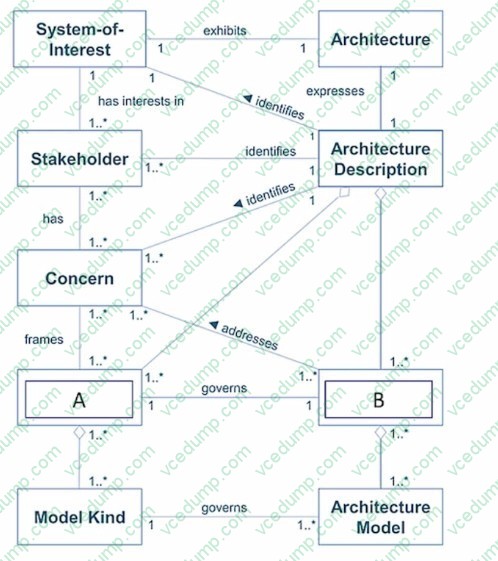
What are items A and B?
A. A-Architecture Viewpoint, B-Architecture View
B. A-Architecture Board, B-Architecture Capability
C. A-Candidate Architecture, B-Trade-off
D. A-Requirement. B-Candidate Architecture -
Question 72:
Please read this scenario prior to answering the question
You are working as Chief Enterprise Architect at a large Internet company. The company has many divisions, ranging from cloud to logistics. The company has grown rapidly, expanding from initially selling physical books and media to a range of services including an online marketplace, live-streaming. eBooks. and cloud services.
Overall management of the numerous divisions has become challenging. Recent high- profile projects have overrun on budget and under delivered, damaging the company's reputation, and adversely impacting its share price. There is a widely held view within the executive management that the organization structure has played a major role in these project failures. The company has an established Enterprise Architecture program based on the TOGAF standard, sponsored jointly by the Chief Executive Officer (CEO) and Chief Information Officer (CIO). The CEO has decided that the company needs to reorganize its divisions around artificial intelligence and machine learning with a focus on automation. The CEO has worked with the Enterprise Architects to create a strategic architecture for the reorganization, including an Architecture Vision, together with definitions for the four domain architectures. This sets out an ambitious vision of the future of the company over a three-year period. This includes a set of work packages and includes three distinct transformations.
The CIO has made it clear that prior to the approval of the detailed Implementation and Migration plan, the EAteam will need to assess the risks associated with the proposed architecture. He has received concerns from key stakeholders across the company that the proposed reorganization may be too ambitious and there is doubt whether it can produce sufficient value to warrant the risks.
Refer to the scenario
You have been asked to recommend an approach to satisfy these concerns. Based on the TOGAF Standard, which of the following is the best answer?
A. The Enterprise Architects should evaluate the organization's readiness to undergo change. This will allow the risks associated with the transformations to be identified, classified, and mitigated for. This should include identifying dependencies between the set of changes, including gaps and work packages. It will also identify improvement actions to be worked into the Implementation and Migration Plan. The business value, effort, and risk associated for each transformation should be determined.
B. The Enterprise Architects should bring together information about potential approaches and produce several alternative target transition architectures. They should then investigate the different architecture alternatives and discuss these with stakeholders using the Architecture Alternatives and Trade-offs technique. Once the target architecture has been selected, it should be analyzed using a state evolution table to determine the Transition Architectures. A value realization process should then be established to ensure that the concerns raised are addressed.
C. Establishing interoperability in alignment with the corporate operating model will ensure risks are minimized. The Enterprise Architects should apply an interoperability analysis to evaluate any potential issues across the architecture. This should include the development of a matrix showing the interoperability requirements. These can then be included within the transformation strategy embedded in the target transition architectures. The Enterprise Architects should then finalize the Architecture Roadmap and the Implementation and Migration Plan.
D. Before preparing the detailed Implementation and Migration plan, the Enterprise Architects should review and consolidate the gap analysis results from Phases B to This will identify the transformations required to achieve the proposed Target Architecture. The Enterprise Architects should then assess the readiness of the organization to undergo change and determine an overall direction to address and mitigate risks identified. The Transition Architecture should then be planned to use a state evolution table. -
Question 73:
What component of the Architecture Repository represents architecture requirements agreed with the Architecture Board?
A. Reference Library
B. Architecture Capability
C. Architecture Requirements Repository
D. Governance Log -
Question 74:
Please read this scenario prior to answering the question
Your role is that of a consultant to the Lead Enterprise Architect to an international supplier of engineering services and automated manufacturing systems. It has three manufacturing plants where it assembles both standard and customized products for industrial production automation. Each of these plants has been operating its own planning and production scheduling systems, as well as applications and control systems that drive the automated production line.
The Enterprise Architecture department has been operating for several years and has mature, well-developed architecture governance and development processes that are based on the TOGAF Standard. The CIO sponsors the Enterprise Architecture.
During a recent management meeting, a senior Vice-President highlighted an interview where a competitor company's CIO is reported as saying that their production efficiency had been improved by replacing multiple planning and scheduling systems with a common Enterprise
Resource Planning (ERP) system located in a central data center. Some discussion followed, with the CIO responding that the situations are not comparable, and the current architecture is already optimized.
In response, the Architecture Board approved a Request for Architecture Work covering the investigations to determine if such an architecture transformation would lead to improvements in efficiency. You have been assigned to support the architecture team working on this project.
A well-known concern of the plant managers is about the security and reliability of driving their planning and production scheduling from a remote centralized system. Any chosen system would also need to support the current supply chain network consisting of local partners at each of the plants.
Refer to the scenario
You have been asked to explain how you will initiate the architecture project.
Based on the TOGAF Standard, which of the following is the best answer?
A. You would research vendor literature and conduct a series of briefings with vendors that are on the current approved supplier list. Based on the findings from the research, you would define a preliminary Architecture Vision including summary views, high-level requirements, and high-level definitions of the baseline and target environments from a business, information systems, and technology perspective. You would then use that to build consensus among the key stakeholders.
B. You would conduct a pilot project that will enable vendors to demonstrate potential off-the-shelf solutions that address the concerns of the stakeholders. Running a pilot project will save time and money later in the process. Based on the findings of that pilot project, a complete set of requirements can then be developed that will drive the evolution of the architecture. Once the requirements are completed, a formal stakeholder review should be held, and permission sought to proceed to develop the target architecture.
C. You would hold a series of interviews at each of the manufacturing plants using the business scenarios technique. This will allow you to understand the systems and integrations with local partners. You would use stakeholder analysis to identify key players in the engagement, and to understand their concerns. You will then identify and document the key high-level stakeholder requirements for the architecture. You will then generate high level definitions of the baseline and target architectures.
D. You would develop baseline and target Architectures for each of the manufacturing plants, ensuring that the views corresponding to selected viewpoints address key concerns of the stakeholders. A business case, together with performance metrics and measures should be defined to ensure the architecture meets the business needs. A consolidated gap analysis between the architectures will then validate the approach and determine the capability increments needed to achieve the target state. -
Question 75:
Please read this scenario prior to answering the question
You are the Chief Enterprise Architect at a large food service company specializing in sales to trade and wholesale, for example, restaurants and other food retailers.
One of your company's competitors has launched a revolutionary product range and is running a very aggressive marketing campaign. Your company's resellers are successively announcing that they are not interested in your company's products and will sell your competitor's.
The CEO has stated there must be significant change to address the situation. He has made it clear that new markets must be found for the company's products, and that the business needs to pivot, and address the retail market as well as the existing wholesale market.
A consideration is the company's ability and willingness to change its business model, and if it is a temporary or permanent change. An additional risk factor is one of culture. The company has been used to a stable business with a reasonably well known and settled client base - all with its own local understandings and practices.
The CEO is the sponsor of the EA program within the company. You have been engaged with the sales, logistics, production, and marketing teams, enabling the architecture activity to start. An Architecture Vision, Architecture Principles, and Requirements have all been agreed. As you move forward to develop a possible Target Architecture you have identified that some of the key stakeholders' preferences are incompatible. The incompatibilities are focused primarily on time-tomarket, cost savings, and the need to bring out a fully featured product range, but there are additional factors.
Refer to the scenario
You have been asked how you will address the incompatibilities between key stakeholder preferences.
Based on the TOGAF standard which of the following is the best answer?
A. You would seek to understand value preferences and priorities of the stakeholders. You would develop alternative Target Architectures, highlighting the gaps between current state and the alternatives. You would consider combining features from one or more alternatives in collaboration with the stakeholders. A formal stakeholder review should then be held to decide which alternative is fit for purpose and should be moved forward with. You will then secure the funding required.
B. You recommend that since the CEO has stated that the company must pivot, it is better to compromise on a full product range rather than time-to-market. You would develop just enough of the Target Architecture to demonstrate fitness of the proposed approach. You would limit the descriptionto just where there is a gap between the current baseline. You would seek approval by the stakeholders to move forward with developing the Target Architecture in detail.
C. You would use the Architecture Vision, Principles, and Requirements to define a set of criteria for alternatives and create a set of architecture views to illustrate the impact of the alternative Target Architectures. You would identify the impact on planned projects. You would understand the strengths and weaknesses of the alternatives. You would conduct a formal stakeholder review to decide which alternative to move forward with. You will determine the funding required.
D. You would review the Stakeholder Map and ensure that you have addressed and represented the concerns of all department heads. You will involve them in resolving the incompatibilities. The Communications Plan should include a report that summarizes the key features of the architecture with and how incompatibilities were resolved to reflects the stakeholders' requirements. You will check with each key stakeholder they are satisfied with how the incompatibilities have been resolved. -
Question 76:
Which TOGAF concept describes a formal agreement between development partners to ensure deliverables meet agreed standards?
A. Architecture Requirements Specification
B. Architecture Vision
C. Architecture Contract
D. Request for Architecture Work -
Question 77:
Which of the following best describes the purpose of the Architecture Roadmap?
A. It provides for effective communication of the end architecture project to the stakeholders
B. It is sent from the sponsor and triggers the start of an architecture development cycle
C. It forms the basis of a contractual agreement between the sponsor and the architecture organization
D. It lists work packages on a timeline showing progress towards the Target Architecture -
Question 78:
Which section of the TOGAF template for Architecture Principles should describe the relationship to other principles?
A. Name
B. Rationale
C. Statement
D. Implications -
Question 79:
What is defined as the effect of uncertainty on objectives?
A. Vulnerability
B. Risk
C. Continuity
D. Threat -
Question 80:
Complete the sentence Business Transformation Readiness Assessment is_________________.
A. a joint effort between corporate staff lines of business and IT planners
B. to ensure the active support of powerful stakeholders
C. a way to put building blocks into context thereby supporting re-usable solutions
D. widely used to validate an architecture that is being developed
Related Exams:
-
OG0-021
ArchiMate 2 Part 1 -
OG0-023
ArchiMate 2 Combined Part 1 and Part 2 -
OG0-061
IT4IT Part 1 -
OG0-091
TOGAF 9 Part 1 -
OG0-092
TOGAF 9 Part 2 -
OG0-093
TOGAF 9 Combined Part 1 and Part 2 -
OGA-031
ArchiMate 3 Part 1 -
OGA-032
ArchiMate 3 Part 2 -
OGB-001
TOGAF Business Architecture Part 1 -
OGBA-101
TOGAF Business Architecture Foundation
Tips on How to Prepare for the Exams
Nowadays, the certification exams become more and more important and required by more and more enterprises when applying for a job. But how to prepare for the exam effectively? How to prepare for the exam in a short time with less efforts? How to get a ideal result and how to find the most reliable resources? Here on Vcedump.com, you will find all the answers. Vcedump.com provide not only The Open Group exam questions, answers and explanations but also complete assistance on your exam preparation and certification application. If you are confused on your OGEA-10B exam preparations and The Open Group certification application, do not hesitate to visit our Vcedump.com to find your solutions here.