NSE7_SDW-7.0 Exam Details
-
Exam Code
:NSE7_SDW-7.0 -
Exam Name
:Fortinet NSE 7 - SD-WAN 7.0 -
Certification
:Fortinet Certifications -
Vendor
:Fortinet -
Total Questions
:115 Q&As -
Last Updated
:Oct 02, 2025
Fortinet NSE7_SDW-7.0 Online Questions & Answers
-
Question 1:
In which two ways does FortiGate learn the FortiManager IP address or FQDN for zero-touch provisioning? (Choose two.)
A. From a FortiGuard definitions update
B. From the central management configuration configured in FortiDeploy
C. From a DHCP server configured with options 240 or 241
D. From another FortiGate device in the same local network -
Question 2:
Which two statements reflect the benefits of implementing the ADVPN solution to replace conventional VPN topologies? (Choose two )
A. It creates redundant tunnels between hub-and-spokes, in case failure takes place on the primary links.
B. It dynamically assigns cost and weight between the hub and the spokes, based on the physical distance.
C. It ensures that spoke-to-spoke traffic no longer needs to flow through the tunnels through the hub.
D. It provides direct connectivity between all sites by creating on-demand tunnels between spokes. -
Question 3:
Refer to the exhibit.
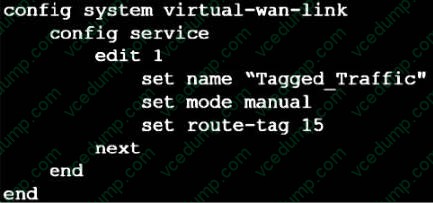
Which statement about the command route-tag in the SD-WAN rule is true?
A. It enables the SD-WAN rule to load balance and assign traffic with a route tag
B. It tags each route and references the tag in the routing table.
C. It uses route tags for a BGP community and assigns the SD-WAN rules with same tag.
D. It ensures route tags match the SD-WAN rule based on the rule order -
Question 4:
Refer to exhibits.
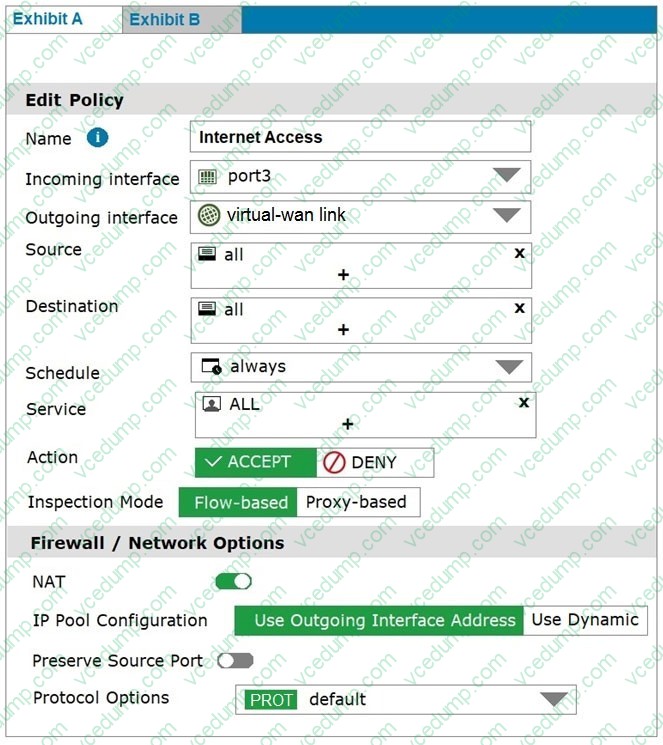
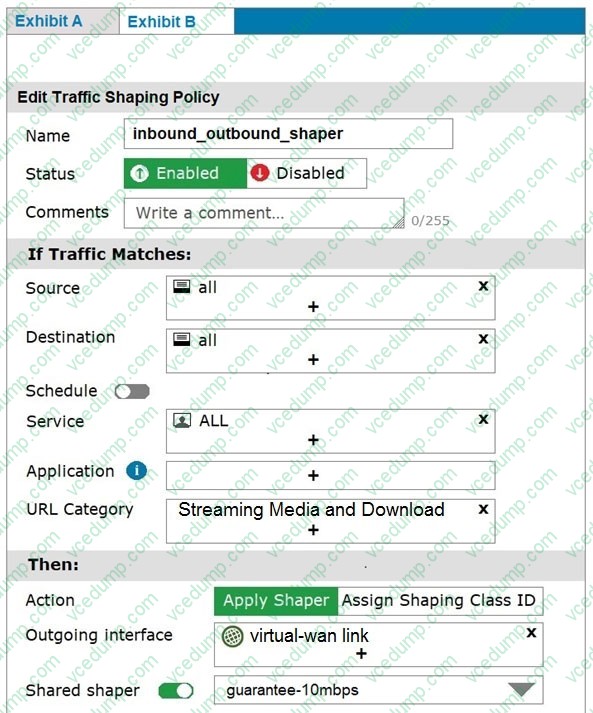
Exhibit A shows the firewall policy and exhibit B shows the traffic shaping policy.
The traffic shaping policy is being applied to all outbound traffic; however, inbound traffic is not being evaluated by the shaping policy.
Based on the exhibits, what configuration change must be made in which policy so that traffic shaping can be applied to inbound traffic?
A. Create a new firewall policy, and the select the SD-WAN zone as Incoming Interface.
B. In the traffic shaping policy, select Assign Shaping Class ID as Action.
C. In the firewall policy, select Proxy-based as Inspection Mode.
D. In the traffic shaping policy, enable Reverse shaper, and then select the traffic shaper to use. -
Question 5:
Refer to the exhibit.
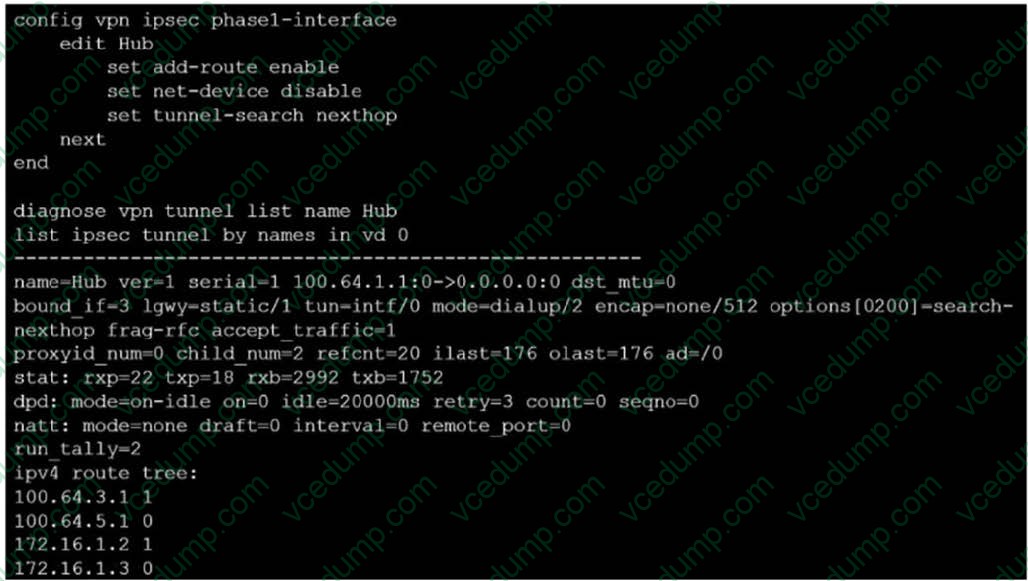
Which two statements about the IPsec VPN configuration and the status of the IPsec VPN tunnel are true? (Choose two.)
A. FortiGate creates separate virtual interfaces for each dial-up client.
B. FortiGate creates a single IPsec virtual interface that is shared by all clients.
C. FortiGate maps the remote gateway 100.64.3.1 to tunnel index interface 1.
D. FortiGate does not install IPsec static routes for remote protected networks in the routing table. -
Question 6:
Refer to the exhibit.
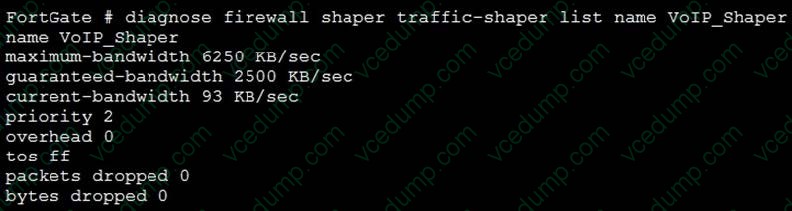
Which two conclusions for traffic that matches the traffic shaper are true? (Choose two.)
A. The traffic shaper drops packets if the bandwidth exceeds 6250 KBps.
B. The traffic shaper limits the bandwidth of each source IP to a maximum of 6250 KBps.
C. The traffic shaper drops packets if the bandwidth is less than 2500 KBps.
D. The measured bandwidth is less than 100 KBps. -
Question 7:
Refer to the exhibit.
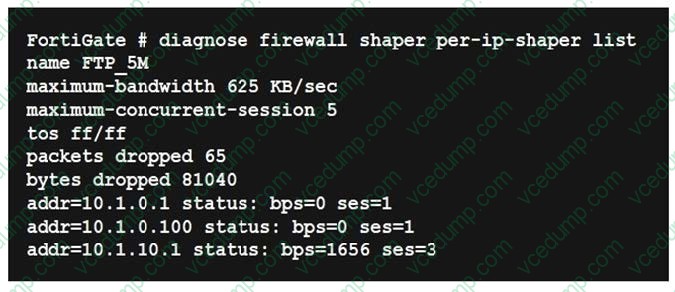
Which two statements about the debug output are correct? (Choose two )
A. The debug output shows per-IP shaper values and real-time readings.
B. This traffic shaper drops traffic that exceeds the set limits.
C. Traffic being controlled by the traffic shaper is under 1 Kbps.
D. FortiGate provides statistics and reading based on historical traffic logs. -
Question 8:
Refer to the exhibit.

Which conclusion about the packet debug flow output is correct?
A. The number of concurrent sessions for 10.1.10.1 exceeded the maximum number of concurrent sessions configured in the traffic shaper, and the packet was dropped.
B. The number of concurrent sessions for 10.1.10.1 exceeded the maximum number of concurrent sessions configured in the firewall policy, and the packet was dropped.
C. The packet size exceeded the outgoing interface MTU.
D. The total number of daily sessions for 10.1.10.1 exceeded the maximum number of concurrent sessions configured in the traffic shaper, and the packet was dropped. -
Question 9:
Which three protocols are available only on the command line to configure as performance SLA status check? (Choose three.)
A. smtp
B. tcp-echo
C. twamp
D. udp-echo
E. icmp -
Question 10:
Which are three key routing principles in SD-WAN? (Choose three.)
A. FortiGate performs route lookups for new sessions only.
B. Regular policy routes have precedence over SD-WAN rules.
C. SD-WAN rules have precedence over ISDB routes.
D. By default, SD-WAN members are skipped if they do not have a valid route to the destination.
E. By default, SD-WAN rules are skipped if the best route to the destination is not an SD- WAN member.
Related Exams:
-
EMEA-ADVANCED-SUPPORT
Fortinet EMEA Advanced Support -
FCP_FAC_AD-6.5
FCP - FortiAuthenticator 6.5 Administrator -
FCP_FAZ_AD-7.4
FCP - FortiAnalyzer 7.4 Administrator -
FCP_FAZ_AN-7.4
FCP - FortiAnalyzer 7.4 Analyst -
FCP_FAZ_AN-7.6
Fortinet NSE 5 - FortiAnalyzer 7.6 Analyst -
FCP_FCT_AD-7.2
FCP - Forti Client EMS 7.2 Administrator -
FCP_FCT_AD-7.4
Fortinet NSE 6 - FortiClient EMS 7.4 Administrator -
FCP_FGT_AD-7.4
FCP - FortiGate 7.4 Administrator -
FCP_FGT_AD-7.6
FortiGate 7.6 Administrator FCP_FGT_AD-7.6 -
FCP_FMG_AD-7.4
FCP - FortiManager 7.4 Administrator
Tips on How to Prepare for the Exams
Nowadays, the certification exams become more and more important and required by more and more enterprises when applying for a job. But how to prepare for the exam effectively? How to prepare for the exam in a short time with less efforts? How to get a ideal result and how to find the most reliable resources? Here on Vcedump.com, you will find all the answers. Vcedump.com provide not only Fortinet exam questions, answers and explanations but also complete assistance on your exam preparation and certification application. If you are confused on your NSE7_SDW-7.0 exam preparations and Fortinet certification application, do not hesitate to visit our Vcedump.com to find your solutions here.