NSE5_SSE_AD-7.6 Exam Details
-
Exam Code
:NSE5_SSE_AD-7.6 -
Exam Name
:Fortinet NSE 5 - FortiSASE and SD-WAN 7.6 Core Administrator -
Certification
:Fortinet Certifications -
Vendor
:Fortinet -
Total Questions
:43 Q&As -
Last Updated
:Jul 07, 2026
Fortinet NSE5_SSE_AD-7.6 Online Questions & Answers
-
Question 1:
DRAG DROP
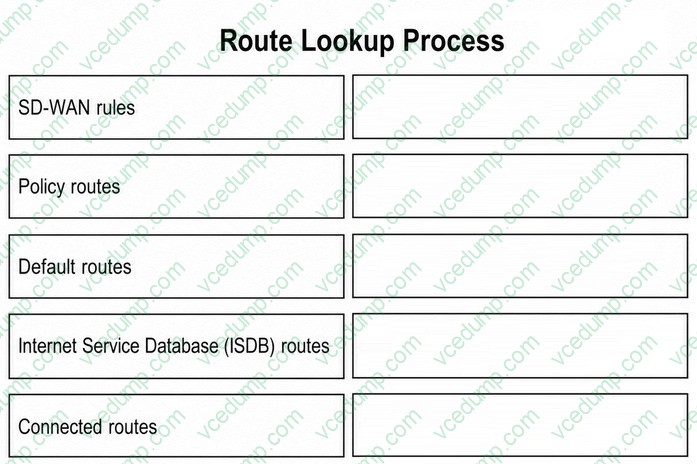
In which order does a FortiGate device consider the following elements shown in the left column during the route lookup process?
Select the element in the left column, hold and drag it to a blank position in the column on the right. Place the four correct elements in order, placing the first element in the first position at the top of the column.
Once you place an element, you can move it again if you want to change your answer before moving to the next question. You need to drop four elements in the work area.
Select and drag the screen divider to change the viewable area of the source and work areas.
Select and Place:
-
Question 2:
How does the FortiSASE security dashboard facilitate vulnerability management for FortiClient endpoints? (Choose one answer)
A. It automatically patches all vulnerabilities without user intervention and does not categorize vulnerabilities by severity.
B. It shows vulnerabilities only for applications and requires endpoint users to manually check for affected endpoints.
C. It displays only critical vulnerabilities, requires manual patching for all endpoints, and does not allow viewing of affected endpoints.
D. It provides a vulnerability summary, identifies affected endpoints, and supports automatic patching for eligible vulnerabilities. -
Question 3:
Which statement about security posture tags in FortiSASE is correct?
A. Multiple tags can be assigned to an endpoint, but only one is used for evaluation.
B. Multiple tags can be assigned to an endpoint and used for evaluation.
C. Tags are static and do not change with endpoint status.
D. Only one tag can be assigned to an endpoint. -
Question 4:
A company needs FortiSASE Secure Internet Access for contractors on unmanaged devices and cannot install FortiClient. The requirement is to secure web browsing only.
Which deployment behavior matches FortiSASE SIA agentless proxy mode?
A. A PAC file configures the browser to use the FortiSASE proxy as an explicit web proxy for HTTP and HTTPS traffic.
B. FortiClient creates an IPsec tunnel that forwards all endpoint traffic to FortiSASE.
C. A static route on the contractor device sends every protocol through a FortiGate SD-WAN zone.
D. ZTNA tags from FortiClient are required before any web traffic can be proxied. -
Question 5:
Refer to the exhibit.
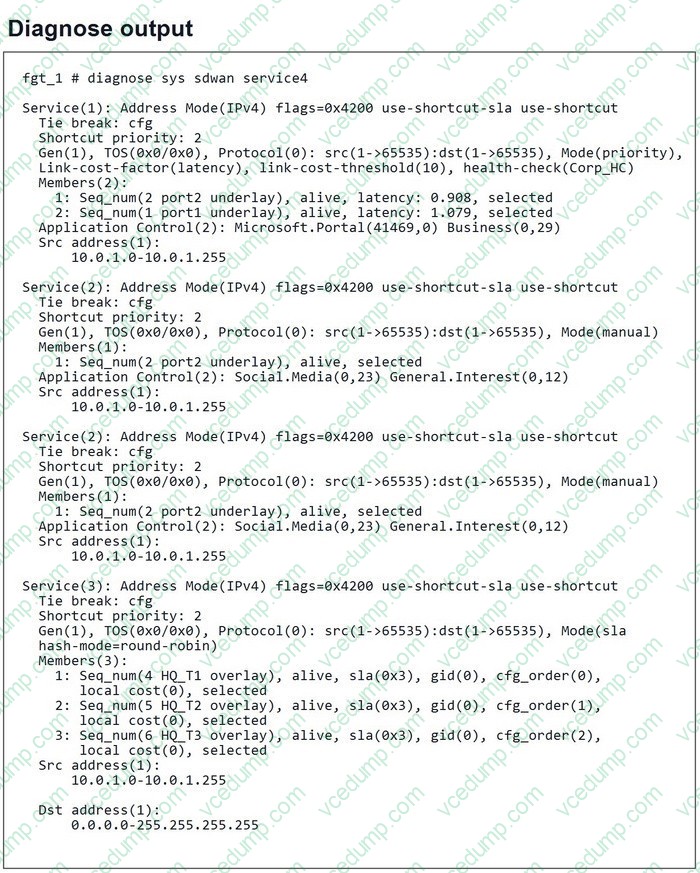
The exhibit shows output of the command diagnose sys sdwan service collected on a FortiGate device.
The administrator wants to know through which interface FortiGate will steer traffic from local users on subnet 10.0.1.0/255.255.255.192 and with a destination of the social media application Facebook.
Based on the exhibits, which two statements are correct? (Choose two.)
A. FortiGate steers traffic for social media applications according to the service rule 2 and steers traffic through port2.
B. There is no service defined for the Facebook application, so FortiGate applies service rule 3 and directs the traffic to headquarters.
C. When FortiGate cannot recognize the application of the flow, it load balances the traffic through the tunnels HQ_T1, HQ_T2, HQ_T3.
D. When FortiGate cannot recognize the application of the flow, it steers the traffic through the preferred member of rule 3, HQ_T1. -
Question 6:
Refer to the exhibit, which shows the SD-WAN rule status and configuration.
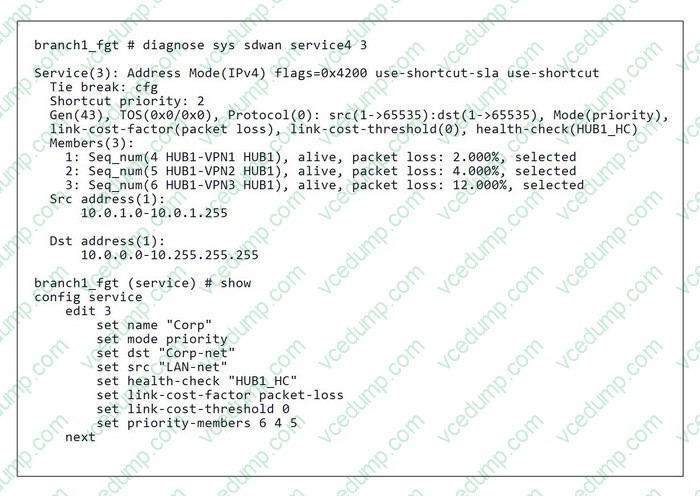
Based on the exhibit, which change in the measured packet loss will make HUB1-VPN3 the new preferred member? (Choose one answer)
A. When all three members have the same packet loss
B. When HUB1-VPN1 has 4% packet loss
C. When HUB1-VPN1 has 12% packet loss
D. When HUB1-VPN3 has 4% packet loss -
Question 7:
Which configuration is a valid use case for FortiSASE features in supporting remote users?
A. Enabling secure SaaS access through SD-WAN integration, protecting against web-based threats with data loss prevention, and monitoring user connectivity with shadow IT visibility.
B. Monitoring SaaS application performance, isolating browser sessions for all websites, and integrating with SD-WAN for data loss prevention.
C. Enabling secure web browsing to protect against threats, providing explicit application access with zero-trust or SD-WAN integration, and addressing shadow IT visibility with data loss prevention.
D. Providing secure web browsing through remote browser isolation, addressing shadow IT with zero-trust access, and protecting data at rest only. -
Question 8:
Refer to the exhibit.
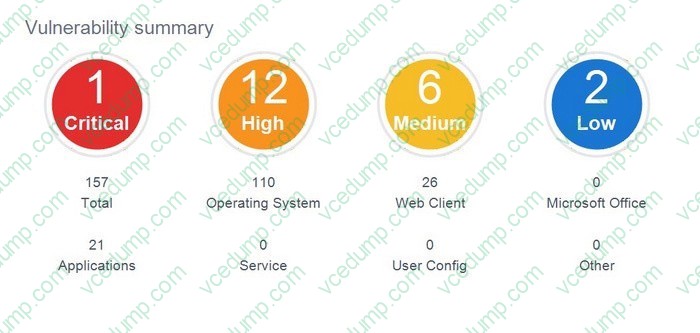
Which two statements about the Vulnerability summary dashboard in FortiSASE are correct? (Choose two.)
A. The dashboard shows the vulnerability score for unknown applications.
B. Vulnerability scan is disabled in the endpoint profile.
C. The dashboard allows the administrator to drill down and view CVE data and severity classifications.
D. Automatic vulnerability patching can be enabled for supported applications. -
Question 9:
An SD-WAN rule uses the Lowest Cost (SLA) strategy. Two member links satisfy the measured SLA, but one member has a lower configured cost value.
What is the expected forwarding behavior?
A. FortiGate selects the link with the lower configured cost.
B. FortiGate ignores the cost field and always selects the first configured member.
C. FortiGate load balances equally across all links that satisfy the SLA.
D. FortiGate disables the rule until all members have identical cost values. -
Question 10:
Refer to the exhibit.
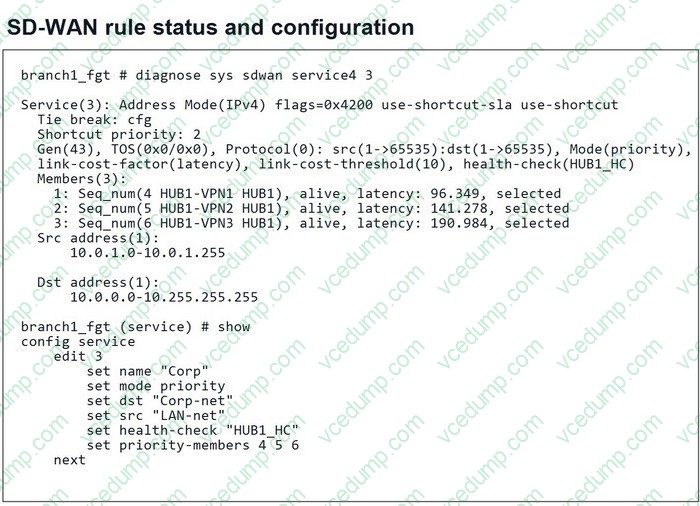
The SD-WAN rule status and configuration is shown.
Based on the exhibit, which change in the measured latency will first make HUB1-VPN3 the new preferred member?
A. When HUB1-VPN3 has a latency of 80 ms
B. When HUB1-VPN3 has a lower latency than HUB1-VPN1 and HUB1-VPN2
C. When HUB1-VPN1 has a latency of 200 ms
D. When HUB1-VPN3 has a latency of 90 ms
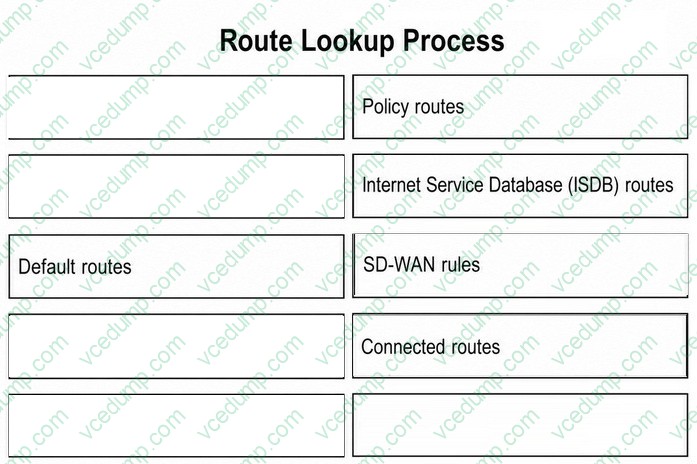
Related Exams:
-
EMEA-ADVANCED-SUPPORT
Fortinet EMEA Advanced Support -
FCP_FAC_AD-6.5
FCP - FortiAuthenticator 6.5 Administrator -
FCP_FAZ_AD-7.4
FCP - FortiAnalyzer 7.4 Administrator -
FCP_FAZ_AN-7.4
FCP - FortiAnalyzer 7.4 Analyst -
FCP_FAZ_AN-7.6
Fortinet NSE 5 - FortiAnalyzer 7.6 Analyst -
FCP_FCT_AD-7.2
FCP - Forti Client EMS 7.2 Administrator -
FCP_FCT_AD-7.4
Fortinet NSE 6 - FortiClient EMS 7.4 Administrator -
FCP_FGT_AD-7.4
FCP - FortiGate 7.4 Administrator -
FCP_FGT_AD-7.6
FortiGate 7.6 Administrator FCP_FGT_AD-7.6 -
FCP_FMG_AD-7.4
FCP - FortiManager 7.4 Administrator
Tips on How to Prepare for the Exams
Nowadays, the certification exams become more and more important and required by more and more enterprises when applying for a job. But how to prepare for the exam effectively? How to prepare for the exam in a short time with less efforts? How to get a ideal result and how to find the most reliable resources? Here on Vcedump.com, you will find all the answers. Vcedump.com provide not only Fortinet exam questions, answers and explanations but also complete assistance on your exam preparation and certification application. If you are confused on your NSE5_SSE_AD-7.6 exam preparations and Fortinet certification application, do not hesitate to visit our Vcedump.com to find your solutions here.