NS0-158 Exam Details
-
Exam Code
:NS0-158 -
Exam Name
:NetApp Certified Data Administrator, ONTAP -
Certification
:NetApp Certifications -
Vendor
:NetApp -
Total Questions
:60 Q&As -
Last Updated
:
NetApp NS0-158 Online Questions & Answers
-
Question 1:
Click the Exhibit button.
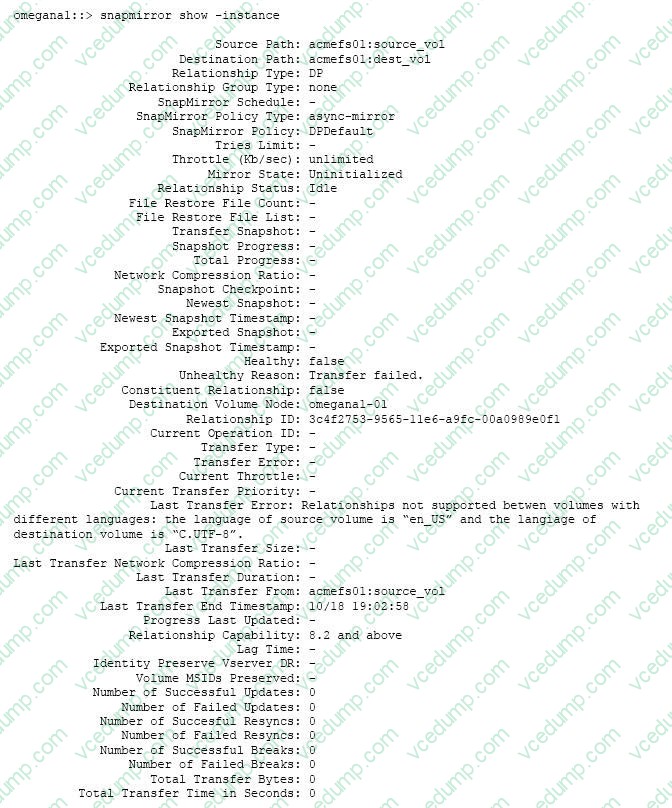
You create a new SnapMirror relationship, but is fails to initialize. The SnapMirror relationship is configured as shown in the exhibit. How would you solve this problem?
A. Re-create the destination volume as C.UTF-8.
B. Re-create the destination volume as en_US.
C. Change the language on the source volume to en_US.
D. Change the language on the destination volume to C.UTF-8. -
Question 2:
A customer has a 1,000 GB volume used as a NAS share that has 3x 100 GB files and has no existing Snapshot copies. The customer creates a Snapshot copy of the volume, adds a 500 Gb file to the volume, and then deletes one of the 100 GB files from the volume.
How much free space is in the volume in this scenario?
A. 500 GB
B. 200 GB
C. 300 GB
D. 600 GB -
Question 3:
You have a cluster of FAS controllers with HDD aggregates. The data is being compressed into 32 KB blocks before being written to a volume. In this scenario, which type of compression is being used?
A. secondary, inline compression
B. adaptive, inline compression
C. adaptive, postprocess compression
D. secondary, postprocess compression -
Question 4:
A storage administrator wants to recover a file from a snapshot. The rest of the data in this volume should be preserved. In this scenario, which command would you use?
A. volume snapshot compute-reclaimable
B. volume snapshot restore
C. volume snapshot rename
D. volume snapshot restore-file -
Question 5:
Click the Exhibit button.
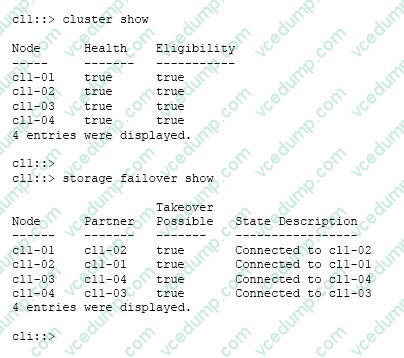
An administrator has a 4-node FAS8200 cluster, as shown in the exhibit. A failover process is initiated to reboot node cl1-02. Regarding storage failover giveback processes, which statement is true?
A. During giveback, node cl1-01 simultaneously returns ownership of both root and data aggregates to cl1-02.
B. During giveback, node cl1-01 returns ownership of all aggregates to cl1-02, before reverting the data LIFs back to the home ports.
C. During giveback, node cl1-01 returns ownership of the root aggregate to cl1-02 before returning ownership of the data aggregates.
D. During giveback, node cl1-01 moves ownership of the root aggregate to cl1-04 and ownership of the data aggregates to cl1-04. -
Question 6:
Click the Exhibit button.
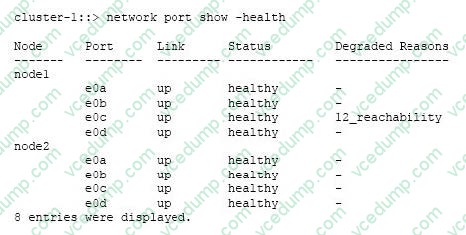
While reviewing the port health shown in the exhibit, you notice that port e0c on node1 is degraded. What would cause this problem?
A. The port is not plugged into a switch.
B. The port is in the wrong broadcast domain.
C. The port does not have an IP address.
D. The port has been flapping. -
Question 7:
Click the exhibit button.
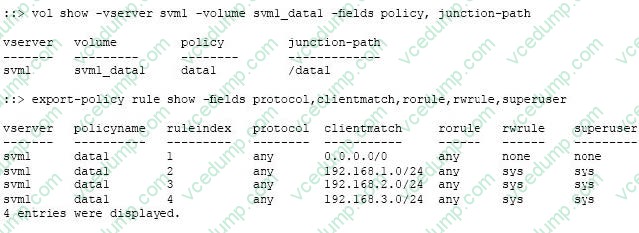
In reference to the NFS export-policy rules shown in the exhibit, NFS clients mounted to /data1 from the 192.168.1.0/24, 192.168.2.0/24 and 192.168.3.0/24 subnets are able to mount /data1 and read files but are unable to edit files or write new files. All other subnets require read-only access to /data1.
What must you do to allow write access to the three subnets while allowing read-only access to all other subnets in this scenario?
A. Set the index of ruleindex 2 to ruleindex 4.
B. Set the index of ruleindex 1 to ruleindex 4.
C. Set the index of ruleindex 3 to ruleindex 4.
D. Set the index of ruleindex 4 to ruleindex 1. -
Question 8:
What are three volume-level storage efficiency features of ONTAP? (Choose three.)
A. deswizzle
B. space reclamation
C. compaction
D. compression
E. deduplication -
Question 9:
An administrator is designing an ONTAP solution that consists of eight FAS8200 nodes in a single cluster. Each node will use four ports for cluster connections. Which cluster interconnect switch model should be used in this scenario?
A. Nexus 5596UP
B. Nexus 5010
C. CN1610
D. CN1601 -
Question 10:
Click the Exhibit button.
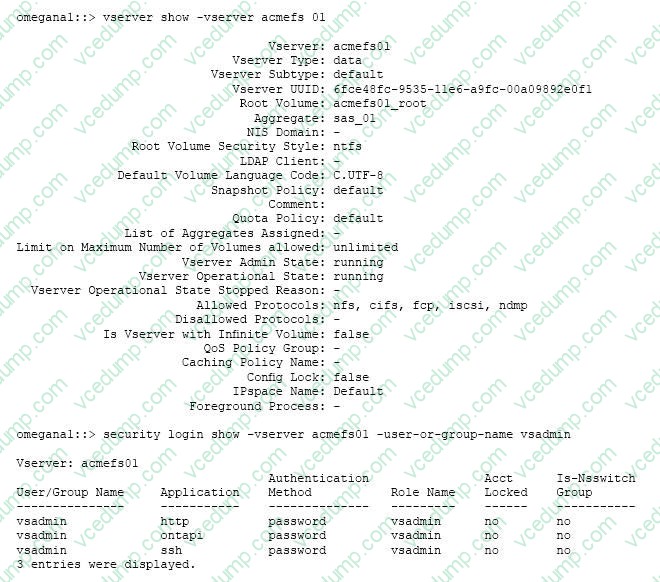
After logging into an SVM using the vsadmin user account, you are able to see existing volumes, but are unable to create new volumes.
Referring to the configuration shown in the exhibit, what is the problem?
A. The vsadmin user is not assigned the correct application access.
B. No aggregates have been assigned to the SVM.
C. Aggregate SAS_01 is out of space.
D. The vsadmin role does not have the create volumes privilege.
Related Exams:
-
NS0-002
NetApp Certified Technology Associate - NCSA - HC -
NS0-003
NetApp Certified Technology Associate -
NS0-004
NetApp Certified Technology Solutions Professional -
NS0-005
NetApp Technology Solutions Professional -
NS0-093
NetApp Accredited Hardware Support Engineer -
NS0-101
NetApp Accredited Sales Professional -
NS0-102
NetApp(ASAP) Accredited Storage Architect Professional -
NS0-111
Network Appliance Storage Associate -
NS0-120
Data ONTAP Advanced -
NS0-121
Network Appliance Data ONTAP Advanced Exam 7G
Tips on How to Prepare for the Exams
Nowadays, the certification exams become more and more important and required by more and more enterprises when applying for a job. But how to prepare for the exam effectively? How to prepare for the exam in a short time with less efforts? How to get a ideal result and how to find the most reliable resources? Here on Vcedump.com, you will find all the answers. Vcedump.com provide not only NetApp exam questions, answers and explanations but also complete assistance on your exam preparation and certification application. If you are confused on your NS0-158 exam preparations and NetApp certification application, do not hesitate to visit our Vcedump.com to find your solutions here.