NCP-MCI-6.10 Exam Details
-
Exam Code
:NCP-MCI-6.10 -
Exam Name
:Nutanix Certified Professional - Multicloud Infrastructure (NCP-MCI v6.10) -
Certification
:Nutanix Certifications -
Vendor
:Nutanix -
Total Questions
:197 Q&As -
Last Updated
:Jul 08, 2026
Nutanix NCP-MCI-6.10 Online Questions & Answers
-
Question 1:
What is the default file system used by Nutanix storage?
A. NTFS
B. XFS
C. NDFS (Nutanix Distributed File System)
D. EXT4 -
Question 2:
When expanding acluster, what is required toautomatically discover new nodes?
A. New nodes must have the same hypervisor version.
B. IPv6 multicast must be allowed on physical switches.
C. New nodes must have the same AOS version.
D. IPv4 multicast must be allowed on physical switches. -
Question 3:
Which two entities can be categorized? (Choose two.)
A. Storage Containers
B. Alerts
C. Virtual Machines
D. ISO Images -
Question 4:
An administrator started anLCM upgrade of the AHV hostsbut realized that theupgrade would exceed the planned maintenance window.
Which feature should be leveraged to prevent additional updates from occurring?
A. Cancel the LCM tasks via theErgon command line (ecli).
B. Run thelcm_task_cleanup.pyscript.
C. RestartGenesison the cluster to restart the LCM service.
D. Use theStop Update feature in LCM. -
Question 5:
An administrator receives complaints about VM performance.
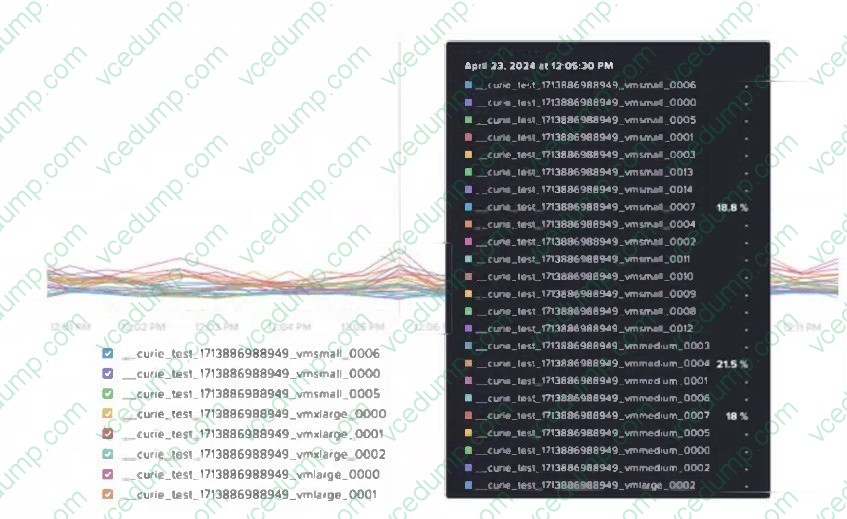
After reviewing theVM's CPU Ready Timedata shown in the exhibit, which step should the administrator take to diagnose the issue further?
A. Check the number of vCPUs assigned to each CVM.
B. Review host CPU utilization.
C. Assess cluster SSD capacity.
D. Enable VM memory oversubscription. -
Question 6:
What additional step is required for LCM to upgrade an AHV host that has GPUs?
A. Use Direct Uploads to upload appropriate driver bundles.
B. Run LCM in dark site mode so it can update AHV independently.
C. Create an agent VM on each host that has GPU drivers installed.
D. Update NCC to the latest version and re-run Inventory. -
Question 7:
An administrator is tasked with ensuring the resiliency of Tier-1 workloads. As such, the administrator creates a Protection Policy with a crash-consistent snapshot period that meets RPO while maintaining 10 recovery points locally and 5 at DR location.
Since it is difficult to quantify how long a DR event will last, management wants the Tier-1 workloads to always have 10 recovery points locally.
How can this be achieved logically and most efficiently?
A. Change retentions within the Protection Policy to be 10 at both locations and Save Schedule.
B. Enable Reverse Retention within the Protection Policy Schedule.
C. Utilize a script that executes an API to take the requisite number of recovery points post-DR.
D. Post DR, recreate the Protection Policy with new/updated values. -
Question 8:
A team wants to repeatedly deploy new VMs from a known configuration instead of rebuilding the same settings each time.
Which Nutanix object best supports this deployment workflow?
A. VM template
B. Syslog module
C. Metro witness
D. Storage container limit -
Question 9:
A Disaster Recovery administrator has setup a Protection Policy for 50 workloads - all configured in a similar fashion in terms of OS, storage, network, and performance. The RPO is 60 minutes with a specified retention of 10 copies local, 5 copies remote, and crash consistency. After configuring the Protection Policy and activating it, the administrator has noticed that recovery points are not showing up in DR. Yet, everything within the Protection Policy looks correct and recovery points are showing up on production side.
What is the most likely issue?
A. Nutanix NGT is not installed on the source VMs.
B. The storage container RF factor of the protected VMs is not the same as the RF factor in the DR cluster container.
C. Windows updates need to be run on all the affected VMs.
D. The storage container name of the protected VMs is not the same as the DR cluster storage container -
Question 10:
An administrator wants a custom view with several charts to compare metrics for impacted VMs in Prism Central.
What should be created?
A. Analysis session
B. Remote site
C. VM template
D. Storage policy
Related Exams:
-
NCA-5.15
Nutanix Certified Associate (NCA) v5.15 -
NCA-5.20
Nutanix Certified Associate (NCA) v5.20 -
NCA-6.10
Nutanix Certified Associate NCA v6.10 -
NCA-6.5
Nutanix Certified Associate (NCA) v6.5 -
NCM-5.15
Nutanix Certified Master - Multicloud Infrastructure (NCM-MCI) v5.15 -
NCM-MCI
Nutanix Certified Master - Multicloud Infrastructure -
NCM-MCI-5.15
Nutanix Certified Master - Multicloud Infrastructure (NCM-MCI) v5.15 -
NCM-MCI-5.20
Nutanix Certified Master - Multicloud Infrastructure (NCM-MCI) v5.20 -
NCM-MCI-6.5
Nutanix Certified Master - Multicloud Infrastructure (NCM-MCI) v6.5 -
NCP-5.10
Nutanix Certified Professional (NCP) v5.10
Tips on How to Prepare for the Exams
Nowadays, the certification exams become more and more important and required by more and more enterprises when applying for a job. But how to prepare for the exam effectively? How to prepare for the exam in a short time with less efforts? How to get a ideal result and how to find the most reliable resources? Here on Vcedump.com, you will find all the answers. Vcedump.com provide not only Nutanix exam questions, answers and explanations but also complete assistance on your exam preparation and certification application. If you are confused on your NCP-MCI-6.10 exam preparations and Nutanix certification application, do not hesitate to visit our Vcedump.com to find your solutions here.