NCA-6.5 Exam Details
-
Exam Code
:NCA-6.5 -
Exam Name
:Nutanix Certified Associate (NCA) v6.5 -
Certification
:Nutanix Certifications -
Vendor
:Nutanix -
Total Questions
:133 Q&As -
Last Updated
:Jul 11, 2026
Nutanix NCA-6.5 Online Questions & Answers
-
Question 11:
Which Nutanix storage efficiency feature is suitable for nearly every workload?
A. Erasure Coding
B. Deduplication
C. Compression
D. Thick Provisioning -
Question 12:
Which URL can be used to open Nutanix support cases?
A. portal.nutanix.com
B. www.nutanix.com
C. console.nutanix.com
D. partnerportal.nutanix.com -
Question 13:
Where can an administrator find information about the Cluster Runway?
A. Prism Element Home Page
B. Prism Element Analysis
C. Prism Central Main Dashboard
D. Prism Central Analysis -
Question 14:
A company's security team has requested that all IT resources be hardened.
What should an administrator do to increase the security of the Nutanix environment?
A. Enable Cluster Lockdown
B. Enable Prism Central KMS
C. Enable Flow
D. Enable STIG -
Question 15:
A 10 GbE link has failed on Node A within the following cluster environment:
Four-node AHV-based cluster All node have only two 10 GbE ports connected to the network Active-backup is configured What impact will user VMs experience from this issue?
A. Performance will Decrease
B. Will failover to another node
C. Will have no impact
D. Will shutdown -
Question 16:
Which type of network supports automatically assigning IP addresses to VMs?
A. Floating IP Network
B. Management traffic network
C. Virtual Network with IPAM
D. Virtual Private Cloud Networks -
Question 17:
Which cluster configuration is LCM unable to perform firmware upgrades against?
A. Five-node
B. Three-node
C. Two-node
D. Single--node -
Question 18:
Refer to the exhibit.
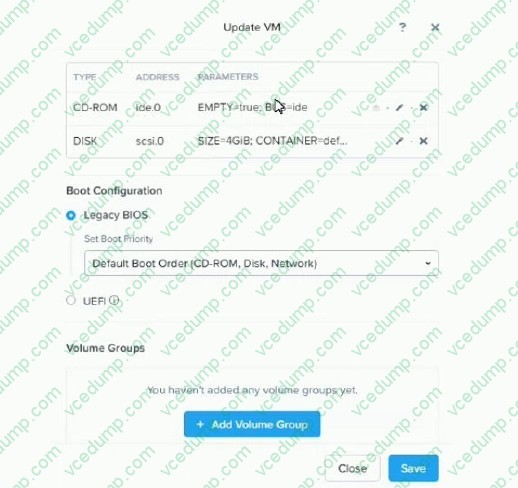
A team member has built a CentOS VM image for use as a template. An administrator deploys a new VM using the CentOS image as the 05 drive. No other drives are presented to the VM.
Following the deployment, the administrator attempts to boot the VM, but is unsuccessful.
What could be causing this issue?
A. The VMS Boot Priority must reference disk first before CD-ROW
B. The VM's Disk (scsi.O) setting must be set to make this disk bootable
C. No Volume Groups have been created for the VM
D. The CentOS VM image was built with UEF: -
Question 19:
An administrator needs to upgrade AOS in a vSphere-based NutaniSJve-node cluster with no automatic live migration. VMs have neither affinity nor anti-affinity rules configured.
What will happen to VMs during the AOS upgrade?
A. VMs will be rebooted on other hosts.
B. VMs will continue to run on the same host.
C. Upgrade fails because host can't go in maintenance mode.
D. AOS automatically live migrate VMs to other hosts. -
Question 20:
Which technology allows applications and data to move freely between runtime environments?
A. Distributed Storage Fabric
B. Disaster Recovery
C. App Mobility Fabric
D. Nutanix Move
Related Exams:
-
NCA-5.15
Nutanix Certified Associate (NCA) v5.15 -
NCA-5.20
Nutanix Certified Associate (NCA) v5.20 -
NCA-6.10
Nutanix Certified Associate NCA v6.10 -
NCA-6.5
Nutanix Certified Associate (NCA) v6.5 -
NCM-5.15
Nutanix Certified Master - Multicloud Infrastructure (NCM-MCI) v5.15 -
NCM-MCI
Nutanix Certified Master - Multicloud Infrastructure -
NCM-MCI-5.15
Nutanix Certified Master - Multicloud Infrastructure (NCM-MCI) v5.15 -
NCM-MCI-5.20
Nutanix Certified Master - Multicloud Infrastructure (NCM-MCI) v5.20 -
NCM-MCI-6.5
Nutanix Certified Master - Multicloud Infrastructure (NCM-MCI) v6.5 -
NCP-5.10
Nutanix Certified Professional (NCP) v5.10
Tips on How to Prepare for the Exams
Nowadays, the certification exams become more and more important and required by more and more enterprises when applying for a job. But how to prepare for the exam effectively? How to prepare for the exam in a short time with less efforts? How to get a ideal result and how to find the most reliable resources? Here on Vcedump.com, you will find all the answers. Vcedump.com provide not only Nutanix exam questions, answers and explanations but also complete assistance on your exam preparation and certification application. If you are confused on your NCA-6.5 exam preparations and Nutanix certification application, do not hesitate to visit our Vcedump.com to find your solutions here.