N10-009 Exam Details
-
Exam Code
:N10-009 -
Exam Name
:CompTIA Network+ -
Certification
:CompTIA Certifications -
Vendor
:CompTIA -
Total Questions
:746 Q&As -
Last Updated
:Jul 10, 2026
CompTIA N10-009 Online Questions & Answers
-
Question 171:
Which of the following describes a fully redundant network topology?
A. Star
B. Bus
C. Mesh
D. Ring -
Question 172:
A network administrator needs to ensure all network ports use a security method that only permits authenticated devices.
The solution must meet the following requirements:
1. Reduced chance of spoofing.
2. Centrally managed solution
3. Auditable logs
Which of the following technologies provides this functionality?
A. MAC filtering
B. Port security
C. ACLs
D. 802.1X -
Question 173:
A junior network administrator is auditing the company network and notices incrementing input errors on a long-range microwave interface.
Which of the following is the most likely reason for the errors?
A. The parabolic signal is misaligned.
B. The omnidirectional signal is being jammed.
C. The omnidirectional signal is not strong enough to receive properly.
D. The parabolic signal uses improper routing protocols. -
Question 174:
A network administrator is reviewing a production web server and observes the following output from the netstat command:
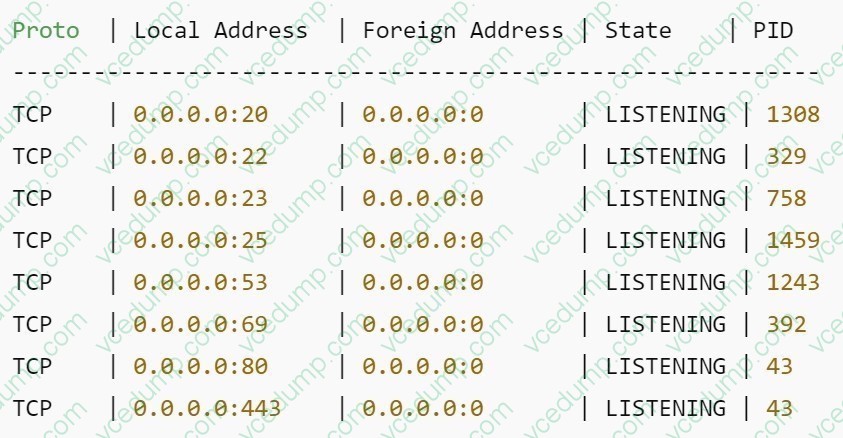
Which of the following actions should the network administrator take to harden the security of the web server?
A. Disable the unused ports.
B. Enforce access control lists.
C. Perform content filtering.
D. Set up a screened subnet. -
Question 175:
A technician is designing a cloud service solution that will accommodate the company's current size, compute capacity, and storage capacity.
Which of the following cloud deployment models will fulfill these requirements?
A. SaaS
B. PaaS
C. IaaS
D. IaC -
Question 176:
SIMULATION
You are tasked with verifying the following requirements are met in order to ensure network security.
Requirements:
Datacenter
- Ensure network is subnetted to allow all devices to communicate properly while minimizing address space usage
- Provide a dedicated server to resolve IP addresses and hostnames correctly and handle port 53 traffic Building A
- Ensure network is subnetted to allow all devices to communicate properly while minimizing address space usage
- Provide devices to support 5 additional different office users
-Add an additional mobile user
-Replace the Telnet server with a more secure solution Screened subnet
-Ensure network is subnetted to allow all devices to communicate properly while minimizing address space usage
-Provide a server to handle external 80/443 traffic
-Provide a server to handle port 20/21 traffic
INSTRUCTIONS
Drag and drop objects onto the appropriate locations. Objects can be used multiple times and not all placeholders need to be filled.
Available objects are located in both the Servers and Devices tabs of the Drag and Drop menu.
If at any time you would like to bring back the initial state of the simulation, please click the Reset All button.
A. See explanation below.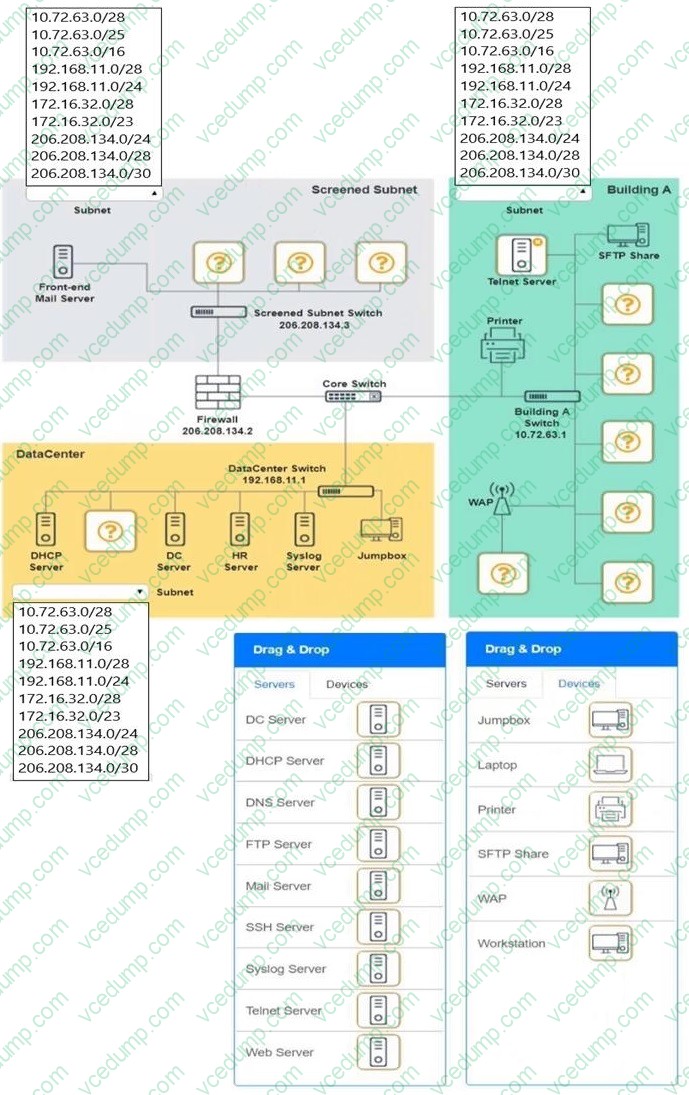
B. PlaceHolder
C. PlaceHolder
D. PlaceHolder -
Question 177:
Which of the following combinations of single cables and transceivers will allow a server to have 40GB of network throughput? (Select two).
A. SFP+
B. SFP
C. QSFP+
D. Multimode
E. Cat 6a
F. Cat5e -
Question 178:
A network administrator wants to ensure that only authorized devices connect to switch ports.
Which of the following should be enabled?
A. Port security
B. NAT
C. DNS
D. QoS -
Question 179:
Which of the following standards enables the use of an enterprise authentication for network access control?
A. 802.1Q
B. 802.1X
C. 802.3bt
D. 802.11h -
Question 180:
Which of the following best describes the transmission format that occurs at the transport layer over connectionless communication?
A. Datagram
B. Segment
C. Frames
D. Packets
Related Exams:
-
220-1001
CompTIA A+ Certification: Core 1 -
220-1002
CompTIA A+ Certification: Core 2 -
220-1101
CompTIA A+ Certification: Core 1 -
220-1102
CompTIA A+ Certification: Core 2 -
220-1201
CompTIA A+ Certification: Core 1 -
220-1202
CompTIA A+ Core 2 (2026) -
220-902
CompTIA A+ Certification -
CAS-004
CompTIA Advanced Security Practitioner (CASP+) -
CAS-005
CompTIA SecurityX -
CLO-001
CompTIA Cloud Essentials+
Tips on How to Prepare for the Exams
Nowadays, the certification exams become more and more important and required by more and more enterprises when applying for a job. But how to prepare for the exam effectively? How to prepare for the exam in a short time with less efforts? How to get a ideal result and how to find the most reliable resources? Here on Vcedump.com, you will find all the answers. Vcedump.com provide not only CompTIA exam questions, answers and explanations but also complete assistance on your exam preparation and certification application. If you are confused on your N10-009 exam preparations and CompTIA certification application, do not hesitate to visit our Vcedump.com to find your solutions here.