MCPA-LEVEL1 Exam Details
-
Exam Code
:MCPA-LEVEL1 -
Exam Name
:MuleSoft Certified Platform Architect - Level 1 -
Certification
:Mulesoft Certifications -
Vendor
:Mulesoft -
Total Questions
:95 Q&As -
Last Updated
:Jul 12, 2026
Mulesoft MCPA-LEVEL1 Online Questions & Answers
-
Question 1:
Version 3.0.1 of a REST API implementation represents time values in PST time using ISO 8601 hh:mm:ss format. The API implementation needs to be changed to instead represent time values in CEST time using ISO 8601 hh:mm:ss format. When following the semver.org semantic versioning specification, what version should be assigned to the updated API implementation?
A. 3.0.2
B. 4.0.0
C. 3.1.0
D. 3.0.1 -
Question 2:
An API implementation is updated. When must the RAML definition of the API also be updated?
A. When the API implementation changes the structure of the request or response messages
B. When the API implementation changes from interacting with a legacy backend system deployed on-premises to a modern, cloud-based (SaaS) system
C. When the API implementation is migrated from an older to a newer version of the Mule runtime
D. When the API implementation is optimized to improve its average response time -
Question 3:
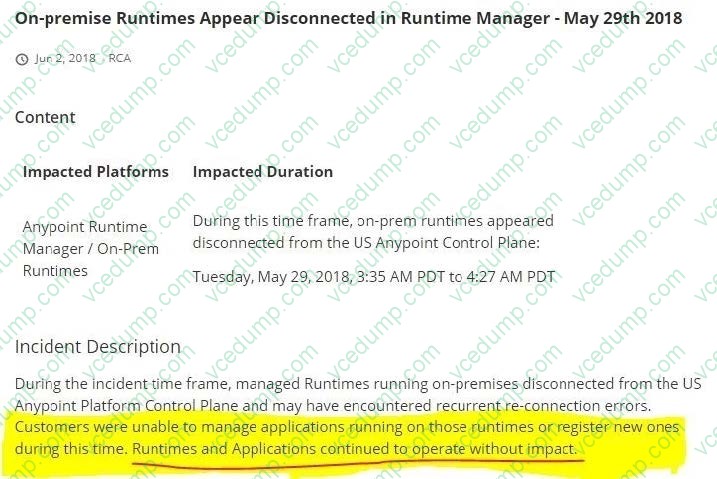
Refer to the exhibit.
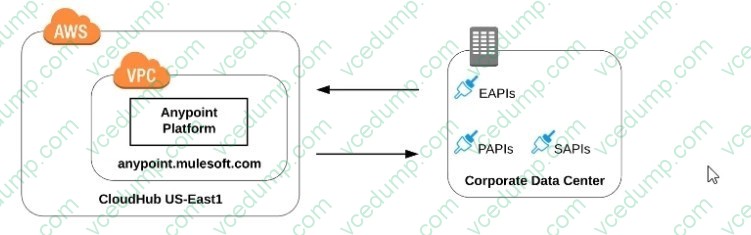
What is true when using customer-hosted Mule runtimes with the MuleSoft-hosted Anypoint Platform control plane (hybrid deployment)?
A. Anypoint Runtime Manager initiates a network connection to a Mule runtime in order to deploy Mule applications
B. The MuleSoft-hosted Shared Load Balancer can be used to load balance API invocations to the Mule runtimes
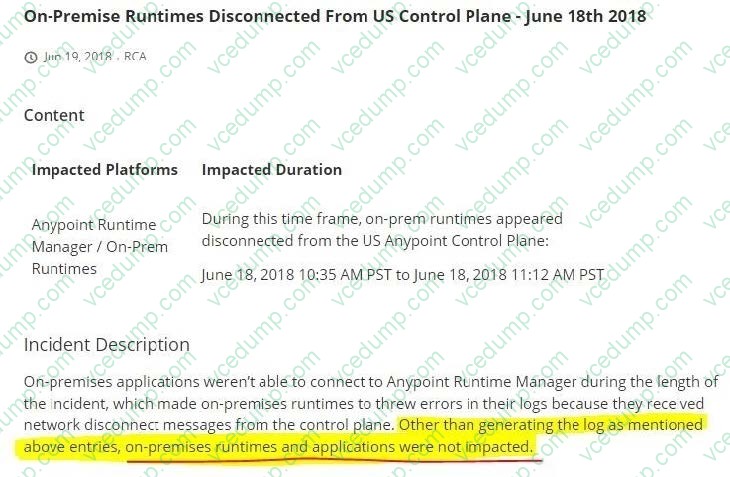
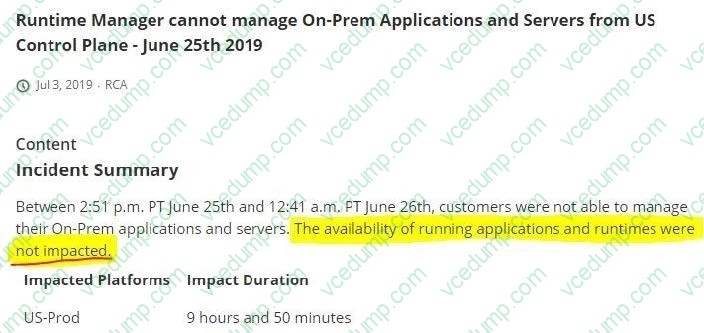
C. API implementations can run successfully in customer-hosted Mule runtimes, even when they are unable to communicate with the control plane
D. Anypoint Runtime Manager automatically ensures HA in the control plane by creating a new Mule runtime instance in case of a node failure -
Question 4:
An API experiences a high rate of client requests (TPS) vwth small message paytoads. How can usage limits be imposed on the API based on the type of client application?
A. Use an SLA-based rate limiting policy and assign a client application to a matching SLA tier based on its type
B. Use a spike control policy that limits the number of requests for each client application type
C. Use a cross-origin resource sharing (CORS) policy to limit resource sharing between client applications, configured by the client application type
D. Use a rate limiting policy and a client ID enforcement policy, each configured by the client application type -
Question 5:
What condition requires using a CloudHub Dedicated Load Balancer?
A. When cross-region load balancing is required between separate deployments of the same Mule application
B. When custom DNS names are required for API implementations deployed to customer- hosted Mule runtimes
C. When API invocations across multiple CloudHub workers must be load balanced
D. When server-side load-balanced TLS mutual authentication is required between API implementations and API clients -
Question 6:
A Mule application exposes an HTTPS endpoint and is deployed to the CloudHub Shared Worker Cloud. All traffic to that Mule application must stay inside the AWS VPC.
To what TCP port do API invocations to that Mule application need to be sent?
A. 443
B. 8081
C. 8091
D. 8082 -
Question 7:
Mule applications that implement a number of REST APIs are deployed to their own subnet that is inaccessible from outside the organization.
External business-partners need to access these APIs, which are only allowed to be invoked from a separate subnet dedicated to partners - called Partner-subnet. This subnet is accessible from the public internet, which allows these external partners to reach it.
Anypoint Platform and Mule runtimes are already deployed in Partner-subnet. These Mule runtimes can already access the APIs.
What is the most resource-efficient solution to comply with these requirements, while having the least impact on other applications that are currently using the APIs?
A. Implement (or generate) an API proxy Mule application for each of the APIs, then deploy the API proxies to the Mule runtimes
B. Redeploy the API implementations to the same servers running the Mule runtimes
C. Add an additional endpoint to each API for partner-enablement consumption
D. Duplicate the APIs as Mule applications, then deploy them to the Mule runtimes -
Question 8:
Refer to the exhibit.
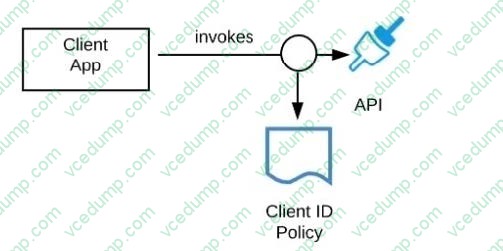
A developer is building a client application to invoke an API deployed to the STAGING environment that is governed by a client ID enforcement policy.
What is required to successfully invoke the API?
A. The client ID and secret for the Anypoint Platform account owning the API in the STAGING environment
B. The client ID and secret for the Anypoint Platform account's STAGING environment
C. The client ID and secret obtained from Anypoint Exchange for the API instance in the STAGING environment
D. A valid OAuth token obtained from Anypoint Platform and its associated client ID and secret -
Question 9:
What is a key requirement when using an external Identity Provider for Client Management in Anypoint Platform?
A. Single sign-on is required to sign in to Anypoint Platform
B. The application network must include System APIs that interact with the Identity Provider
C. To invoke OAuth 2.0-protected APIs managed by Anypoint Platform, API clients must submit access tokens issued by that same Identity Provider
D. APIs managed by Anypoint Platform must be protected by SAML 2.0 policies -
Question 10:
What Mule application deployment scenario requires using Anypoint Platform Private Cloud Edition or Anypoint Platform for Pivotal Cloud Foundry?
A. When it Is required to make ALL applications highly available across multiple data centers
B. When it is required that ALL APIs are private and NOT exposed to the public cloud
C. When regulatory requirements mandate on-premises processing of EVERY data item, including meta-data
D. When ALL backend systems in the application network are deployed in the organization's intranet

Related Exams:
-
MCD-ASSOC
MuleSoft Certified Developer - Integration and API Associate (Mule 3) -
MCD-LEVEL1
MuleSoft Certified Developer - Level 1 (Mule 4) -
MCD-LEVEL1-DELTA
MuleSoft Certified Developer - Level 1 (Mule 4) DELTA -
MCD-LEVEL2
MuleSoft Certified Developer - Level 2 (Mule 4) -
MCIA-LEVEL1
MuleSoft Certified Integration Architect - Level 1 -
MCIA-LEVEL1-MAINTENANCE
MuleSoft Certified Integration Architect - Level 1 MAINTENANCE -
MCPA-LEVEL1
MuleSoft Certified Platform Architect - Level 1 -
MCPA-LEVEL1-MAINTENANCE
MuleSoft Certified Platform Architect - Level 1 MAINTENANCE
Tips on How to Prepare for the Exams
Nowadays, the certification exams become more and more important and required by more and more enterprises when applying for a job. But how to prepare for the exam effectively? How to prepare for the exam in a short time with less efforts? How to get a ideal result and how to find the most reliable resources? Here on Vcedump.com, you will find all the answers. Vcedump.com provide not only Mulesoft exam questions, answers and explanations but also complete assistance on your exam preparation and certification application. If you are confused on your MCPA-LEVEL1 exam preparations and Mulesoft certification application, do not hesitate to visit our Vcedump.com to find your solutions here.