Mulesoft MCD-LEVEL2 Online Practice
Questions and Exam Preparation
MCD-LEVEL2 Exam Details
Exam Code
:MCD-LEVEL2
Exam Name
:MuleSoft Certified Developer - Level 2 (Mule 4)
Certification
:Mulesoft Certifications
Vendor
:Mulesoft
Total Questions
:60 Q&As
Last Updated
:Jan 12, 2026
Mulesoft MCD-LEVEL2 Online Questions &
Answers
Question 1:
Which statement is true when using XML SDK for creating custom message processors?
A. Properties are fields defined by an end user of the XML SDK component and serve as a global configuration for the entire Mule project in which they are used B. An XML SDK provides both inbound and outbound operations C. Operations can be reused in recursive calls D. All operations are public
D. All operations are public explanation:
Explanation
When using XML SDK for creating custom message processors, all operations are public by default and can be used by any Mule application that imports them. There is no way to make an operation private or protected in XML SDK.
A custom policy needs to be developed to intercept all cutbound HTTP requests made by Mule applications.
Which XML element must be used to intercept outbound HTTP requests?
A. It is not possible to intercept outgoing HTTP requests, only inbound requests B. http-policy:source C. htt-policy:operation D. http-policy:processor
D. http-policy:processor explanation:
Explanation
The http-policy:processor element is used to intercept outbound HTTP requests made by Mule applications. It allows customizing the request before it is sent to the target API and modifying the response after it is received from the target API.
A system API that communicates to an underlying MySQL database is deploying to CloudHub. The DevOps team requires a readiness endpoint to monitor all system APIs.
Which strategy should be used to implement this endpoint?
A. Create a dedicated endpoint that responds with the API status and reachability of the underlying systems B. Create a dedicated endpoint that responds with the API status and health of the server C. Use an existing resource endpoint of the API D. Create a dedicated endpoint that responds with the API status only
A. Create a dedicated endpoint that responds with the API status and reachability of the underlying systems explanation:
Explanation
To implement a readiness endpoint to monitor all system APIs, the developer should create a dedicated endpoint that responds with the API status and reachability of the underlying systems. This way, the DevOps team can check if the system API is ready to receive requests and if it can communicate with its backend systems without errors.
A Mute Object Store is configured with an entry TTL of one second and an expiration interval of 30 seconds.
What is the result of the flow if processing between os'store and os:retrieve takes 10 seconds?
A. nullPayload B. originalPayload C. OS:KEY_NOT_FOUND D. testPayload
A. nullPayload explanation:
Explanation
The result of the flow is nullPayload if processing between os:store and os:retrieve takes 10 seconds. This is because the entry TTL of the object store is one second, which means that any stored value expires after one second and is removed from the object store. The expiration interval of 30 seconds only determines how often the object store checks for expired values, but it does not affect the TTL. Therefore, when os:retrieve tries to get the value after 10 seconds, it returns nullPayload because the value has already expired and been removed.
Two APIs are deployed to a two-node on-prem cluster. Due to a requirements change, the two APIs must communicate to exchange data asynchronously.
A. If the two APIs use the same domain, the VM Connector can be leveraged B. The VM Connector is used to inter-application communication, so it is not possible to use the VM Connector C. Instead of using the VM Connector use directly D. It is not possible to use the VM Connector since the APIs are running in a cluster mode and each mode has it own set of VM Queues
A. If the two APIs use the same domain, the VM Connector can be leveraged explanation:
Explanation
To communicate asynchronously between two APIs deployed to a two-node on-prem cluster, the developer can use the VM Connector if the two APIs use the same domain. The VM Connector allows passing messages between different Mule applications within a single Mule runtime instance or across different instances using shared memory or persistent storage. If two APIs are deployed under the same domain, they can share resources such as VM queues and communicate asynchronously using VM Connector operations.
A Mule application includes a subflow containing a Scatter.Gather scope. Within each log of the Scatter.Gatter. an HTTP connector calls a PUT endpoint to modify records in different upstream system. The subflow is called inside an Unit successful scope to retry if a transitory exception is raised.
A technical spike is being performed to increase reliability of the Mule application.
Which steps should be performed within the Mule flow above the ensure idempontent behavior?
A. Change the PUT requests inside the Scatter-Gather to POST requests B. Ensure an error-handling flow performs corrective actions to roll back all changes if any leg of the Scatter-Gather fails C. Remove the Put requests from the Scatter-Getter and perform them sequentially D. None, the flow already exhibits idempotent behavior
B. Ensure an error-handling flow performs corrective actions to roll back all changes if any leg of the Scatter-Gather fails explanation:
Explanation
To ensure idempotent behavior within a Mule flow that contains a subflow with a Scatter-Gather scope, the developer should ensure an error-handling flow performs corrective actions to roll back all changes if any leg of the Scatter-Gather fails. Idempotency means that multiple identical requests have the same effect as a single request. Therefore, if one of the HTTP requests inside the Scatter-Gather fails, the error-handling flow should undo any changes made by other successful requests to ensure consistency and avoid partial updates.
A developer generates the base scaffolding for an API in Anypoint Studio. Which HTTP status code is returned while testing using the API Kit console if no values are entered in client-secret?
A. HTTP status code:200 B. HTTP status code:403 C. HTTP status code:400 D. HTTP status code:500
B. HTTP status code:403 explanation:
Explanation
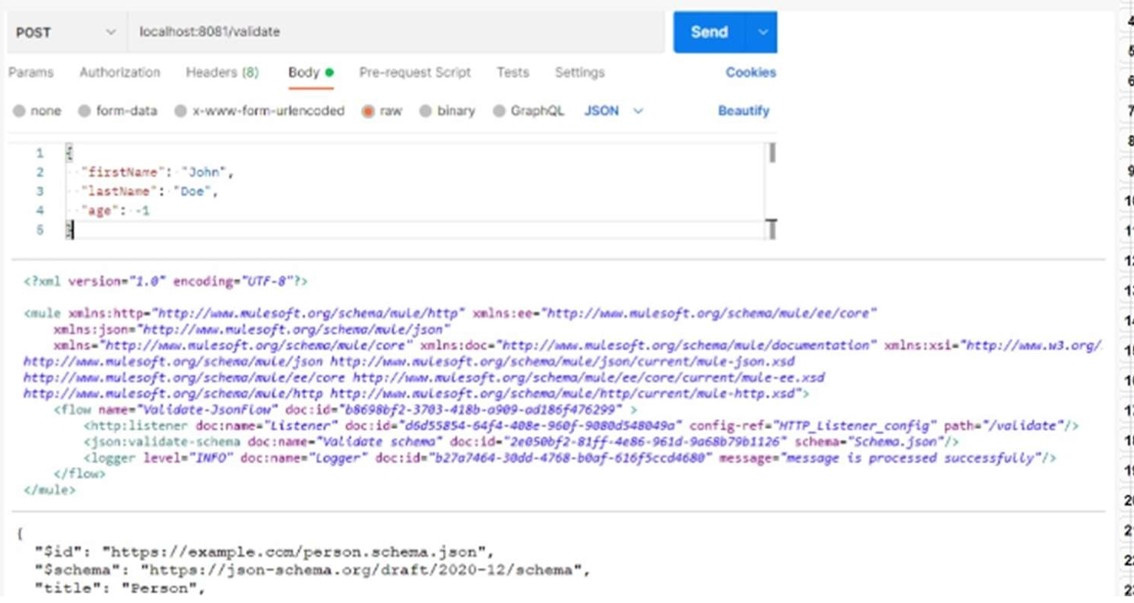
Based on the code snippet and schema.json file below, when testing using the API Kit console if no values are entered in client-secret, HTTP status code 403 (FORBIDDEN) is returned. This is because client-secret is defined as a required header parameter in schema.json file, which means that it must be present in every request. If no values are entered in client-secret, then it is equivalent to omitting this header parameter, which violates the schema and causes APIKit Router to return HTTP status code 403.
What is the MuleSoft recommended method to encrypt sensitive property data?
A. The encryption key and sensitive data should be different for each environment B. The encryption key should be identical for all environments C. The encryption key should be identical for all environments and the sensitive data should be different for each environment D. The encryption key should be different for each environment and the sensitive data should be the same for all environments
A. The encryption key and sensitive data should be different for each environment explanation:
Explanation
The MuleSoft recommended method to encrypt sensitive property data is to use the Secure Properties Tool that comes with Anypoint Studio. This tool allows encrypting properties files with a secret key and then decrypting them at runtime using the same key. The encryption key and sensitive data should be different for each environment to ensure security and avoid accidental exposure of sensitive data.
A Mule application defines as SSL/TLS keystore properly `tis,keystore.keyPassword'' as secure.
How canthis property be referenced to access its value within the application?
A. #{secure::tiskeystore,keyPassowrd} B. ${secure::tiskeystore,keyPassowrd} C. ${secure::tiskeystore,keyPassowrd} D. p{secure::tiskeystore,keyPassowrd}
B. ${secure::tiskeystore,keyPassowrd} explanation:
Explanation
secure::tiskeystore,keyPassowrdShortExplanationofCorrectAnswerOnly:Toreferenceasecur epropertyvaluewithintheapplication,thedeveloperneedstousethesyntax{secure::}. In this case, the property name is tiskeystore,keyPassword, so the correct syntax is ${secure::tiskeystore,keyPassowrd}.
A scatter-gather router is configured with four routes:Route A, B, C and
D.
Route C false.
A. Error,errorMesage.payload.results [`2'] B. Payload failures[`2'] C. Error,errorMessage,payload.failures[`2'] D. Payload [`2']
C. Error,errorMessage,payload.failures[`2'] explanation:
Explanation
The result of accessing route C failure is Error,errorMessage,payload.failures[`2']. This is because a scatter-gather router returns an aggregated message that contains an array of results from each route and an array of failures from each route. The failures array contains error objects with information about each failed route execution. To access route C failure, which is the third route (index 2), the developer needs to use Error.errorMessage.payload.failures[`2'] expression.
Nowadays, the certification exams become more and more important and required by more and more
enterprises when applying for a job. But how to prepare for the exam effectively? How to prepare
for the exam in a short time with less efforts? How to get a ideal result and how to find the
most reliable resources? Here on Vcedump.com, you will find all the answers.
Vcedump.com provide not only Mulesoft exam questions,
answers and explanations but also complete assistance on your exam preparation and certification
application. If you are confused on your MCD-LEVEL2 exam preparations
and Mulesoft certification application, do not hesitate to visit our
Vcedump.com to find your solutions here.