JN0-633 Exam Details
-
Exam Code
:JN0-633 -
Exam Name
:Security, Professional (JNCIP-SEC) -
Certification
:Juniper Certifications -
Vendor
:Juniper -
Total Questions
:175 Q&As -
Last Updated
:Jul 11, 2026
Juniper JN0-633 Online Questions & Answers
-
Question 131:
Click the Exhibit button.
[edit security idp-policy test]
user@host# show
rulebase-ips {
rule R3 {
match {
source-address any;
destination-address any;
attacks {
predefined-attacks FTP:USER:ROOT;
}
}
then {
action {
recommended;
}
}
terminal;
}
rule R4 {
match {
source-address any;
destination-address any;
attacks {
predefined-attacks HTTP:HOTMAIL:FILE-UPLOAD;
}
}
then {
action {
recommended;
}
}
}
}
You have just committed the new IDP policy shown in the exhibit. However, you notice no action is taken on traffic matching the R4 IDP rule. Which two actions will resolve the problem? (Choose two.)
A. Change the R4 rule to match on a predefined attack group.
B. Insert the R4 rule above the R3 rule.
C. Delete the terminal statement from the R3 rule.
D. Change the IPS rulebase to an exempt rulebase. -
Question 132:
You configured a custom signature attack object to match specific components of an attack:
HTTP-request Pattern .*\x90 90 90 ... 90 Direction: client-to-server
Which client traffic would be identified as an attack?
A. HTTP GET .*\x90 90 90 ... 90
B. HTTP POST .*\x90 90 90 ... 90
C. HTTP GET .*x909090 ... 90
D. HTTP POST .*x909090 ... 90 -
Question 133:
An external host is attacking your network. The host sends an HTTP request to a Web server, but does not include the version of HTTP in the request. Which type of attack is being performed?
A. signature-based attack
B. application identification
C. anomaly
D. fingerprinting -
Question 134:
user@host> show interfaces routing-instance all ge* terse Interface Admin Link Proto Local Instance ge-0/0/0.0 up up inet 172.16.12.205/24 default ge-0/0/1.0 up up inet 5.0.0.5/24 iso A ge-0/0/2.0 up up inet 25.0.0.5/24 iso B
user@host> show security flow session Session ID: 82274, Policy name: default-policy-00/2, Timeout: 1770, Valid In: 5.0.0.25/61935 --> 25.0.0.25/23;tcp, If: ge-0/0/1.0, Pkts: 31, Bytes: 1781 Out: 25.0.0.25/23 --> 5.0.0.25/61935;tcp, If: ge-0/0/2.0, Pkts: 23, Bytes: 1452 Total sessions: 3
user@host> show route
inet.0: 4 destinations, 4 routes (4 active, 0 holddown, 0 hidden) + = Active Route, - = Last Active, + = Both
0.0.0.0/0 *[Static/5] 04:08:52 > to 172.16.12.1 via ge-0/0/0.0 172.16.12.0/24 *[Direct/0] 04:08:52 via ge-0/0/0.0 172.16.12.205/32 *[Local/0] 4w4d 23:04:29 Loca1 via ge-0/0/0.0 224.0.0.5/32 *[OSPF/10] 14:37:35, metric 1 MultiRecv
A. inet.0: 4 destinations, 4 routes {4 active, 0 holddown, 0 hidden) + = Active Route, - = Last Active, * = Both 5.0.0.0/24 5 *[Direct/0] 00:05:04 > via ge-0/0/1.0 5.0.0.5/32 *[Local/0] 00:05:04 Local via ge-0/0/1.0 25.0.0.0/24 *[Direct/0] 00:02:37 > via ge-0/0/2.0
B. inet.0: 3 destinations, 3 routes (3 active, 0 holddown, 0 hidden) + = Active Route, - = Last Active, * = Both 5.0.0.25/32 *[Static/5] 00:02:38 to table A.inet.0 25.0.0.0/24 *[Direct/0] 00:02:37 > via ge-0/0/2.0 25.0.0.5/32 *[Local/0] 00:02:37 Local via ge-0/0/2.0
C. The routing instances A and B are connected using an lt interface.
D. Routing instance A's routes are shared with routing instance B.
E. Routing instance B's routes are shared with routing instance A.
F. The routing instances A and B are connected using a vt interface. -
Question 135:
You want to implement an IPsec VPN on an SRX device using PKI certificates for authentication. As part of the implementation, you are required to ensure that the certificate submission, renewal, and retrieval processes are handled automatically from the certificate authority. Regarding this scenario, which statement is correct?
A. You can use SCEP to accomplish this behavior.
B. You can use OCSP to accomplish this behavior.
C. You can use CRL to accomplish this behavior.
D. You can use SPKI to accomplish this behavior. -
Question 136:
For an SRX chassis cluster in transparent mode, which action occurs to signal a high availability failover to neighboring switches?
A. the SRX chassis cluster generates Spanning Tree messages
B. the SRX chassis cluster generates gratuitous ARPs
C. the SRX chassis cluster flaps the former active interfaces
D. the SRX chassis cluster uses IP address monitoring -
Question 137:
Click the Exhibit button.
user@host> monitor traffic interface ge-0/0/3
verbose output suppressed, use
or for full protocol decode Address resolution is ON. Use to avoid any reverse lookup delay. Address resolution timeout is 4s.
Listening on ge-0/0/3, capture size 96 bytes
Reverse lookup for 172.168.3.254 failed (check DNS reachability). Other reverse lookup failures will not be reported.
Use
to avoid reverse lockups on IP addresses. 19:24:16.320907 In arp who-has 172.168.3.254 tell 172.168.3.1 19.24:17.322751 In arp who has 172.168.3.254 tell 172.168.3.1 19.24:18.328895 In arp who-has 172.168.3.254 tell 172.168.3.1 19.24:18.332956 In arn who has 172.168.3.254
tell 172.168.3.1
A new server has been set up in your environment. The administrator suspects that the firewall is blocking the traffic from the new server. Previously existing servers in the VLAN are working correctly. After reviewing the logs, you do not see
any traffic for the new server.
Referring to the exhibit, what is the cause of the problem?
Exhibit:
A. The server is in the wrong VLAN.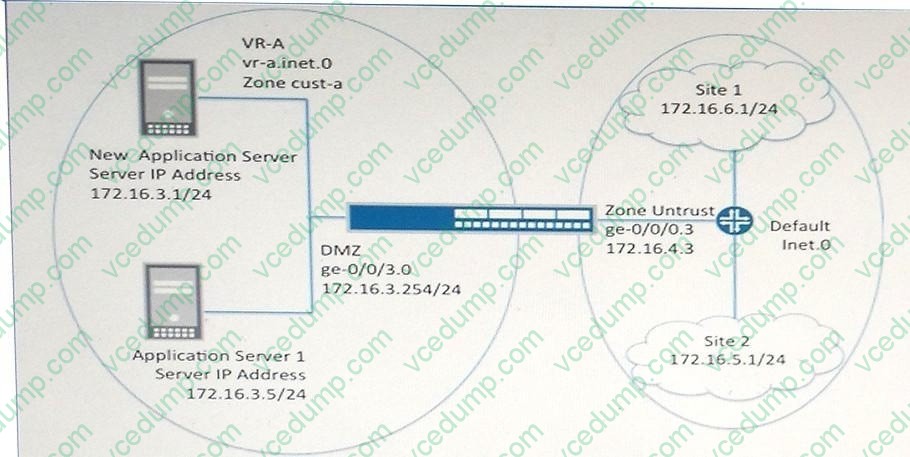
B. The server has been misconfigured with the wrong IP address.
C. The firewall has been misconfigured with the incorrect routing-instance.
D. The firewall has a filter enabled to block traffic from the server. -
Question 138:
Click the Exhibit button.
Host traffic is traversing through an IPsec tunnel. Users are complaining of intermittent issues with their connection.
Referring to the exhibit, what is the problem?
Exhibit:
A. The tunnel is down due to a configuration change.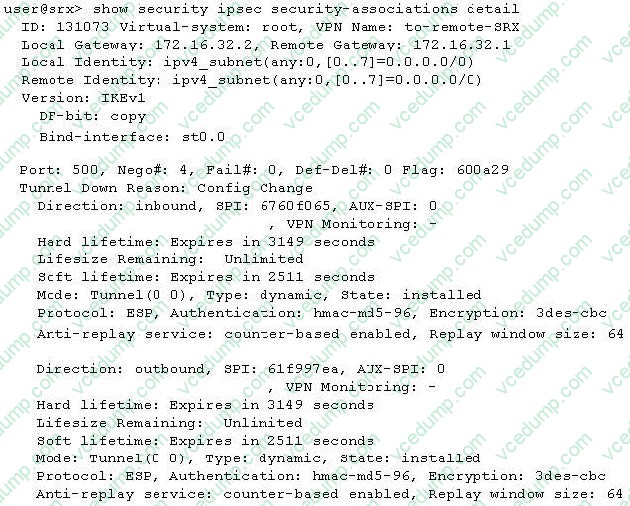
B. The do-not-fragment bit is copied to the tunnel header.
C. The MSS option on the SYN packet is set to 1300.
D. The TCP SYN check option is disabled for tunnel traffic. -
Question 139:
Click the Exhibit button.
user@host> show services application-identification application-system--cache Application System Cache Configurations: Application-cache: off nested-application-cache: on cache-unknown-result: on cache-entry-timeout: 3600 seconds
You are using the application identification feature on your SRX Series device. The help desk reports that users are complaining about slow Internet connectivity. You issue the command shown in the exhibit.
What must you do to correct the problem?
A. Modify the configuration with the delete services application-identification no- application-system-cache command and commit the change.
B. Modify the configuration with the delete services application-identification no- clear-application-system-cache command and commit the change.
C. Reboot the SRX Series device.
D. Modify the configuration with the delete services application-identification no- application identification command and commit the change. -
Question 140:
You are asked to deploy dynamic VPNs between the corporate office and remote employees that work from home. The gateway device at the corporate office is a chassis cluster formed from two SRX240s. Which two statements about this deployment are true? (Choose two.)
A. You must remove the SRX240s from the chassis cluster before enabling the dynamic VPNs.
B. The remote clients can run Windows XP, Windows Vista, Windows 7, or OS X operating systems.
C. If more than two dynamic VPN tunnels are required, you must purchase and install a new license.
D. The remote users can be authenticated by the SRX240s or a configured RADIUS server.
Related Exams:
-
JN0-102
Internet Associate, Junos(JNCIA-Junos) -
JN0-104
Junos, Associate (JNCIA-Junos) -
JN0-105
Junos, Associate (JNCIA-Junos) -
JN0-106
Junos - Associate (JNCIA-Junos) Junos OS 21.2 -
JN0-1101
Juniper Networks Certified Design Associate (JNCDA) -
JN0-1103
Design, Associate (JNCIA-Design) -
JN0-130
Juniper networks Certified internet specialist.e(jncis-e) -
JN0-1301
Data Center Design, Specialist (JNCDS-DC) -
JN0-1302
Data Center Design Specialist (JNCDS-DC) -
JN0-1331
Security Design, Specialist (JNCDS-SEC)
Tips on How to Prepare for the Exams
Nowadays, the certification exams become more and more important and required by more and more enterprises when applying for a job. But how to prepare for the exam effectively? How to prepare for the exam in a short time with less efforts? How to get a ideal result and how to find the most reliable resources? Here on Vcedump.com, you will find all the answers. Vcedump.com provide not only Juniper exam questions, answers and explanations but also complete assistance on your exam preparation and certification application. If you are confused on your JN0-633 exam preparations and Juniper certification application, do not hesitate to visit our Vcedump.com to find your solutions here.