JN0-361 Exam Details
-
Exam Code
:JN0-361 -
Exam Name
:Service Provider Routing and Switching, Specialist (JNCIS-SP) -
Certification
:Juniper Certifications -
Vendor
:Juniper -
Total Questions
:542 Q&As -
Last Updated
:May 25, 2026
Juniper JN0-361 Online Questions & Answers
-
Question 131:
Click the Exhibit button
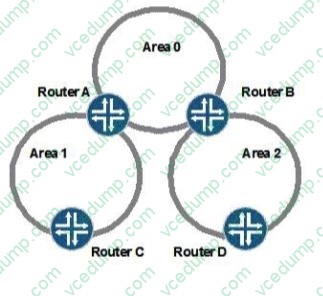
Given the OSPF network topology shown in the exhibit, you would like to inject external (non-OSPF) routes into the network on Router D. Which two OSPF area types will support this configuration? (Choose two)
A. stub area
B. totally stubby area
C. not-so-stubby area
D. non-backbone area -
Question 132:
You are deploying IS-IS in your network to enable the routing of only IPv6. Assume that the loopback interface has been properly configured.
What is the minimum required configuration to enable only IPv6 routing in IS-IS?
A. user@host# show protocols isis rib-group inet6; interface ge-0/0/0.0; interface lo0.0 { passive; } user@host# show interfaces ge-0/0/0 unit 0 { family inet6 address fd85:5944:1aee:026::1/64; }
B. user@host# show protocols isis interface ge-0/0/0.0; interface lo0.0 { passive; } user@host# show interfaces ge-0/0/0 unit 0 { family iso; family inet6 address fd85:5944:1aee:026::1/64; }
C. user@host# show protocols isis no-ipv4-routing; interface ge-0/0/0.0 interface lo0.0 { passive; } user@host# show interfaces ge-0/0/0 unit 0 { family iso; family inet6 address fd85:5944:1aee:026::1/64; }
D. user@host# show protocols isis no-ipv4-routing; interface ge-0/0/0.0; interface lo0.0 { passive; } user@host# show interfaces ge-0/0/0 unit 0 { family iso; family inet6; }
E. user@host# show protocols isis traffic-engineering { family inet6 { shortcuts; } } interface ge-0/0/0.0; interface lo0.0 { passive; } user@host# show interfaces ge-0/0/0 unit 0 { family inet6 address fd85:5944:1aee:026::1/64; family iso; } -
Question 133:
Click the Exhibit button
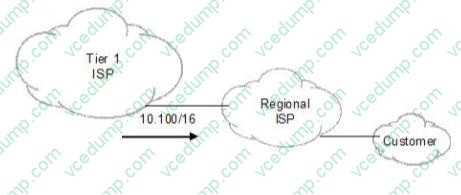
You work for the regional Internet service provider shown in the exhibit You have a partial BGP table and are receiving a 10 100/16 route from your upstream ISP You have been asked to configure a default route that can be sent to your downstream customer This route should forward customer traffic toward your upstream Tier 11SP as long as the 10.100/16 route is present.
What would accomplish this goal?
A. Create and announce an aggregate default route
B. Create and announce a static default route with a next-hop of discard
C. Create and announce a static default route with a next-hop of reject
D. Create and announce a generated default route
E. Create an advertise-map with exist-map -
Question 134:
By default, which BGP attribute is only compared when two route advertisements are received from the same neighboring AS?
A. MED
B. AS-Path
C. Communities
D. Next Hop -
Question 135:
A route to the same destination is received from two different BGP sources. Which criterion is considered first to determine the active BGP route?
A. cluster length
B. AS-path length
C. lowest RID
D. local preference -
Question 136:
Which two events could cause the BGP Active state to appear? (Choose two.)
A. The local router does not have a route to the peer device.
B. The local router failed to establish a TCP connection with the peer device.
C. A firewall is stopping all UDP packets.
D. The BGP configuration is incomplete. -
Question 137:
Which fields are added to an Ethernet frame when using Q-in-Q?
A. S-VLAN and C-VLAN
B. S-VLAN and D-VLAN
C. P-VLAN and D-VLAN
D. P-VLAN and C-VLAN -
Question 138:
What are three functions of a provider edge bridge when implementing provider bridging? (Choose three.)
A. to forward frames based only on the S-VLAN tag
B. to encapsulate customer frames and append a C-VLAN tag
C. to forward IEEE 802.1Q frames to customers
D. to encapsulate customer frames using the IEEE 802.1ad format
E. to forward customer frames across a provider bridged network -
Question 139:
Click the Exhibit.
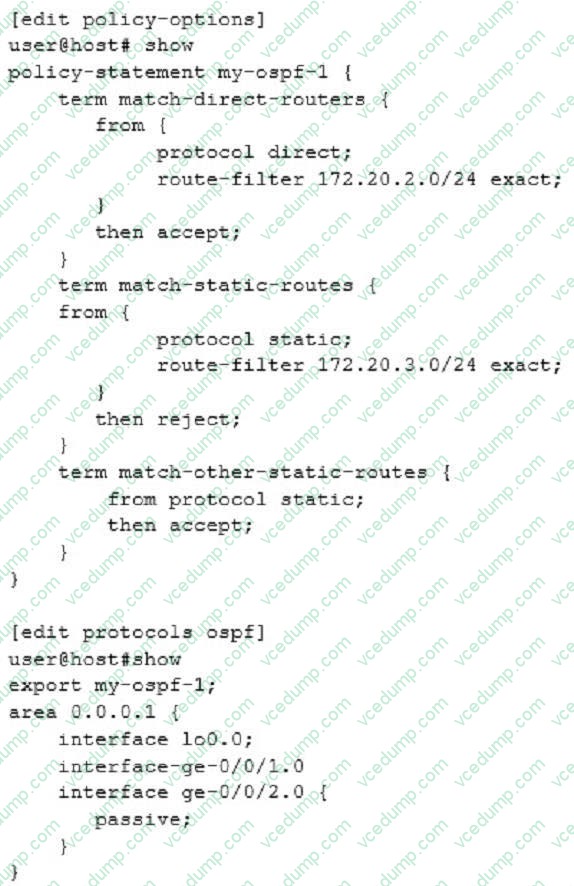
The router with the configuration shown in the exhibit has two interfaces, both of which are operational and can pass traffic. These interfaces are connected to two different routers, both of which are configured for OSPF area 0.0.0.1. The router has received LSAs and can now send traffic into the backbone area.
Which two statements are correct? (Choose two.)
A. The router is an ASBR.
B. The router has only a single OSPF adjacency.
C. The router is an ABR.
D. The router has two OSPF adjacencies. -
Question 140:
Which two statements are true about the BGP MED attribute? (Choose two.)
A. It has a default value of 100
B. It has an assumed value of 0
C. It is designed for use when multiple connections exist between the same two autonomous systems
D. It is designed for use when a BGP router is peering with at least two different autonomous systems
Related Exams:
-
JN0-102
Internet Associate, Junos(JNCIA-Junos) -
JN0-104
Junos, Associate (JNCIA-Junos) -
JN0-105
Junos, Associate (JNCIA-Junos) -
JN0-106
Junos - Associate (JNCIA-Junos) Junos OS 21.2 -
JN0-1101
Juniper Networks Certified Design Associate (JNCDA) -
JN0-1103
Design, Associate (JNCIA-Design) -
JN0-130
Juniper networks Certified internet specialist.e(jncis-e) -
JN0-1301
Data Center Design, Specialist (JNCDS-DC) -
JN0-1302
Data Center Design Specialist (JNCDS-DC) -
JN0-1331
Security Design, Specialist (JNCDS-SEC)
Tips on How to Prepare for the Exams
Nowadays, the certification exams become more and more important and required by more and more enterprises when applying for a job. But how to prepare for the exam effectively? How to prepare for the exam in a short time with less efforts? How to get a ideal result and how to find the most reliable resources? Here on Vcedump.com, you will find all the answers. Vcedump.com provide not only Juniper exam questions, answers and explanations but also complete assistance on your exam preparation and certification application. If you are confused on your JN0-361 exam preparations and Juniper certification application, do not hesitate to visit our Vcedump.com to find your solutions here.