JN0-351 Exam Details
-
Exam Code
:JN0-351 -
Exam Name
:Enterprise Routing and Switching, Specialist (JNCIS-ENT) -
Certification
:Juniper Certifications -
Vendor
:Juniper -
Total Questions
:175 Q&As -
Last Updated
:May 31, 2026
Juniper JN0-351 Online Questions & Answers
-
Question 111:
Which two statements are correct about using firewall filters on EX Series switches? (Choose two.)
A. You can deploy only stateless firewall filters on an EX Series switch.
B. You can only apply firewall filters to Layer 2 traffic on an EX Series switch.
C. You can apply firewall filters to both Layer 2 and Layer 3 traffic on an EX Series switch.
D. You can deploy both stateless and stateful firewall filters on an EX Series switch. -
Question 112:
Which two statements are true about GRE tunnels on Junos devices? (Choose two.)
A. Only one GRE tunnel can be included for each logical unit.
B. Multiple GRE tunnels can be included for each logical unit.
C. GRE interfaces can include multiple logical units.
D. GRE interfaces can include only a single logical unit. -
Question 113:
Click the Exhibit button.
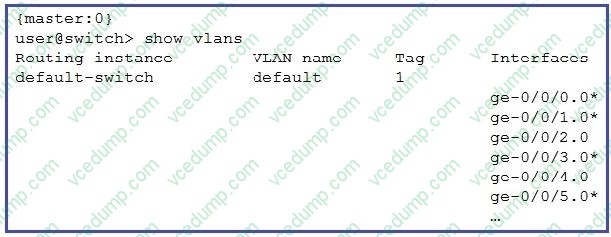
Referring to the exhibit, what does the asterisk(*) following the ge-0/0/5.0 interface indicate?
A. It indicates the interface is not active.
B. It indicates the interface is a trunk port.
C. It indicates the interface is an access port.
D. It indicates the interface is active. -
Question 114:
Referring to the exhibit, which two statements are correct? (Choose two.)
A. R2 and R3 can form a Level 1 IS-IS adjacency.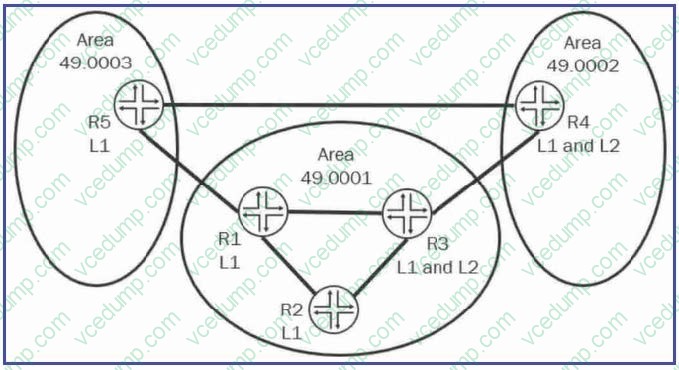
B. R4 and R5 can form a Level 1 IS-IS adjacency.
C. R1 and R5 can form a Level 1 IS-IS adjacency.
D. R3 and R4 can form a Level 2 IS-IS adjacency. -
Question 115:
What are three types of port designation specific to Private VLANs? (Choose three.)
A. Promiscuous ports
B. Transparent ports
C. PVLAN trunk ports
D. Designated ports
E. Isolated ports -
Question 116:
Click the Exhibit button.
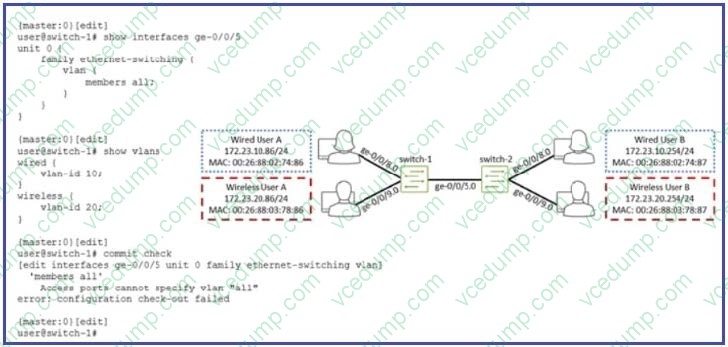
You are building a network and make some configuration changes. While trying to validate these changes, you receive the error shown in the exhibit.
How would you solve this problem?
A. You must create a new VLAN called all using the VLAN ID of 30.
B. You must configure the ge-0/0/5.0 interface with family inet instead of family ethernet- switching.
C. You must configure the port mode as trunk on the ge-0/0/5.0 interface.
D. You must create two sub-interfaces on ge-0/0/5 with the appropriate VLAN member assigned to each. -
Question 117:
Referring to the exhibit, which devices will receive the packet sent by User B?
A. User A and User D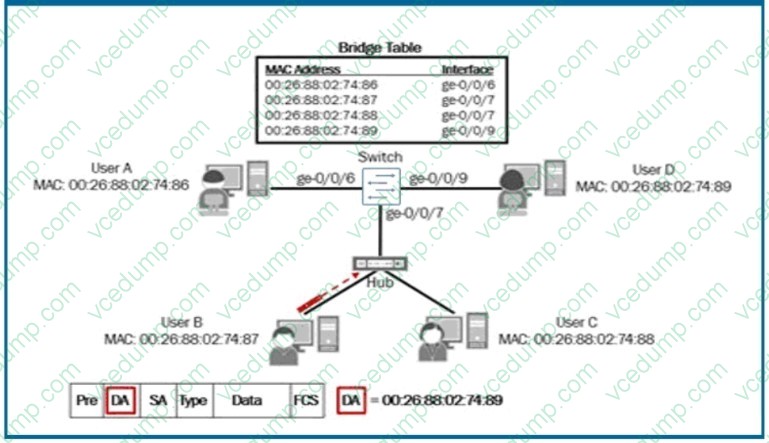
B. User C and User D
C. User C
D. User C, User A, and User D -
Question 118:
Click the Exhibit button.
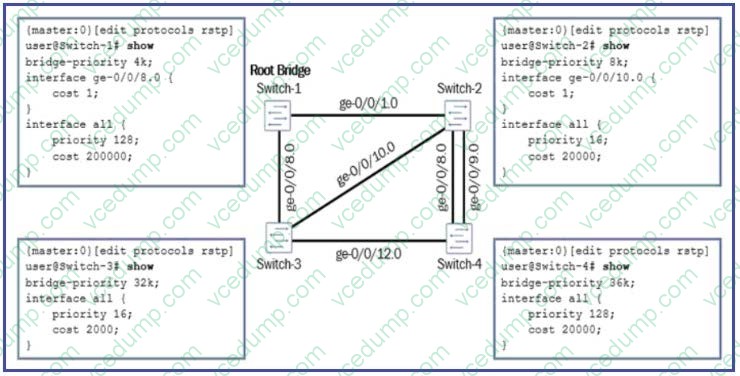
Referring to the exhibit, which port on Switch-2 will be selected as the RSTP root port?
A. ge-0/0/8.0
B. ge-0/0/9.0
C. ge-0/0/10.0
D. ge-0/0/1.0 -
Question 119:
Click the Exhibit button.
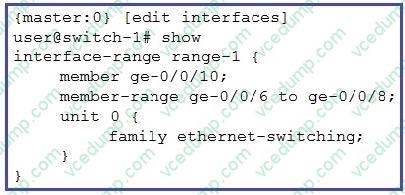
Referring to the exhibit, which set of interfaces is enabled for Ethernet switching?
A. ge-0/0/6, ge-0/0/7, and ge-0/0/8
B. ge-0/0/6, ge-0/0/8, and ge-0/0/10
C. ge0/0/6, ge-0/0/7, ge-0/0/8, and ge-0/0/10
D. ge-0/0/6 and ge-0/0/8 -
Question 120:
You are concerned about spoofed MAC addresses on your LAN.
Which two Layer 2 security features should you enable to minimize this concern? (Choose two.)
A. dynamic ARP inspection
B. IP source guard
C. DHCP snooping
D. static ARP
Related Exams:
-
JN0-102
Internet Associate, Junos(JNCIA-Junos) -
JN0-104
Junos, Associate (JNCIA-Junos) -
JN0-105
Junos, Associate (JNCIA-Junos) -
JN0-106
Junos - Associate (JNCIA-Junos) Junos OS 21.2 -
JN0-1101
Juniper Networks Certified Design Associate (JNCDA) -
JN0-1103
Design, Associate (JNCIA-Design) -
JN0-130
Juniper networks Certified internet specialist.e(jncis-e) -
JN0-1301
Data Center Design, Specialist (JNCDS-DC) -
JN0-1302
Data Center Design Specialist (JNCDS-DC) -
JN0-1331
Security Design, Specialist (JNCDS-SEC)
Tips on How to Prepare for the Exams
Nowadays, the certification exams become more and more important and required by more and more enterprises when applying for a job. But how to prepare for the exam effectively? How to prepare for the exam in a short time with less efforts? How to get a ideal result and how to find the most reliable resources? Here on Vcedump.com, you will find all the answers. Vcedump.com provide not only Juniper exam questions, answers and explanations but also complete assistance on your exam preparation and certification application. If you are confused on your JN0-351 exam preparations and Juniper certification application, do not hesitate to visit our Vcedump.com to find your solutions here.