Exhibit:
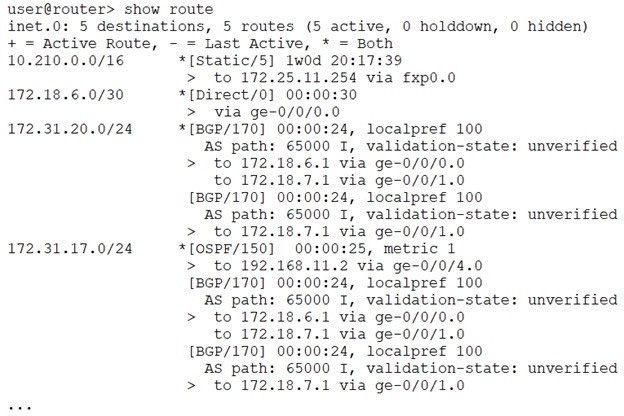
You notice traffic destined to 172.31.17.0/24 is traversing an OSPF path rather than BGP Path.
What is causing this behavior?
Show answer and explanation
Correct answer: B
JN0-105 Real Exam Questions
144 questions available · Page 1 of 15
Updated Exam DumpsVerified AnswersPass Guarantee
Exhibit:
You notice traffic destined to 172.31.17.0/24 is traversing an OSPF path rather than BGP Path.
What is causing this behavior?
Correct answer: B
Click the Exhibit button.
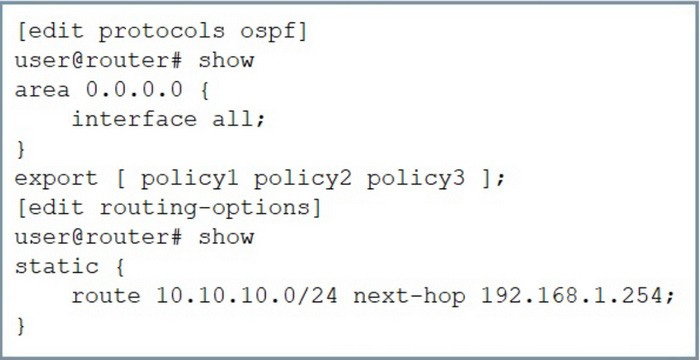
Referring to the exhibit, OSPF has three export policies that match different static route prefixes. The 10.10.10.0/24 static route does not match any terms in the policy1 routing policy.
What happens next in this scenario?
Correct answer: C
In Junos, when multiple policies are applied to a routing protocol for route export, the routes are evaluated in the order in which the policies are listed. In the exhibit, the OSPF configuration has three export policies listed: policy1, policy2, and policy 3. The static route 10.10.10.0/24 does not match any terms in policy1;
therefore, it is not rejected by policy1 but is instead passed on to the next policy in the sequence, which is policy 2. If the static route matches a term in policy2 that permits the route, it will be exported into OSPF. If it does not match in policy2, it will then be evaluated by policy 3. If there is no match in policy3 as well, and assuming there are no more policies listed, the route would then be subject to the default routing policy behavior, which typically rejects the route unless an explicit accept statement is present in the policies.
When considering routing policies, which two statements are correct? (Choose two.)
Correct answers: A, B
Routing policies in Junos OS are crucial for controlling route advertisements and path selection. The correct answers are B and C. An import routing policy for BGP determines which received prefix advertisements are placed in the routing information base (RIB), and policy terms are evaluated from top to bottom, with action taken on the first match found. This sequential evaluation allows for precise control over routing decisions.
What are two attributes of the UDP protocol? (Choose two.)
Correct answers: A, B
Click the Exhibit button
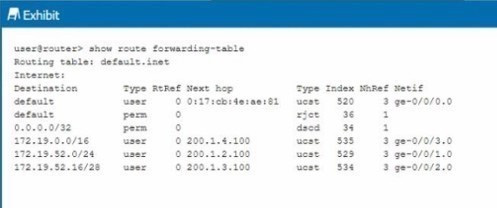
What is the next-hop interface for traffic destined to 172.19.52.101 as shown in the exhibit?
Correct answer: D
Which component is considered part of the data plane?
Correct answer: A
The Packet Forwarding Engine (PFE) is an integral component of Juniper Networks devices, responsible for the data plane operations. The data plane, also known as the forwarding plane, is where the actual processing and forwarding of packets occur based on the routing and forwarding tables. The PFE executes the forwarding decisions made by the Routing Engine (RE), handling all packet transmissions, including routing, filtering, and switching packets towards their destination. This contrasts with the control plane operations handled by the RE, which involve routing table maintenance, system management, and control protocol processing.
Which two statements apply to the Routing Engine functions? (Choose two.)
Correct answers: B, C
The Routing Engine (RE) in Juniper Networks devices plays a critical role in the control plane operations.
One of its functions includes responding to network utility commands like ping and traceroute, which are essential for diagnosing network connectivity and path issues. Furthermore, the RE is responsible for maintaining the routing tables, which contain information about network paths and destinations. These tables are vital for making forwarding decisions but are distinct from the actual forwarding of packets, which is handled by the Packet Forwarding Engine (PFE).
Click the Exhibit button
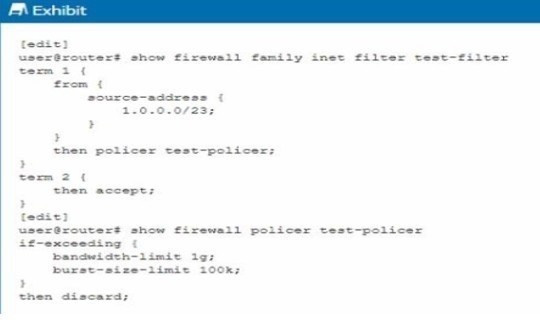
Referring to the exhibit, what will happen to traffic that is less than the bandwidth limit from source address
1.0.0.207
Correct answer: D
Click the Exhibit button.
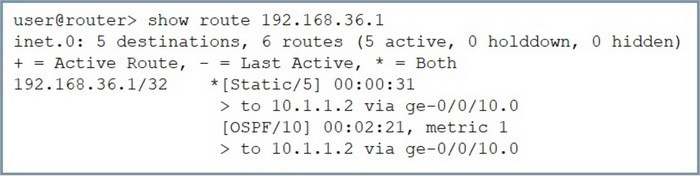
Referring to the exhibit, which route(s) will be selected by Junos for packet forwarding?
Correct answer: A
Junos OS selects routes based on the route preference (also known as administrative distance). Static routes typically have a lower route preference than OSPF routes, meaning they are more preferred. Since the static route to 192.168.36.1/32 is shown with a preference of 5, it will be selected over the OSPF route for packet forwarding, assuming no other factors such as route filters or policies affect the routing decision.
Which protocol is responsible for learning an IPv4 neighbor's MAC address?
Correct answer: B
The Address Resolution Protocol (ARP) is responsible for mapping an IPv4 address to a machine's MAC address. ARP operates at Layer 2 of the OSI model and is used to find the MAC address of a host given its IPv4 address. When a device wants to communicate with another device on the same local network, it uses ARP to discover the recipient's MAC address.
References:
Juniper official documentation: ARP.
Networking standards: RFC 826.