ISO-27001-LA Exam Details
-
Exam Code
:ISO-27001-LA -
Exam Name
:ISO/IEC 27001:2022 Lead Auditor -
Certification
:PECB Certifications -
Vendor
:PECB -
Total Questions
:394 Q&As -
Last Updated
:May 31, 2026
PECB ISO-27001-LA Online Questions & Answers
-
Question 321:
Which two of the following best describe the purpose of a stage 1 audit in an initial certification audit?
A. To confirm readiness for stage 2 by reviewing documented information and site-specific conditions
B. To test operational effectiveness of Annex A controls through extensive technical testing
C. To evaluate internal audit and management review performance for planning stage 2
D. To issue the certification decision -
Question 322:
Scenario 2: Knight is an electronics company from Northern California, US that develops video game consoles. Knight has more than 300 employees worldwide. On the fifth anniversary of their establishment, they have decided to deliver the G-Console, a new generation video game console aimed for worldwide markets. G-Console is considered to be the ultimate media machine of 2021 which will give the best gaming experience to players.
The console pack will include a pair of VR headset, two games, and other gifts.
Over the years, the company has developed a good reputation by showing integrity, honesty, and respect toward their customers. This good reputation is one of the reasons why most passionate gamers aim to have Knight's G-console as soon as it is released in the market.
Besides being a very customer-oriented company, Knight also gained wide recognition within the gaming industry because of the developing quality. Their prices are a bit higher than the reasonable standards allow.
Nonetheless, that is not considered an issue for most loyal customers of Knight, as their quality is top-notch.
Being one of the top video game console developers in the world, Knight is also often the center of attention for malicious activities. The company has had an operational ISMS for over a year. The ISMS scope includes all departments of Knight, except Finance and HR departments.
Recently, a number of Knight's files containing proprietary information were leaked by hackers. Knight's incident response team (IRT) immediately started to analyze every part of the system and the details of the incident.
The IRT's first suspicion was that Knight's employees used weak passwords and consequently were easily cracked by hackers who gained unauthorized access to their accounts. However, after carefully investigating the incident, the IRT determined that hackers accessed accounts by capturing the file transfer protocol (FTP) traffic.
FTP is a network protocol for transferring files between accounts. It uses clear text passwords for authentication.
Following the impact of this information security incident and with IRT's suggestion, Knight decided to replace the FTP with Secure Shell (SSH) protocol, so anyone capturing the traffic can only see encrypted data.
Following these changes, Knight conducted a risk assessment to verify that the implementation of controls had minimized the risk of similar incidents. The results of the process were approved by the ISMS project manager who claimed that the level of risk after the implementation of new controls was in accordance with the company's risk acceptance levels.
Based on this scenario, answer the following question:
Based on scenario 2, Knight decided to replace the FTP with Secure Shell (SSH) protocol. Should the Statement of Applicability (SoA) be updated in this case?
A. No, the usage of SSH protocol is not an ISO/IEC 27001 requirement and; therefore, does not need to be included in the SoA
B. No, because the SoA should be updated only when new controls are added, not when old ones are canceled
C. Yes, the implementation of the new control should be justified and included in the SoA -
Question 323:
A data processing tool crashed when a user added more data in the buffer than its storage capacity allows. The incident was caused by the tool's inability to bound check arrays. What kind of vulnerability is this?
A. Intrinsic vulnerability, because inability to bound check arrays is a characteristic of the data processing tool
B. Extrinsic vulnerability, because inability to bound check arrays is related to external factors
C. None, the tool's inability to bound check arrays is not a vulnerability, but a threat -
Question 324:
AppFolk, a software development company, is seeking certification against ISO/IEC 27001. In the initial phases of the external audit, the certification body in discussion with the company excluded the marketing division from the audit scope, although they stated in their ISMS scope that the whole company is included. Is this acceptable?
A. Yes, audit and ISMS scope do not necessarily need to be the same
B. No, divisions that are not critical for the industrial sector in which the auditee operates can be excluded from the audit scope
C. No, audit scope should reflect all of the organization's divisions covered by the ISMS -
Question 325:
Scenario 4: SendPay is a financial company that provides its services through a network of agents and financial institutions. One of their main services is transferring money worldwide. SendPay, as a new company, seeks to offer top quality services to its clients. Since the company offers international transactions, it requires from their clients to provide personal information, such as their identity, the reason for the transactions, and other details that might be needed to complete the transaction. Therefore,
SendPay has implemented security measures to protect their clients' information, including detecting, investigating, and responding to any information security threats that may emerge. Their commitment to offering secure services was also reflected during the ISMS implementation where the company invested a lot of time and resources.
Last year, SendPay unveiled their digital platform that allows money transactions through electronic devices, such as smartphones or laptops, without requiring an additional fee. Through this platform, SendPay's clients can send and receive money from anywhere and at any time. The digital platform helped SendPay to simplify the company's operations and further expand its business. At the time, SendPay was outsourcing its software operations, hence the project was completed by the software
development team of the outsourced company. The same team was also responsible for maintaining the technology infrastructure of SendPay.
Recently, the company applied for ISO/IEC 27001 certification after having an ISMS in place for almost a year. They contracted a certification body that fit their criteria. Soon after, the certification body appointed a team of four auditors to audit SendPay's ISMS.
During the audit, among others, the following situations were observed:
1.The outsourced software company had terminated the contract with SendPay without prior notice. As a result, SendPay was unable to immediately bring the services back in-house and its operations were disrupted for five days. The auditors requested from SendPay's representatives to provide evidence that they have a plan to follow in cases of contract terminations. The representatives did not provide any documentary evidence but during an interview, they told the auditors that the top management of
SendPay had identified two other software development companies that could provide services immediately if similar situations happen again. 2.There was no evidence available regarding the monitoring of the activities that were outsourced to the software development company. Once again, the representatives of SendPay told the auditors that they regularly communicate with the software development company and that they are appropriately informed for any possible change that might occur. 3.There was
no nonconformity found during the firewall testing. The auditors tested the firewall configuration in order to determine the level of security provided by these services. They used a packet analyzer to test the firewall policies which enabled them to check the packets sent or received in real-time.
Based on this scenario, answer the following question:
Based on scenario 4, the auditors requested documentary evidence regarding the monitoring process of outsourced operations. What does this indicate?
A. The auditors demonstrated professional skepticism
B. The auditors compromised the confidentiality of outsourced operations
C. The auditors evaluated the evidence based on a risk-based approach -
Question 326:
You are performing an ISMS audit at a residential nursing home railed ABC that provides healthcare services. The next step in your audit plan is to verify the effectiveness of the continual improvement process. During the audit, you learned most of the residents' family members (90%) receive WeCare medical device promotional advertisements through email and SMS once a week via ABC's healthcare mobile app. All of them do not agree on the use of the collected personal data (or marketing or any other
purposes than nursing and medical care on the signed service agreement with ABC. They have very strong reason to believe that ABC is leaking residents' and family members' personal information to a non- relevant third party and they have filed complaints.
The Service Manager says that all these complaints have been treated as nonconformities, and the corrective actions have been planned and implemented according to the Nonconformity and Corrective management procedure. The corrective action involved stopping working with WeCare the medical device manufacturer immediately and asking them to delete all personal data received as well as sending an apology email to all residents and their family members.
You are preparing the audit findings. Select one option of the correct finding.
A. Nonconformity: ABC does not follow the signed healthcare service agreement with residents' family members
B. No nonconformity: I would like to collect more evidence on how the organisation defines the management system scope and see if they covered WeCare medical device manufacture
C. No nonconformity: The Service Manager implemented the corrective actions and the Customer Service Representative evaluates the effectiveness of implemented corrective actions
D. Nonconformity: The management review does not take the feedback from residents' family members into consideration -
Question 327:
Scenario:
Branding is a marketing company that works with some of the most famous companies in the US. To reduce internal costs. Branding has outsourced the software development and IT helpdesk operations to Techvology for over two years. Techvology. equipped with the necessary expertise, manages Branding's software, network, and hardware needs. Branding has implemented an information security management system (ISMS) and is certified against ISO/IEC 27001, demonstrating its commitment to
maintaining high standards of information security. It actively conducts audits on Techvology to ensure that the security of its outsourced operations complies with ISO/IEC 27001 certification requirements. During the last audit. Branding's audit team defined the processes to be audited and the audit schedule. They adopted an evidence based approach, particularly in light of two information security incidents reported by Techvology in the past year The focus was on evaluating how these incidents were addressed and ensuring compliance with the terms of the outsourcing agreement The audit began with a comprehensive review of Techvology's methods for monitoring the quality of outsourced operations, assessing whether the services provided met Branding's expectations and agreed-upon standards The auditors also verified whether Techvology complied with the contractual requirements established between the two entities This involved thoroughly examining the terms and conditions in the outsourcing agreement to guarantee that all aspects, including information security
measures, are being adhered to.
Furthermore, the audit included a critical evaluation of the governance processes Techvology uses to manage its outsourced operations and other organizations. This step is crucial for Branding to verify that proper controls and oversight mechanisms are in place to mitigate potential risks associated with the outsourcing arrangement.
The auditors conducted interviews with various levels of Techvology's personnel and analyzed the incident resolution records. In addition, Techvology provided the records that served as evidence that they conducted awareness sessions for the staff regarding incident management. Based on the information gathered, they predicted that both information security incidents were caused by incompetent personnel. Therefore, auditors requested to see the personnel files of the employees involved in the
incidents to review evidence of their competence, such as relevant experience, certificates, and records of attended trainings.
Branding's auditors performed a critical evaluation of the validity of the evidence obtained and remained alert for evidence that could contradict or question the reliability of the documented information received. During the audit at Techvology, the auditors upheld this approach by critically assessing the incident resolution records and conducting thorough interviews with employees at different levels and functions. They did not merely take the word of Techvology's representatives for facts; instead, they sought
concrete evidence to support the representatives' claims about the incident management processes.
Based on the scenario above, answer the following question:
Question:
According to Scenario, what type of audit evidence did the auditors collect to determine the source of the information security incidents?
A. Verbal and documentary evidence
B. Confirmative and technical evidence
C. Analytical and mathematical evidence -
Question 328:
DRAG DROP
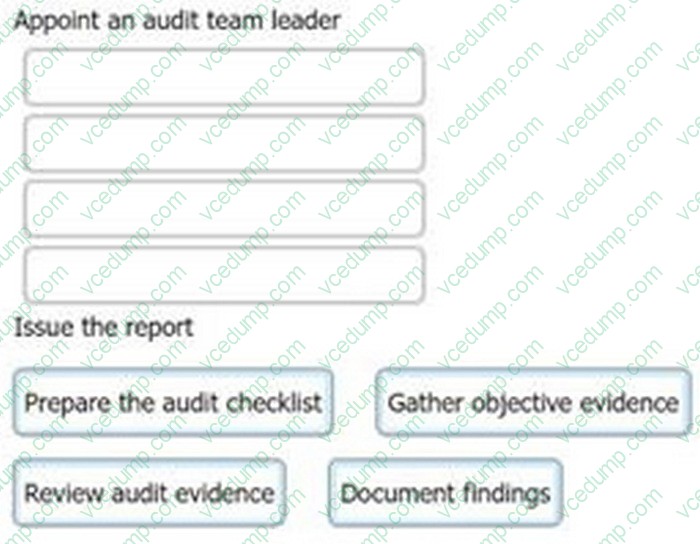
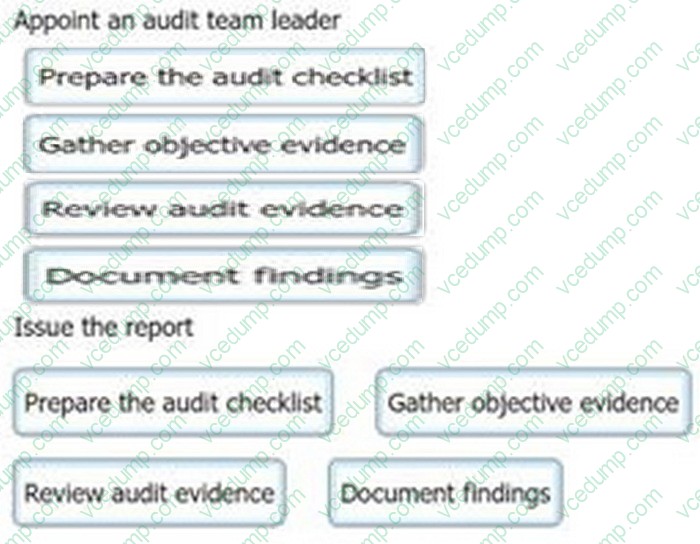
The following options are key actions involved in a first-party audit. Order the stages to show the sequence in which the actions should take place.
Select and Place:
-
Question 329:
DRAG DROP
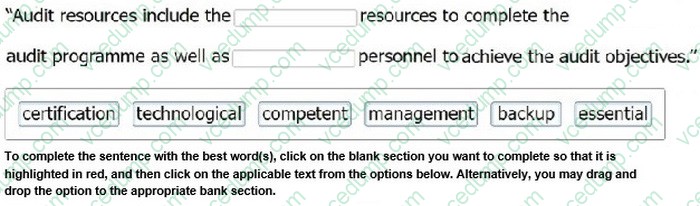
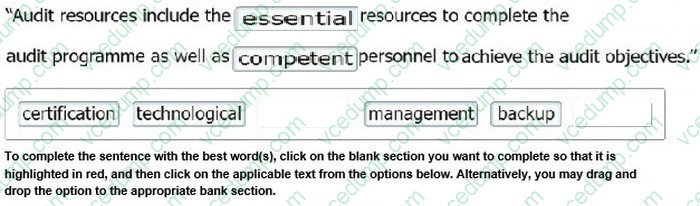
Select the words that best complete the sentence below to describe audit resources:
Select and Place:
-
Question 330:
Review the following statements and determine which two are false:
A. Conducting a technology check in advance of a virtual audit can improve the effectiveness and efficiency of the audit
B. During a virtual audit, auditees participating in interviews are strongly recommended to keep their webcam enabled
C. The number of days assigned to a third-party audit is determined by the auditee's availability
D. Due to confidentiality and security concerns, screen sharing during a virtual audit is one method by which the audit team can review the auditee's documentation
E. The selection of onsite, virtual or combination audits should take into consideration historical performance and previous audit results
F. Auditors approved for conducting onsite audits do not require additional training for virtual audits, as there are no significant differences in the skillset required
Related Exams:
-
ISO-20000-FND
ISO/IEC 20000 Foundation -
ISO-22301-BCMS-CLA
ISO 22301 BCMS - Certified Lead Auditor -
ISO-22301-LA
ISO 22301 Lead Auditor -
ISO-22301-LEAD-AUDITOR
PECB Certified ISO 22301 Lead Auditor Exam -
ISO-22301-LI
ISO 22301 Lead Implementer -
ISO-27001-ISMS-FND
ISO 27001:2013 ISMS - Foundation -
ISO-27001-LA
ISO/IEC 27001:2022 Lead Auditor -
ISO-27001-LI
ISO/IEC 27001:2022 Lead Implementer -
ISO-27002-LI
ISO/IEC 27002 - Lead Implementer -
ISO-27005-RM
ISO/IEC 27005 Risk Manager
Tips on How to Prepare for the Exams
Nowadays, the certification exams become more and more important and required by more and more enterprises when applying for a job. But how to prepare for the exam effectively? How to prepare for the exam in a short time with less efforts? How to get a ideal result and how to find the most reliable resources? Here on Vcedump.com, you will find all the answers. Vcedump.com provide not only PECB exam questions, answers and explanations but also complete assistance on your exam preparation and certification application. If you are confused on your ISO-27001-LA exam preparations and PECB certification application, do not hesitate to visit our Vcedump.com to find your solutions here.