ISO-27001-LA Exam Details
-
Exam Code
:ISO-27001-LA -
Exam Name
:ISO/IEC 27001:2022 Lead Auditor -
Certification
:PECB Certifications -
Vendor
:PECB -
Total Questions
:394 Q&As -
Last Updated
:May 31, 2026
PECB ISO-27001-LA Online Questions & Answers
-
Question 271:
During a certification audit, an auditor photocopies employee training attendance records containing personal identifiers and takes the copies off-site without the auditee's authorization. Which auditing principle is most directly at risk?
A. Integrity
B. Confidentiality
C. Fair presentation
D. Due professional care -
Question 272:
Scenario 5: Data Grid Inc. is a well-known company that delivers security services across the entire information technology infrastructure. It provides cybersecurity software, including endpoint security, firewalls, and antivirus software. For two decades, Data Grid Inc. has helped various companies secure their networks through advanced products and services. Having achieved reputation in the information and network security field, Data Grid Inc. decided to obtain the ISO/IEC 27001 certification to better
secure its internal and customer assets and gain competitive advantage.
Data Grid Inc. appointed the audit team, who agreed on the terms of the audit mandate. In addition, Data Grid Inc. defined the audit scope, specified the audit criteria, and proposed to close the audit within five days. The audit team rejected Data Grid Inc.'s proposal to conduct the audit within five days, since the company has a large number of employees and complex processes. Data Grid Inc. insisted that they have planned to complete the audit within five days, so both parties agreed upon conducting the
audit within the defined duration. The audit team followed a risk-based auditing approach.
To gain an overview of the main business processes and controls, the audit team accessed process descriptions and organizational charts. They were unable to perform a deeper analysis of the IT risks and controls because their access to the IT infrastructure and applications was restricted. However, the audit team stated that the risk that a significant defect could occur to Data Grid Inc.'s ISMS was low since most of the company's processes were automated. They therefore evaluated that the ISMS, as a
whole, conforms to the standard requirements by asking the representatives of Data Grid Inc. the following questions:
How are responsibilities for IT and IT controls defined and assigned?
How does Data Grid Inc. assess whether the controls have achieved the desired results?
What controls does Data Grid Inc. have in place to protect the operating environment and data from malicious software?
Are firewall-related controls implemented?
Data Grid Inc.'s representatives provided sufficient and appropriate evidence to address all these questions.
The audit team leader drafted the audit conclusions and reported them to Data Grid Inc.'s top management. Though Data Grid Inc. was recommended for certification by the auditors, misunderstandings were raised between Data Grid Inc. and the certification body in regards to audit objectives. Data Grid Inc. stated that even though the audit objectives included the identification of areas for potential improvement, the audit team did not provide such information.
Based on this scenario, answer the following question:
Data Grid Inc. is responsible for all the actions below, EXCEPT:
A. Specifying the audit criteria
B. Appointing the audit team
C. Defining the audit scope -
Question 273:
Scenario:
Techmanic is a Belgian company founded in 1995 and currently operating in Brussels. It provides IT consultancy, software design, and hardware/software services, including deployment and maintenance. The company serves sectors like public services, finance, telecom, energy, healthcare, and education. As a customer-centered company, it prioritizes strong client relationships and leading security practices.
Techmanic has been ISO/IEC 27001 certified for a year and regards this certification with pride. During the certification audit, the auditor found some inconsistencies in its ISMS implementation. Since the observed situations did not affect the capability of its ISMS to achieve the intended results, Techmanic was certified after auditors followed up on the root cause analysis and corrective actions remotely During that year, the company added hosting to its list of services and requested to expand its certification
scope to include that area The auditor in charge approved the request and notified Techmanic that the extension audit would be conducted during the surveillance audit
Techmanic underwent a surveillance audit to verify its iSMS's continued effectiveness and compliance with ISO/IEC 27001. The surveillance audit aimed to ensure that Techmanic's security practices, including the recent addition of hosting services, aligned seamlessly with the rigorous requirements of the certification
The auditor strategically utilized the findings from previous surveillance audit reports in the recertification activity with the purpose of replacing the need for additional recertification audits, specifically in the IT consultancy sector. Recognizing the value of continual improvement and learning from past assessments. Techmanic implemented a practice of reviewing previous surveillance audit reports. This proactive approach not only facilitated identifying and resolving potential nonconformities but also aimed to
streamline the recertification process in the IT consultancy sector.
During the surveillance audit, several nonconformities were found. The ISMS continued to fulfill the ISO/IEC 27001*s requirements, but Techmanic failed to resolve the nonconformities related to the hosting services, as reported by its internal auditor. In addition, the internal audit report had several inconsistencies, which questioned the independence of the internal auditor during the audit of hosting services. Based on this, the extension certification was not granted. As a result. Techmanic requested a
transfer to another certification body. In the meantime, the company released a statement to its clients stating that the ISO/IEC 27001 certification covers the IT services, as well as the hosting services.
Based on the scenario above, answer the following question:
Question:
Auditors recommended Techmanic for certification after following up on corrective actions remotely . Is this acceptable?
A. Yes, auditors may follow up on action plans remotely since minor nonconformities were detected
B. No, an audit follow-up must be performed since the audit report contained nonconformities
C. No, an audit follow-up must be performed on-site since an extension was requested -
Question 274:
DRAG DROP
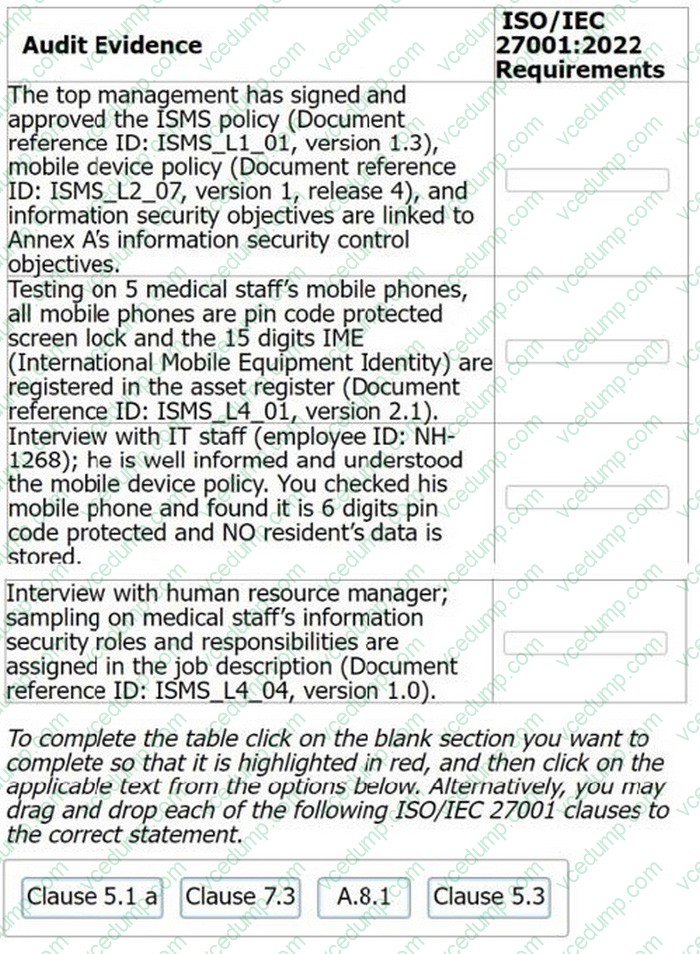
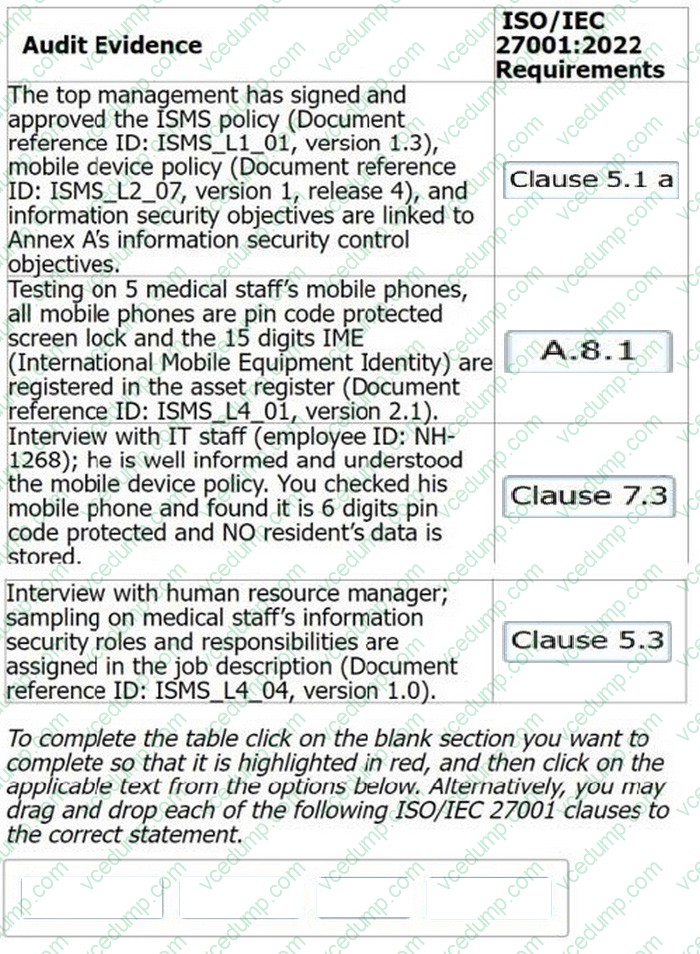
You are performing an ISMS audit at a European-based residential nursing home called ABC that provides healthcare services. You find all nursing home residents wear an electronic wristband for monitoring their location, heartbeat, and blood pressure always. You learned that the electronic wristband automatically uploads all data to the artificial intelligence (AI) cloud server for healthcare monitoring and analysis by healthcare staff.
The next step in your audit plan is to verify that the information security policy and objectives have been established by top management.
During the audit, you found the following audit evidence.
Match the audit evidence to the corresponding requirement in ISO/IEC 27001:2022.
Select and Place:
-
Question 275:
Scenario: SunPort Logistics uses removable drives to transfer shipping manifests. The procedure states "Sensitive manifests shall not be stored on removable media." During the audit, you find 2 out of 80 removable drives contain sensitive manifests due to mislabeling. Which two Annex A controls are most directly implicated?
A. 5.13 Labelling of information
B. 6.3 Information security awareness, education and training
C. 7.10 Storage media
D. 8.15 Logging -
Question 276:
DRAG DROP
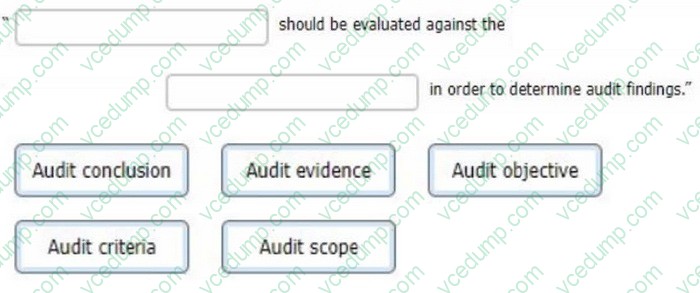
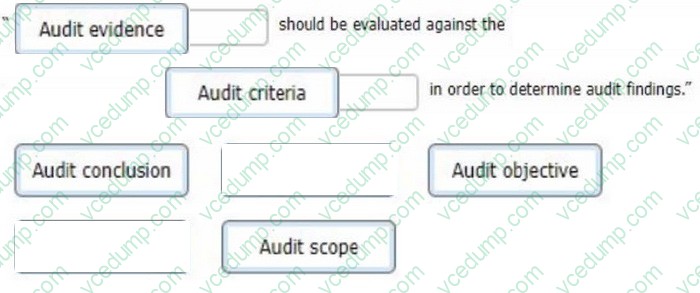
In regard to generating an audit finding, select the words that best complete the following sentence.
To complete the sentence with the best word(s), click on the blank section you want to complete so that it Is highlighted in red, and then click on the applicable text from the options below. Alternatively, you may drag and drop the option to the appropriate blank section.
Select and Place:
-
Question 277:
You are an experienced ISMS audit team leader guiding an auditor in training. You are testing her understanding of follow-up audits by asking her a series of questions to which the answer is either "true* or 'false'. Which four of the following questions should the answer be true"'
A. A follow-up audit may be carried out where nonconformities are major
B. A follow-up audit may be carried out where nonconformities are minor
C. The outcomes of a follow-up audit should be reported to top management and the audit team leader who carried out the audit where the nonconformities were initially identified
D. The outcome of a follow-up audit could lower a major nonconformity to minor status
E. The outcome of a follow-up audit could be a recommendabon to suspend the client's certification
F. The outcomes of a follow-up audit should be reported to the individual managing the audit programme and the audit client
G. A follow-up audit is required in all instances where nonconformities have been identified
H. A follow-up audit is required only in instances where a major nonconformity has been identified -
Question 278:
DRAG DROP
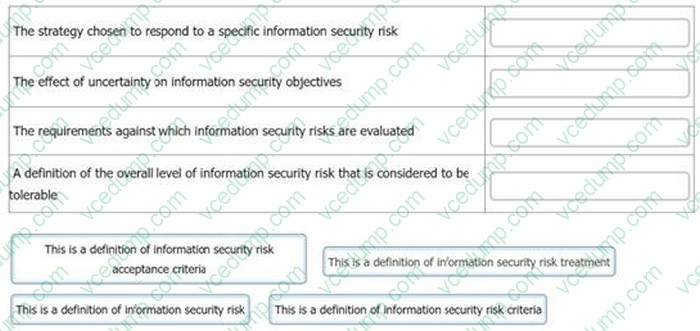
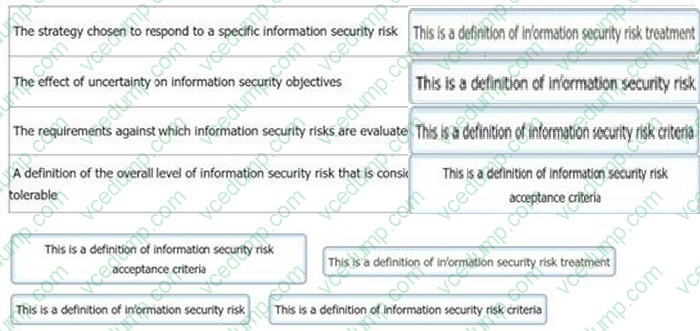
You have just completed a scheduled information security audit of your organisation when the IT Manager approaches you and asks for your assistance in the revision of the company's risk management process.
He is attempting to update the current documentation to make it easier for other managers to understand, however, it is clear from your discussion he is confusing several key terms.
You ask him to match each of the descriptions with the appropriate risk term. What should the correct answers be?
Select and Place:
-
Question 279:
DRAG DROP
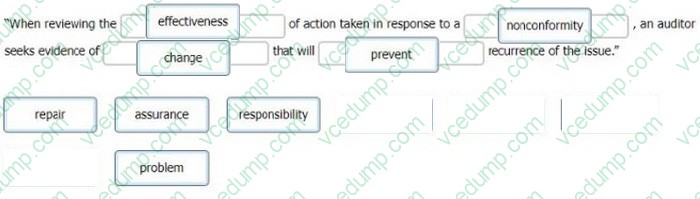
You are performing an ISMS audit at a European-based residential nursing home called ABC that provides healthcare services. The next step in your audit plan is to verify the effectiveness of the continual improvement process.
During the audit, you learned most of the residents' family members (90%) receive WeCare medical devices promotion advertisements through email and SMS once a week via ABC's healthcare mobile app. All of them do not agree on the use of the collected personal data for marketing or any other purposes than nursing and medical care on the signed service agreement with ABC. They have very strong reason to believe that ABC is leaking residents' and family members' personal information to a non-relevant third party and they have filed complaints.
The Service Manager says that, after investigation, all these complaints have been treated as nonconformities. The corrective actions have been planned and implemented according to the nonconformity and corrective management procedure (Document reference ID: ISMS_L2_10.1, version 1).
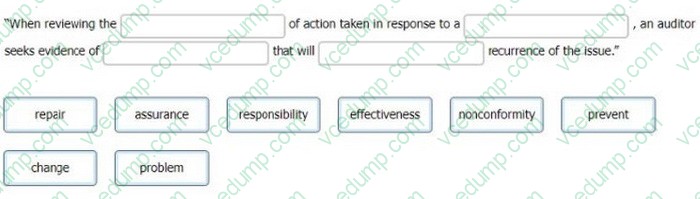
You write a nonconformity which you will follow up on later. Select the words that best complete the sentence:
Select and Place:
-
Question 280:
Scenario 8: EsBank provides banking and financial solutions to the Estonian banking sector since September 2010. The company has a network of 30 branches with over 100 ATMs across the country.
Operating in a highly regulated industry, EsBank must comply with many laws and regulations regarding the security and privacy of data. They need to manage information security across their operations by implementing technical and nontechnical controls. EsBank decided to implement an ISMS based on ISO/IEC 27001 because it provided better security, more risk control, and compliance with key requirements of laws and regulations.
Nine months after the successful implementation of the ISMS, EsBank decided to pursue certification of their ISMS by an independent certification body against ISO/IEC 27001 .The certification audit included all of EsBank's systems, processes, and technologies.
The stage 1 and stage 2 audits were conducted jointly and several nonconformities were detected. The first nonconformity was related to EsBank's labeling of information. The company had an information classification scheme but there was no information labeling procedure. As a result, documents requiring the same level of protection would be labeled differently (sometimes as confidential, other times sensitive).
Considering that all the documents were also stored electronically, the nonconformity also impacted media handling. The audit team used sampling and concluded that 50 of 200 removable media stored sensitive information mistakenly classified as confidential. According to the information classification scheme, confidential information is allowed to be stored in removable media, whereas storing sensitive information is strictly prohibited. This marked the other nonconformity.
They drafted the nonconformity report and discussed the audit conclusions with EsBank's representatives, who agreed to submit an action plan for the detected nonconformities within two months.
EsBank accepted the audit team leader's proposed solution. They resolved the nonconformities by drafting a procedure for information labeling based on the classification scheme for both physical and electronic formats. The removable media procedure was also updated based on this procedure.
Two weeks after the audit completion, EsBank submitted a general action plan. There, they addressed the detected nonconformities and the corrective actions taken, but did not include any details on systems, controls, or operations impacted. The audit team evaluated the action plan and concluded that it would resolve the nonconformities. Yet, EsBank received an unfavorable recommendation for certification.
Based on the scenario above, answer the following question:
Based on scenario 8, EsBank submitted a general action plan. Is this acceptable?
A. Yes, nonconformities with the same root cause should have a general action plan
B. No, an action plan should only address one nonconformity
C. No, a general action plan does not enable the correction of nonconformities
Related Exams:
-
ISO-20000-FND
ISO/IEC 20000 Foundation -
ISO-22301-BCMS-CLA
ISO 22301 BCMS - Certified Lead Auditor -
ISO-22301-LA
ISO 22301 Lead Auditor -
ISO-22301-LEAD-AUDITOR
PECB Certified ISO 22301 Lead Auditor Exam -
ISO-22301-LI
ISO 22301 Lead Implementer -
ISO-27001-ISMS-FND
ISO 27001:2013 ISMS - Foundation -
ISO-27001-LA
ISO/IEC 27001:2022 Lead Auditor -
ISO-27001-LI
ISO/IEC 27001:2022 Lead Implementer -
ISO-27002-LI
ISO/IEC 27002 - Lead Implementer -
ISO-27005-RM
ISO/IEC 27005 Risk Manager
Tips on How to Prepare for the Exams
Nowadays, the certification exams become more and more important and required by more and more enterprises when applying for a job. But how to prepare for the exam effectively? How to prepare for the exam in a short time with less efforts? How to get a ideal result and how to find the most reliable resources? Here on Vcedump.com, you will find all the answers. Vcedump.com provide not only PECB exam questions, answers and explanations but also complete assistance on your exam preparation and certification application. If you are confused on your ISO-27001-LA exam preparations and PECB certification application, do not hesitate to visit our Vcedump.com to find your solutions here.