ISO-27001-LA Exam Details
-
Exam Code
:ISO-27001-LA -
Exam Name
:ISO/IEC 27001:2022 Lead Auditor -
Certification
:PECB Certifications -
Vendor
:PECB -
Total Questions
:394 Q&As -
Last Updated
:May 31, 2026
PECB ISO-27001-LA Online Questions & Answers
-
Question 221:
DRAG DROP
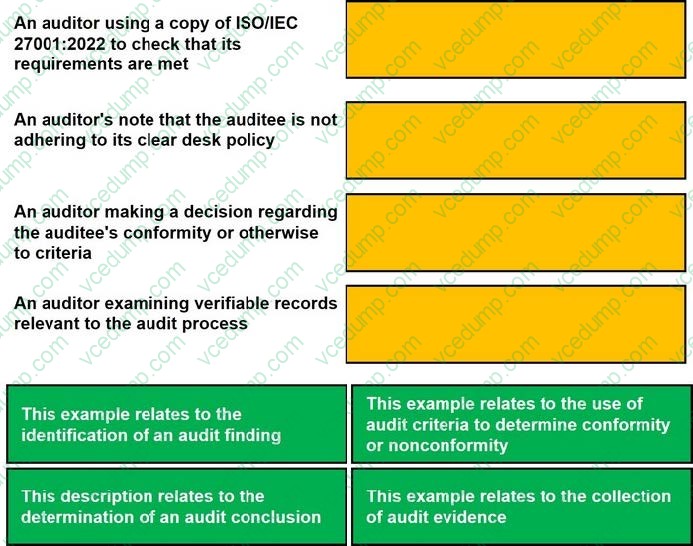
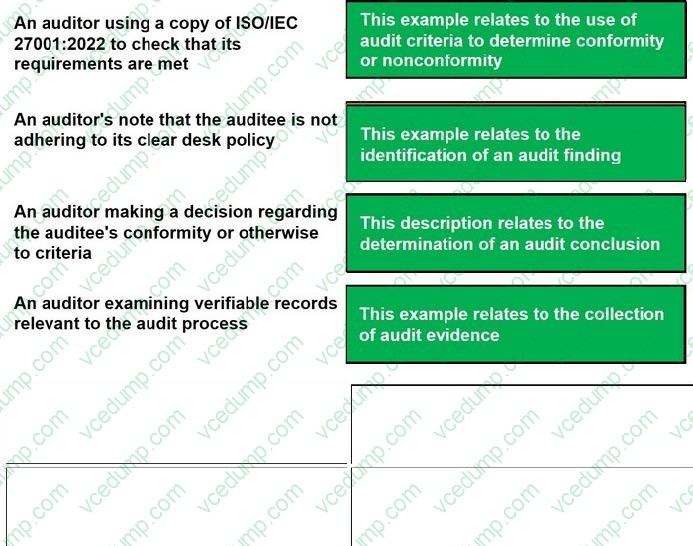
You are an experienced ISMS audit team leader, assisting an auditor in training to write their first audit report.
You want to check the auditor in training's understanding of terminology relating to the contents of an audit report and chose to do this by presenting the following examples.
For each example, you ask the auditor in training what the correct term is that describes the activity
Match the activity to the description.
Select and Place:
-
Question 222:
A property of Information that has the ability to prove occurrence of a claimed event.
A. Electronic chain letters
B. Integrity
C. Availability
D. Accessibility -
Question 223:
You are performing an ISMS audit at a residential nursing home that provides healthcare services. The next step in your audit plan is to verify the information security incident management process. The IT Security Manager presents the information security incident management procedure and explains that the process is based on ISO/IEC 27035-1:2016.
You review the document and notice a statement "any information security weakness, event, and incident should be reported to the Point of Contact (PoC) within 1 hour after identification". When interviewing staff, you found that there were differences in the understanding of the meaning of "weakness, event, and incident".
You sample incident report records from the event tracking system for the last 6 months with summarized results in the following table.
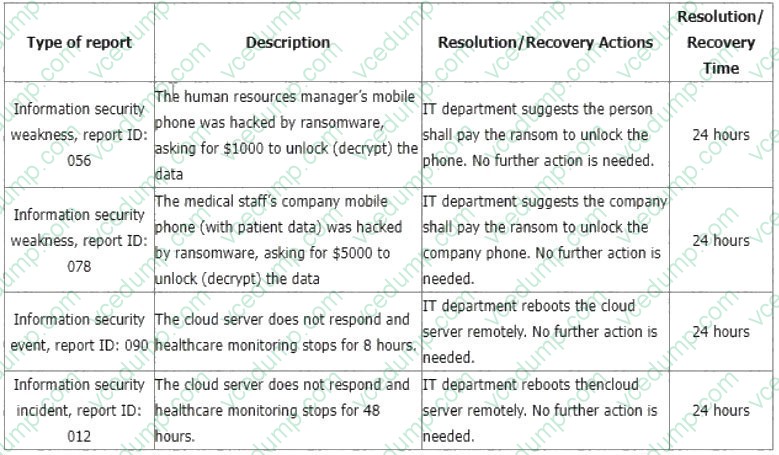
You would like to further investigate other areas to collect more audit evidence. Select two options that will not be in your audit trail.
A. Collect more evidence on how and when the Human Resources manager pays the ransom fee to unlock personal mobile data, i.e., credit card, and bank transfer. (Relevant to control A.5.26)
B. Collect more evidence on what the service requirements of healthcare monitoring are. (Relevant to clause 4.2)
C. Collect more evidence on how the organization determined no further action was needed after the incident. (Relevant to control A.5.26)
D. Collect more evidence on how the organisation determined the incident recovery time. (Relevant to control A.5.27)
E. Collect more evidence on the incident recovery procedures. (Relevant to control A.5.26)
F. Collect more evidence by interviewing more staff about their understanding of the reporting process.(Relevant to control A.6.8)
G. Collect more evidence on how and when the company pays the ransom fee to unlock the company's mobile phone and data, i.e., credit card, and bank transfer. (Relevant to control A.5.26) -
Question 224:
You are an experienced audit team leader guiding an auditor in training.
Your team is currently conducting a third-party surveillance audit of an organisation that stores data on behalf of external clients. The auditor in training has been tasked with reviewing the PEOPLE controls listed in the Statement of Applicability (SoA) and mplemented at the site.
Select four controls from the following that would you expect the auditor in training to review.
A. Confidentiality and nondisclosure agreements
B. How protection against malware is implemented
C. Information security awareness, education and training
D. Remote working arrangements
E. The conducting of verification checks on personnel
F. The operation of the site CCTV and door control systems
G. The organisation's arrangements for information deletion
H. The organisation's business continuity arrangements -
Question 225:
Three auditors were assigned to conduct a certification audit in Company X . Before the audit commenced, the certification body provided the auditors' names and background information to Company X. Company X requested the replacement of one of the auditors because they are a former employee. Is this acceptable?
A. A situation of conflict of interest is a valid reason to request the replacement of the auditor
B. No, the auditee can request the replacement of the auditor only if a valid reason is presented such as unprofessional conduct or situations with real conflict of interest
C. No, the auditee cannot request the replacement of auditors -
Question 226:
Scenario 7: Lawsy is a leading law firm with offices in New Jersey and New York City. It has over 50 attorneys offering sophisticated legal services to clients in business and commercial law, intellectual property, banking, and financial services. They believe they have a comfortable position in the market thanks to their commitment to implement information security best practices and remain up to date with technological developments.
Lawsy has implemented, evaluated, and conducted internal audits for an ISMS rigorously for two years now. Now, they have applied for ISO/IEC 27001 certification to ISMA, a well-known and trusted certification body.
During stage 1 audit, the audit team reviewed all the ISMS documents created during the implementation. They also reviewed and evaluated the records from management reviews and internal audits.
Lawsy submitted records of evidence that corrective actions on nonconformities were performed when necessary, so the audit team interviewed the internal auditor. The interview validated the adequacy and frequency of the internal audits by providing detailed insight into the internal audit plan and procedures.
The audit team continued with the verification of strategic documents, including the information security policy and risk evaluation criteria. During the information security policy review, the team noticed inconsistencies between the documented information describing governance framework (i.e., the information security policy) and the procedures.
Although the employees were allowed to take the laptops outside the workplace, Lawsy did not have procedures in place regarding the use of laptops in such cases. The policy only provided general information about the use of laptops. The company relied on employees' common knowledge to protect the confidentiality and integrity of information stored in the laptops. This issue was documented in the stage 1 audit report.
Upon completing stage 1 audit, the audit team leader prepared the audit plan, which addressed the audit objectives, scope, criteria, and procedures.
During stage 2 audit, the audit team interviewed the information security manager, who drafted the information security policy. He justified the Issue identified in stage 1 by stating that Lawsy conducts mandatory information security training and awareness sessions every three months.
Following the interview, the audit team examined 15 employee training records (out of 50) and concluded that Lawsy meets requirements of ISO/IEC 27001 related to training and awareness. To support this conclusion, they photocopied the examined employee training records.
Based on the scenario above, answer the following question:
Lawsy lacks a procedure regarding the use of laptops outside the workplace and it relies on employees' common knowledge to protect the confidentiality of information stored in the laptops. This presents:
A. An anomaly
B. A nonconformity
C. A conformity -
Question 227:
You are performing an ISMS audit at a residential nursing home that provides healthcare services. The next step in your audit plan is to verify the information security of the business continuity management process. During the audit, you learned that the organisation activated one of the business continuity plans (BCPs) to make sure the nursing service continued during the recent pandemic. You ask Service Manager to explain how the organisation manages information security during the business continuity
management process.
The Service Manager presents the nursing service continuity plan for a pandemic and summarises the process as follows:
Stop the admission of any NEW residents.
70% of administration staff and 30% of medical staff will work from home.
Regular staff self-testing including submitting a negative test report 1 day BEFORE they come to the office.
Install ABC's healthcare mobile app, tracking their footprint and presenting a GREEN Health Status QR-Code for checking on the spot.
You ask the Service Manager how to prevent non-relevant family members or interested parties from accessing residents' personal data when staff work from home. The Service Manager cannot answer and suggests the n" Security Manager should help with that. You would like to further investigate other areas to collect more audit evidence Select three options that will be in your audit trail.
A. Collect more evidence on how the organisation manages information security on mobile devices and during teleworking (Relevant to control A.6.7)
B. Collect more evidence by interviewing more staff about their feeling about working from home.(Relevant to clause 4.2)
C. Collect more evidence on what resources the organisation provides to support the staff working from home. (Relevant to clause 7.1)
D. Collect more evidence on how the organisation performs a business risk assessment to evaluate how fast the existing residents can be discharged from the nursing home. (Relevant to clause 6)
E. Collect more evidence on how and when the Business Continuity Wan has been tested. (Relevant to control A.5.29)
F. Collect more evidence on how the organisation makes sure only staff with a negative test result can enter the organisation (Relevant to control A.7.2) -
Question 228:
Scenario 8: EsBank provides banking and financial solutions to the Estonian banking sector since September 2010. The company has a network of 30 branches with over 100 ATMs across the country.
Operating in a highly regulated industry, EsBank must comply with many laws and regulations regarding the security and privacy of data. They need to manage information security across their operations by implementing technical and nontechnical controls. EsBank decided to implement an ISMS based on ISO/IEC 27001 because it provided better security, more risk control, and compliance with key requirements of laws and regulations.
Nine months after the successful implementation of the ISMS, EsBank decided to pursue certification of their ISMS by an independent certification body against ISO/IEC 27001 .The certification audit included all of EsBank's systems, processes, and technologies.
The stage 1 and stage 2 audits were conducted jointly and several nonconformities were detected. The first nonconformity was related to EsBank's labeling of information. The company had an information classification scheme but there was no information labeling procedure. As a result, documents requiring the same level of protection would be labeled differently (sometimes as confidential, other times sensitive).
Considering that all the documents were also stored electronically, the nonconformity also impacted media handling. The audit team used sampling and concluded that 50 of 200 removable media stored sensitive information mistakenly classified as confidential. According to the information classification scheme, confidential information is allowed to be stored in removable media, whereas storing sensitive information is strictly prohibited. This marked the other nonconformity.
They drafted the nonconformity report and discussed the audit conclusions with EsBank's representatives, who agreed to submit an action plan for the detected nonconformities within two months.
EsBank accepted the audit team leader's proposed solution. They resolved the nonconformities by drafting a procedure for information labeling based on the classification scheme for both physical and electronic formats. The removable media procedure was also updated based on this procedure.
Two weeks after the audit completion, EsBank submitted a general action plan. There, they addressed the detected nonconformities and the corrective actions taken, but did not include any details on systems, controls, or operations impacted. The audit team evaluated the action plan and concluded that it would resolve the nonconformities. Yet, EsBank received an unfavorable recommendation for certification.
Based on the scenario above, answer the following question:
Which option justifies the unfavorable recommendation for certification? Refer to scenario 8.
A. The major nonconformity related to storing sensitive information in removable media
B. The minor nonconformity related to the lack of information labeling procedure
C. The unrealistic date of the submitted action plan (two weeks) -
Question 229:
Finnco, a subsidiary of a certification body, provided ISMS consultancy services to an organization. Considering this scenario, when can the certification body certify the organization?
A. There is no time constraint in such a situation
B. At no time, since it presents a conflict of interest
C. If a minimum period of two years has passed since the last consulting activities -
Question 230:
Scenario 1: Fintive is a distinguished security provider for online payments and protection solutions. Founded in 1999 by Thomas Fin in San Jose, California, Fintive offers services to companies that operate online and want to improve their information security, prevent fraud, and protect user information such as PII. Fintive centers its decision-making and operating process based on previous cases. They gather customer data, classify them depending on the case, and analyze them. The company needed a
large number of employees to be able to conduct such complex analyses. After some years, however, the technology that assists in conducting such analyses advanced as well. Now, Fintive is planning on using a modern tool, a chatbot, to achieve pattern analyses toward preventing fraud in real-time. This tool would also be used to assist in improving customer service.
This initial idea was communicated to the software development team, who supported it and were assigned to work on this project. They began integrating the chatbot on their existing system. In addition, the team set an objective regarding the chatbot which was to answer 85% of all chat queries.
After the successful integration of the chatbot, the company immediately released it to their customers for use.
The chatbot, however, appeared to have some issues.
Due to insufficient testing and lack of samples provided to the chatbot during the training phase, in which it was supposed "to learn" the queries pattern, the chatbot failed to address user queries and provide the right answers. Furthermore, the chatbot sent random files to users when it received invalid inputs such as odd patterns of dots and special characters. Therefore, the chatbot was unable to properly answer customer queries and the traditional customer support was overwhelmed with chat queries and
thus was unable to help customers with their requests.
Consequently, Fintive established a software development policy. This policy specified that whether the software is developed in-house or outsourced, it will undergo a black box testing prior to its implementation on operational systems.
Based on this scenario, answer the following question:
The chatbot was supposed "to learn" the queries pattern to address user queries and provide the right answers.
What type of technology enables this?
A. Artificial intelligence
B. Cloud computing
C. Machine learning
Related Exams:
-
ISO-20000-FND
ISO/IEC 20000 Foundation -
ISO-22301-BCMS-CLA
ISO 22301 BCMS - Certified Lead Auditor -
ISO-22301-LA
ISO 22301 Lead Auditor -
ISO-22301-LEAD-AUDITOR
PECB Certified ISO 22301 Lead Auditor Exam -
ISO-22301-LI
ISO 22301 Lead Implementer -
ISO-27001-ISMS-FND
ISO 27001:2013 ISMS - Foundation -
ISO-27001-LA
ISO/IEC 27001:2022 Lead Auditor -
ISO-27001-LI
ISO/IEC 27001:2022 Lead Implementer -
ISO-27002-LI
ISO/IEC 27002 - Lead Implementer -
ISO-27005-RM
ISO/IEC 27005 Risk Manager
Tips on How to Prepare for the Exams
Nowadays, the certification exams become more and more important and required by more and more enterprises when applying for a job. But how to prepare for the exam effectively? How to prepare for the exam in a short time with less efforts? How to get a ideal result and how to find the most reliable resources? Here on Vcedump.com, you will find all the answers. Vcedump.com provide not only PECB exam questions, answers and explanations but also complete assistance on your exam preparation and certification application. If you are confused on your ISO-27001-LA exam preparations and PECB certification application, do not hesitate to visit our Vcedump.com to find your solutions here.