IMANET-CMA Exam Details
-
Exam Code
:IMANET-CMA -
Exam Name
:Certified Management Accountant (CMA) -
Certification
:IMANET Certifications -
Vendor
:IMANET -
Total Questions
:1336 Q&As -
Last Updated
:May 24, 2026
IMANET IMANET-CMA Online Questions & Answers
-
Question 1251:
In the decision making process, differential cost is a (n)
A. Sunk cost of alternative courses of action.
B. Fixed cost of alternative courses of action.
C. Opportunity cost of alternative courses of action.
D. Cost that changes among alternative courses of action. -
Question 1252:
The most likely effect of a marketing public relations (publicity) campaign is to
A. Increase overall promotion costs.
B. Reach only people exposed to other promotional tools.
C. Provide greater credibility than other promotional tools.
D. Have little effect on the corporate image. -
Question 1253:
An important concept in decision making is described as "the contribution to income that is forgone by not using a limited resource in its best alternative use." This concept is called
A. Marginal cost.
B. Incremental cost.
C. Potential cost.
D. Opportunity cost. -
Question 1254:
Copeland Inc. produces X-547 in a joint manufacturing process. The company is studying whether to sell X-547 at the split-off point or upgrade the product to become Xylene. The following information has been gathered:
I. Selling price per pound of X-547
II. Variable manufacturing costs of upgrade process Ill. Avoidable fixed costs of upgrade process
IV.
Selling price per pound of Xylene
V.
Joint manufacturing costs to produce X-547
Which items should be reviewed when making the upgrade decision?
A. I, II, and IV only.
B. I, II, Ill, and IV only.
C. I, II, IV, and V only.
D. II and Ill only. -
Question 1255:
The best advantage of a zero-coupon bond to the issuer is that the
A. Bond requires a low issuance cost.
B. Bond requires no interest income calculation to the holder or issuer until maturity.
C. Interest can be amortized annually by the APR method and need not be shown as an interest expense to the issuer
D. Interest can be amortized annually on a straight-line basis but is a noncash outlay -
Question 1256:
Scenario development
A. Is a quantitative forecasting method.
B. Is a method of determining an organization's direction?
C. Is used to identify courses of action.
D. Requires preparation of future event scenarios. -
Question 1257:
Zero-based budgeting forces managers to
A. Estimate a product's revenues and expenses over its expected life cycle.
B. Prepare a budget based on historical costs.
C. Formulate s budget by objective rather than function.
D. Justify all expenditures at the beginning of every budget period. -
Question 1258:
Two companies produce and sell the same product in a competitive industry. Thus, the selling price of the product for each company is the same. Company 1 has a contribution margin ratio of 40% and fixed costs of $25 million. Company 2 is more automated, making its fixed costs 40% higher than those of Company 1. Company 2 also has a contribution margin ratio that is 30% greater than that of Company 1. By comparison, Company 1 will have the
- breakeven point in terms of dollar sales volume and will have the
- dollar profit potential once the indifference point in dollar sales volume is exceeded.
A. Option A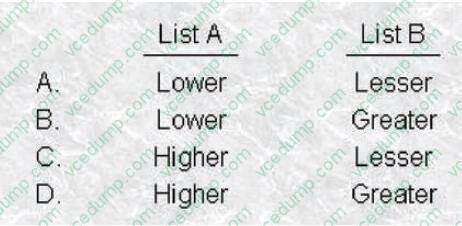
B. Option B
C. Option C
D. Option D -
Question 1259:
A company is considering two mutually exclusive projects with the following projected cash flows:
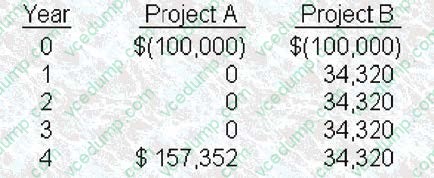
The company has a required rate of return of 8%. If the company's objective is to maximize shareholder wealth, which one of the following is the most valid reason for selecting one of the projects?
A. The net present value of Project A is greater than the net present value of Project B, therefore select Project A.
B. The net present value of Project A is less than the net present value of Project B, therefore select Project B.
C. The internal rate of return of Project A is greater than the internal rate of return of Project B, therefore select Project A.
D. The internal rate of return of Project A is less than the internal rate of return of Project B, therefore select Project B. -
Question 1260:
Calamity Cauliflower Corporation is considering undertaking a capital project. The company would have to commit $24000 of working capital in addition to an immediate outlay of $160 .000 for new equipment. The project is expected to generate $100 .000 of annual income for 10 years. At the end of that time, the new equipment, witch will be depreciated on a straight-line basis, is expected to have a salvage value of $ 10.000. The existing equipment that would be sold to make room for the project has a historical cost of $220,000 and accumulated depreciation of $208,000. It has an estimated remaining useful life of 2 years and the remaining book value is being depreciated on a straight-line basis. A scrap dealer has agreed to buy it for $8,000. The company's effective tax rate is 40%. Calamity Cauliflower's relevant after-tax annual cash inflow from the ongoing operations of the project is
A. $100,000
B. $60,000
C. $40,000
D. $0


Related Exams:
Tips on How to Prepare for the Exams
Nowadays, the certification exams become more and more important and required by more and more enterprises when applying for a job. But how to prepare for the exam effectively? How to prepare for the exam in a short time with less efforts? How to get a ideal result and how to find the most reliable resources? Here on Vcedump.com, you will find all the answers. Vcedump.com provide not only IMANET exam questions, answers and explanations but also complete assistance on your exam preparation and certification application. If you are confused on your IMANET-CMA exam preparations and IMANET certification application, do not hesitate to visit our Vcedump.com to find your solutions here.