IMANET IMANET-CMA Online Practice
Questions and Exam Preparation
IMANET-CMA Exam Details
Exam Code
:IMANET-CMA
Exam Name
:Certified Management Accountant (CMA)
Certification
:IMANET Certifications
Vendor
:IMANET
Total Questions
:1336 Q&As
Last Updated
:Jun 01, 2026
IMANET IMANET-CMA Online Questions &
Answers
Question 1131:
The internal rate of return on an investment
A. Usually coincides with the company's hurdle rate. B. Disregards discounted cash flows. C. May produce different rankings from the net present value method on mutually exclusive projects. D. Would tend to be reduced if a company used an accelerated method of depreciation for tax purposes rather than the straight-line method.
C. May produce different rankings from the net present value method on mutually exclusive projects.
Explanation
Investment projects may be mutually exclusive under conditions of capital rationing (limited capital). In other words, scarcity of resources will prevent an entity from undertaking all available profitable activities. Under the IRR method, an interest rate is computed such that the present value of the expected future cash flows equals the cost of the investment (NPV = 0). The IRR method assumes that the cash flows will be reinvested at the IRR. The NPV is the excess of the present value of the estimated net cash inflows over the net cost of the investment. The cost of capital must be specified in the NPV method. An assumption of the NPV method is that cash flows from the investment will be reinvested at the particular project's cost of capital. Because of the difference in the assumptions regarding the reinvestment of cash flows, the two methods will occasionally give different answers regarding the ranking of mutually exclusive projects. Moreover, the IRR method may rank several small, short-lived projects ahead of a large project with a lower rate of return but with a longer life span. However, the large project might return more dollars to the company because of the larger amount invested and the longer time span over which earnings will accrue. When faced with capital rationing, an investor will want to invest in projects that generate the most dollars in relation to the limited resources available and the size and returns from the possible investments. Thus, the NPV method should be used because it determines the aggregate present value for each feasible combination of projects.
Question 1132:
The U.S. Postal Service is looking for a new machine to help sort the mail. Two companies have submitted bids to Cliff Kraven, the postal inspector responsible for choosing a machine. A cash flow analysis of the two machines indicates the following:
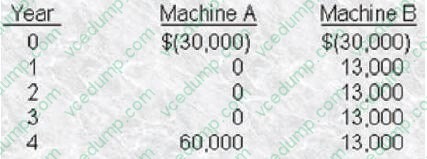
It the cost of capital for the Postal Service is 8%. which of the two mail sorters should Cliff choose and why?
A. Machine A. because NPV of A > NPV of B. by $1,044. B. Machine B. because NPV of A > NPV of B. by $22,000. C. Machine A. because NPV of A > NPV of B. by $8,000 D. Machine B. because IRR of A > IRR of B.
A. Machine A. because NPV of A > NPV of B. by $1,044.
Explanation
Question 1133:
Whatney Co. is considering the acquisition of a new, more efficient press. The cost of the press is $360,000, and the press has an estimated 6-year life with zero salvage value. Whatney uses straight-line depreciation for both financial reporting and income tax reporting purposes and has a 40% corporate income tax rate. In evaluating equipment acquisitions of this type, Whatney uses a goal of a 4-year payback period. To meet Whatney's desired payback period, the press must produce a minimum annual before4ax operating cash savings of
A. $90,000 B. $110,000 C. $114,000 D. $150,000
B. $110,000
Explanation
Payback is the number of years required to complete the return of the original investment. Given a periodic constant cash flow, the payback period equals net investment divided by the constant expected periodic after-tax cash flow. The desired payback period is 4 years1 so the constant after-tax annual cash flow must be $90,000 ($360,000 ?4). Assuming that the company has sufficient other income to permit realization of the full tax savings, depreciation of the machine will shield $60,000 ($360000 ?6) of income from taxation each year, an after-tax cash savings of $24000 ($60,000 x 40%). Thus, the machine must generate an additional $66,000 ($90,000 -- $24,000) of after-tax cash savings from operations. This amount is equivalent to $1 10,000 [$66,000 ?(1 .0 -- .4)] of before-tax operating cash savings.
Question 1134:
Capital budgeting is concerned with?
A. Decisions affecting only capital intensive industries. B. Analysis of short-range decisions. C. Analysis of long-range decisions. D. Scheduling office personnel in office buildings.
C. Analysis of long-range decisions.
Explanation
Capital budgeting is concerned with long-range decisions, such as whether to add a product line, to build new facilities, or to lease or buy equipment Any decision regarding cash inflows and outflows over a period of more than 1 year probably needs capital budgeting analysis.
Question 1135:
Total production costs of prior periods for a company are listed as follows. Assume that the same cost behavior patterns can be extended linearly over the range of 31000to 35. 000 units and that the cost driver for each cost is the number of units produced.

What is the average cost per unit at a production level of 8,000 units for costX?
A. $5. 98 B. $5. 85 C. $7. 90 D. $4. 83
A. $5. 98
Explanation
Question 1136:
A proposed investment is not expected to have any salvage value at the end of its 5-year life. Because of realistic depreciation practices, the net carrying amount and the salvage value are equal at the end of each year. For present value purposes, cash flows are assumed to occur at the end of each year. The company uses a 12% after-tax target rate of return.
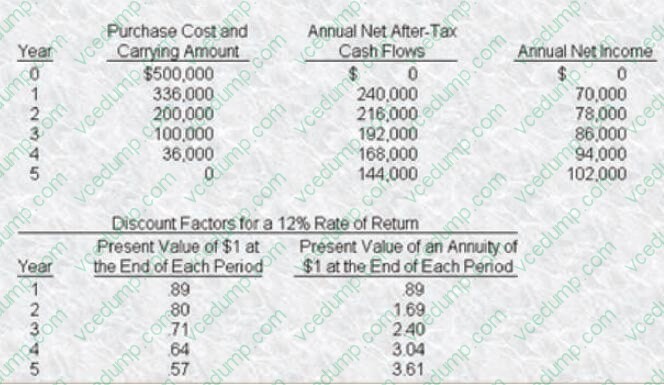
The traditional payback period is
A. Over5years. B. 2. 23years. C. 1.65years. D. 2. 83 years.
B. 2. 23years.
Explanation
The payback period is the number of years required to complete the return of the original investment. The cash flows are not time adjusted. When the annual cash flows are not uniform, a cumulative computation is necessary. Thus, the total paybackafter2years is $456,000 ($240,000 + $216,000), and another $44,000 ($500,000 -- $456,000) must be recovered in the third year. The third year fraction is found by assuming that cash flows occur evenly throughout the period. Dividing $44,000 by the $192,000 of third year inflows yields a ratio of .23. Hence, the payback period is 2. 23 years.
Question 1137:
The accounting rate of return?
A. Is sonorous with the internal rate of return. B. Focuses on income as opposed to cash flows. C. Is inconsistent with the divisional performance measure known as return on investment. D. Recognizes the time value of money.
B. Focuses on income as opposed to cash flows.
Explanation
The accounting rate of return (also called the unadjusted rate of return or book value rate of return) is calculated by dividing the increase in accounting net income by the required investment. Sometimes the denominator is the average investment rather than the initial irstment This method ignores the time value of money hand focuses on income as opposed to cash flows.
Question 1138:
Relevant costs refer to
A. All fixed costs. B. Costs that would be incurred within the relevant range of production. C. Past costs that are expected to be different in the future. D. Anticipated future costs that will differ among various alternatives.
D. Anticipated future costs that will differ among various alternatives.
Explanation
Relevant costs are anticipated costs that will vary among the choices available. In other words1 if two courses of action share some costs, those costs are not relevant because they will be incurred regardless of the decision made.
Question 1139:
Maloney Company uses a 12% hurdle rate for all capital expenditures and has done the following analysis for four projects for the upcoming year
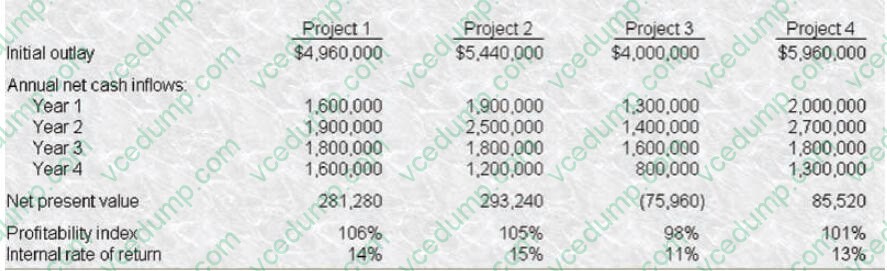
Which project(s) should Maloney undertake during the upcoming year if it has only $6,000,000 of funds available?
A. Project 3. B. Projects 1 and 2. C. Project 1. D. Project 2.
C. Project 1. D. Project 2.
Explanation
With only $6,000,000 available and each project costing $4,000,000 or more, no more than one project can be undertaken. Project 1 should be chosen because it has a positive NPV and the highest profitability index. The high profitability index means that the company will achieve the highest NPV per dollar of investment with Project 1.The profitability index facilitates comparison of different-sized investments.
Question 1140:
Maylar Corporation has sold $50 million of $1 .000 par value, 12% coupon bonds The bonds were sold at a discount and the corporation received $985 per bond. If the corporate tax rate is 40%. the after-tax cost of these bonds for the first year (rounded to the nearest hundredth percent) is
A. 7. 31%. B. 4. 87%. C. 12. 00%. D. 7. 09%.
A. 7. 31%.
Explanation
Interest is 12%, and the annual interest payment on one bond is $120.Thus the effective rate is 12. 18% ($120 $985).Reducing this rate by the 40% tax savings lowers the cost to 7. 31%.
Nowadays, the certification exams become more and more important and required by more and more
enterprises when applying for a job. But how to prepare for the exam effectively? How to prepare
for the exam in a short time with less efforts? How to get a ideal result and how to find the
most reliable resources? Here on Vcedump.com, you will find all the answers.
Vcedump.com provide not only IMANET exam questions,
answers and explanations but also complete assistance on your exam preparation and certification
application. If you are confused on your IMANET-CMA exam preparations
and IMANET certification application, do not hesitate to visit our
Vcedump.com to find your solutions here.