HPE7-A03 Exam Details
-
Exam Code
:HPE7-A03 -
Exam Name
:Aruba Certified Campus Access Architect -
Certification
:HP Certifications -
Vendor
:HP -
Total Questions
:70 Q&As -
Last Updated
:Jul 12, 2026
HP HPE7-A03 Online Questions & Answers
-
Question 1:
A global furniture retail company called 'No-Stair Inc.' requests you design their new WLAN infrastructure for a global footprint. Each location of No-Stair Inc.' has a similar layout: three small manager offices, a warehouse, and a 'retail' area. The 'retail' area and the warehouse together amount to 95% of the location. The IT department of the company Is minimally engaged In their LAN refresh so the CTO of the company has shared the information below
Current WLAN Infrastructure Is based on the 802.1 In "WlF14Less" access-points series (both model 2013-INT (2.4 only Internal antenna) and model 2019-EXT (dual-band external antenna only)). These AP models are standalone without any centralized management. Last year 'No-Stair InC ran a project called secure. It' ensuring that all needed network security was Implemented to be fully compliant with their security standards. During this project, they also upgraded the AAA infrastructure to handle the Increased AAA requests. No additional Wi-Fi or security requirements are listed for this WLAN refresh, which means that 'No-Stair Inc.' will continue to use bridged SSIDs. with local breakout into different VLANs.
The CTO of No-Stair Inc.' understands the need for you to ask additional questions to deliver the design The questions may be sent in written form and will be answered within two weeks.
Which additional question is correct in order to collect needed information for the WLAN design?
A. Who is the campus switch vendor?
B. Is there a current RF survey report that you can share?
C. What type of fiber connection Is used between the core and access layer switches?
D. IS there enough cooling In the MDF? -
Question 2:
A customer wants to have the ability to show network usage. Which product would allow them to have this visibility?
A. Central
B. ClearPass
C. UXI
D. Aruba OS 8.X -
Question 3:
'Don't Buy at Us' is a US-based retail company that is expanding Into Europe. They are expanding into EMEA with a regional headquarters called HQ2 inside The Netherlands.
Their US-based headquarters HQ1 was refreshed last year based on the Aruba ESP architecture. You have treated the design for HQ? based on the same design as HQ1. a two-tier architecture. The high level is shown below.
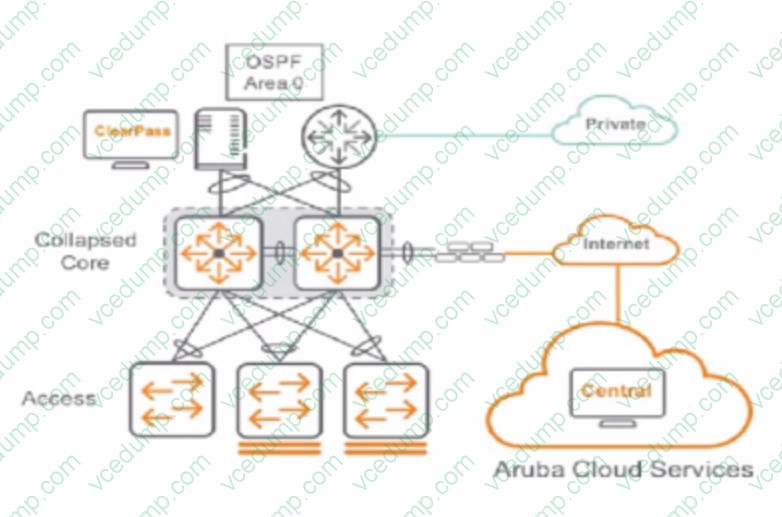
Switch BOM for this project based on Two Tier:
Collapsed Core: 2 x Aruba 8360-16Y2C in VSX (ISL 2?ICOG0E DAC)
Access Slack: 10 x Slack of Aruba 6200F 48G Class4 PoE 4SFP- 740W each stack has A members. VSF
with 10GbE VSF links) 12 x 10GbE uplink pet stack)
During the presentation of your design to the CTO of "Don't Buy at Us" you were informed about the changes they want you to incorporate into the updated design
1.HQ2 will include the EMEA regional distribution center (EMEA-OISTR) next to the HQ2.
2.Only two pairs of 0S1 are available between HQ2 and EMEA-DlSTR.
3.The uplinks from all access stacks need to increase to 2 x 25GbE. the fiber in HQ2 and EMEA-DI5TRI is certified for 25GbE.
4.EMEA-DlSTR needs at least 7 x stack of Aruba 48 ports switches (each stack has 4 members).
Whichanswer based on best practice is presenting the correct Switch BOM tor the updated design?
A. core: 2 x 8360-12C in VSX (ISL 2x100GbE DAC) aggregation: 2 x Aggregation stacks, each consists of 2 Aruba 8360-16Y2C in VSX (ISL 2x100GbE DAC, 2 x 25GbE uplinks per stack) access stack: 17 x stack of Aruba 6300F 48-port 1GbE Class 4 PoE and 4-port SFP56 (each stack has 4 members, VSF with 50GbE VSF links, 2 x 25GbE uplinks per stack)
B. core: 2 x 8360-12C in VSX (ISL 2x100GbE DAC) aggregation: 2 x aggregation stacks, each consists of 2 Aruba 8360-16Y2C in VSX (ISL 2x100GbE DAC, 2 x 100GbE uplinks per stack) access stack: 17 x stack of Aruba 6300F 48-port 1GbE Class 4 PoE and 4-port SFP56 (each stack has 4 members, VSF with 50GbE VSF links, 2 x 25GbE uplinks per stack)
C. core: 2 x 8360-12C in VSX (ISL 2x100GbE DAC) aggregation: 2 x aggregation stacks, each consists of 2 Aruba 8360-32Y4C in VSX (ISL 2x100GbE DAC, 2 x 100GbE uplinks per stack) access stack: 17 x stack of Aruba 6300F 48-port 1GbE Class 4 PoE and 4-port SFP56 (each stack has 4 members, VSF with 50GbE VSF links, 2 x 25GbE uplinks per stack)
D. collapsed core: 2 x 8360-16Y2C in VSX (ISL 2x100GbE DAC) access switch: 17 x stack of Aruba 6200F 48G Class4 PoE 4SFP+ 740W (each stack has 4 members, VSF with 10GbE VSF links, 2 x 10GbE uplinks per stack) -
Question 4:
The customer recently found out that Aruba OS-CX switches are capable of Application Recognition. What requirements should be fulfilled in order to do this? (Select two.)
A. 6400 with Aruba CX Advanced License
B. 6300F/M with Aruba CX Advanced License
C. 8360 with Aruba CX Advanced License
D. 6200F/M with Aruba CX Advanced License -
Question 5:
ACME retail has 38 locations spread out across Ave US states and two provinces in Canada. They are looking to grow 20% over the next two years. They have an HO with a staff of 200 employees. The organization has eight Regional Managers and two VPs who work from home and the road. Stores typically have 17 employees on average per location.
The two warehouses have a remote loading system and 20 employees each to load the trucks and fulfill the online orders. The warehouse has 40-foot ceilings and large metal racks to store inventory. The main location is 240K sq ft (22300 st) m) and the Canadian warehouse Is 130K sq ft (12100 sq ml. The forkllfts on the loading docks are equipped with a wireless tablet on board.
A typical store Is reportedly about 60.000 sq ft (5575 sqm) and smaller stores are planned at 25.000 sq ft '2320 sq mi. The locations need to expand the abilities to vendors that need to add setup displays or Interactive kiosks in the stores. The current Infrastructure was installed In 2015 and used wireless N technology in a coverage model. The wiring is CatS. and they are unsure of the fiber connections. The inventory is all placed on the floor when it is delivered to the local store.
Inventory control is handled through Zebra barcode scanners, and they have had a lot of issues in getting signals throughout the stores and this makes monthly inventory difficult. The organization has a small help desk to troubleshoot issues that happen at the retail locations and PC support for the office. The company is looking to upgrade away from the current pbx system later this year. With the need to grow and cut costs, they are interested in moving the data to the cloud but need to get almost real-time inventory control for the online service to function.
The network has all been wired over the last ten years, but with the new systems being all wireless, they have seen the trend to offer wireless to all the vendors for their needs but also would like to allow employees, guests, and contractors all to use it. With the new IT director starting next week, the project has been set by the CTO of the company. The marketing group has asked how they can interact with the customers and get more info, while the IT support desk needs to cut staff in halt.
The. office has an MDF and two IDFs located on floors one and two. The HOF is in the basement, and you have multiple WAN circuits for the HO links. Each store has a local handoff from the cable company (ethernet) In the middle of the store in the office, so distance for the wiring is not an issue.
The customer has budget concerns but does want something that could last 7+ years.
Which two projects does the customer have in the planning state? (Select two)
A. VoIP upgrade
B. Inventory Control System
C. kiosks/display station
E. new POS system -
Question 6:
DRAG DROP
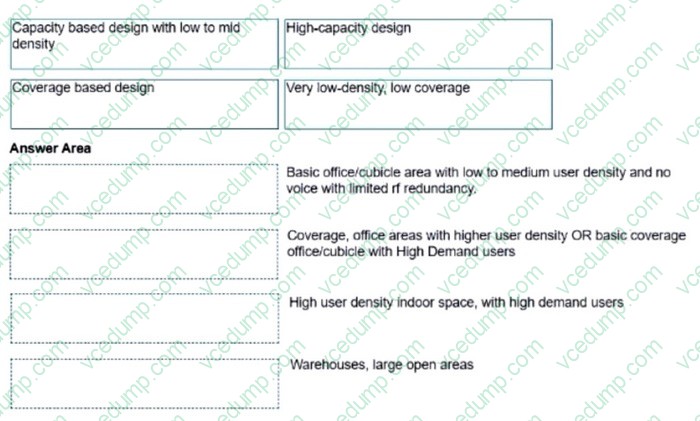
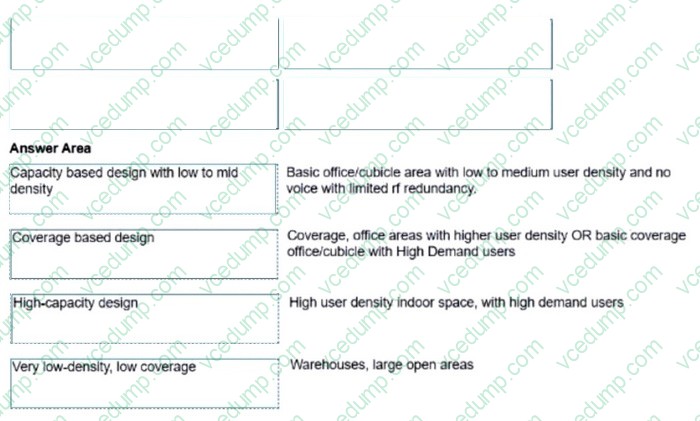
Match the deployment type with the usage scenario.
Select and Place:
-
Question 7:
You are delivering a replacement collapsed core network proposal to the customer where the core switches will have the switched virtual interlaces (SVl) configured. The customer is not sure that a USX pair of switches will Be able to act as I tie spanning tree root in their environment.
Which options are true about spanning tiee and VSX that will help assure the customer that a VSX pair of switches are appropriate for a collapsed core? (Select two.)
A. The primary vsx switch ts the spanning tree root and the default behavior is the links on the secondary vsx switch are blocked with sub-millisecond failover assured by vsx active-gateway.
B. When LAG interfaces are configured on a VSX pair of switches, both switches are "operational primary" and ensure active-active LAG operation equally.
C. Both VSX switches are configured with the system MAC and then create unique STP bridge-IDs to identify "operational primary" and "operational secondary" for proper STP functioning
D. Aruba VSX switches support either multiple spanning tree (MSTP) or rapid per VLAN spanning tree (RPVST).
E. The ISL between VSX switches is never part of STP domain and doesn't send or receive BPDUs on this link and this ensures the "operational primary" and "operational secondary" switches are deterministic to other dual-attached switches. -
Question 8:
A large multinational financial institution has contracted you to design a new full-stack wired and wireless network for their new 6-story regional office building. The bottom two floors of this facility willbe retail space for a large banking branch. The upper floors will be carpeted office space for corporate users, each floor being approximately 100.000 sq ft (9290 sqm). Data centers are all off site and will be out of scope for this project. The customer is underserved by its existing L2based network Infrastructure and would like to take advantage of modern best practices in the new design. The network should be fully resilient and fault-tolerant, with dynamic segmentation at the edge.
The retail space will include public guest Wi-Fi access. Retail associates will have corporate tablets for customer service, and there will be a mix of wired and wireless devices throughout the retail floors. The corporate users will primarily use wireless for connectivity, but several wired clients, printers, and hard VoIP phones will be In use.
The customer is also planning on renovating the corporate office space in order to take advantage of "smart office' technology. These improvements will drive blue-dot wayfinding. presence analytics, and other location-based services.
The client has decided that more critical switch stacks supporting Contact Center resources will need to support greater than 600W of CL4 PoE and have redundant power supplies These stacks will have approximately six members.
What would be the most economical choice Aruba switch series to meet these requirements?
A. Aruba CX 6100
B. Aruba CX 6400
C. Aruba CX6300F
D. Aruba CX6200M -
Question 9:
DRAG DROP
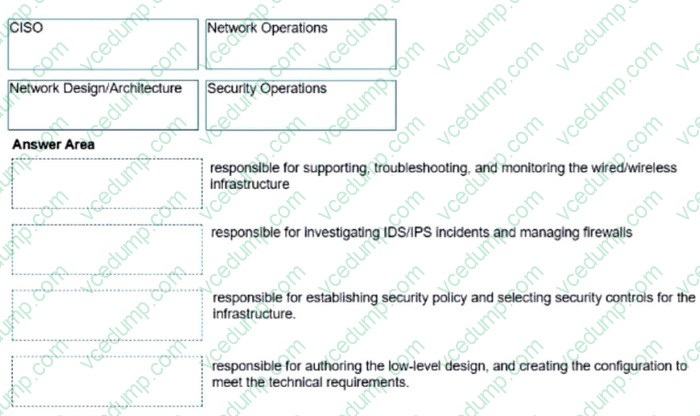
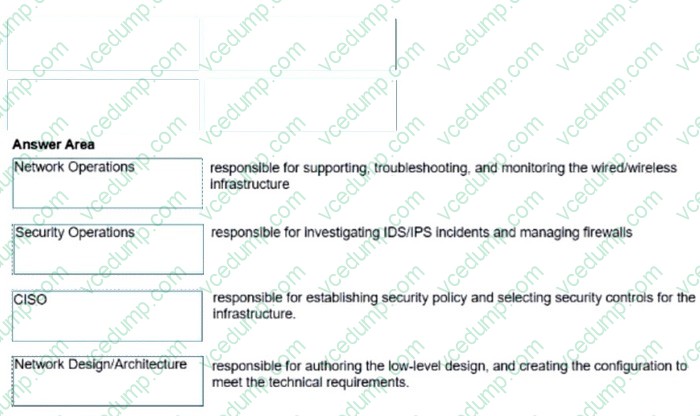
You hired a junior engineer to assist you with a large-scale network infrastructure project. The engineer has never worked on such a complex project before and wants to better understand the role that each stakeholder will play in the project.
Match the stakeholder title to the responsibilities that would most likely apply to their role.
Select and Place:
-
Question 10:
Which documentation resources con be used for finding validated information on Aruba products that assist the architect in building the solution design? (Select three.)
A. product reviews (CNET,Network World)
B. configuration guides
C. datasheets
D. Gartner annual reports
E. competitive documentation
F. validated Solution Guide
Related Exams:
-
HP0-003
HP OpenView Service Desk 5.x -
HP0-045
Supporting the ESL E-Series Lobraries -
HP0-052
Planning and Design of HP 9000/HP Integrity Server Solutions -
HP0-053
Enterprise Integration and Management of HP ProLiant Servers -
HP0-054
Compaq/Oracle 8i I and P with Windows NT -
HP0-055
Implementing HP ProLiant Servers -
HP0-058
Configuration and Management of HP Integrity Mid-Range Servers -
HP0-063
LF PROFESSIONAL COLOR WORKFLOW MANAGEMENT -
HP0-064
HP BladeSystems C-Class Solutions 1 -
HP0-065
Planning and Designing ProLiant Solutions for the Enterprise
Tips on How to Prepare for the Exams
Nowadays, the certification exams become more and more important and required by more and more enterprises when applying for a job. But how to prepare for the exam effectively? How to prepare for the exam in a short time with less efforts? How to get a ideal result and how to find the most reliable resources? Here on Vcedump.com, you will find all the answers. Vcedump.com provide not only HP exam questions, answers and explanations but also complete assistance on your exam preparation and certification application. If you are confused on your HPE7-A03 exam preparations and HP certification application, do not hesitate to visit our Vcedump.com to find your solutions here.