HPE6-A82 Exam Details
-
Exam Code
:HPE6-A82 -
Exam Name
:Aruba Certified ClearPass Associate -
Certification
:HP Certifications -
Vendor
:HP -
Total Questions
:60 Q&As -
Last Updated
:Jul 12, 2026
HP HPE6-A82 Online Questions & Answers
-
Question 41:
Which option supports DHCP profiling for devices in a network?
A. configuring ClearPass as a DHCP relay for the client
B. DHCP profiling is enabled on ClearPass by default; configuration of the network access devices is not necessary
C. enabling the DHCP server to profile endpoints and forward meta-data to ClearPass
D. enabling DHCP relay on our network access devices so DHCP requests are forwarded to ClearPass -
Question 42:
When is it appropriate to use the built-in Local user database in ClearPass?
A. In a public-facing guest network environment where the guests are prompted to self-register.
B. In small-business environments where the user accounts rarely change and new accounts are uncommon.
C. In a hospitality deployment for guest accounts created and managed by staff.
D. In a large campus environment where Students and Contractors account for 35.000 entries that change weekly. -
Question 43:
Refer to the exhibit.
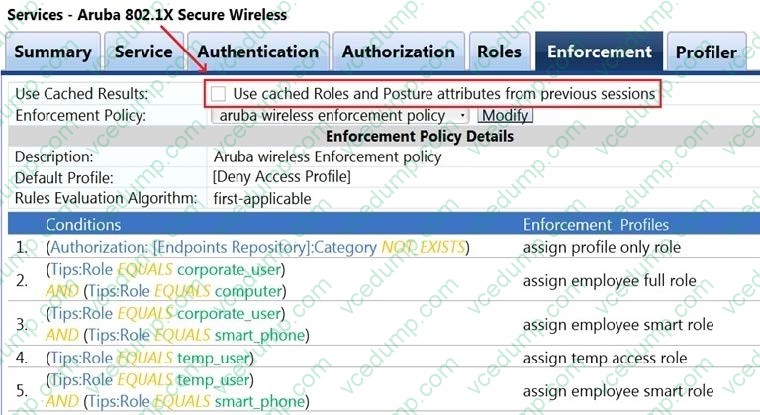
What is true regarding leaving the indicated option "Use cached Roles and Posture attributes from previous sessions" unchecked?
A. A posture change applied to an endpoint is going to be lost each time the client re-authenticates.
B. The service will make the enforcement decision based upon the updated Posture regardless of caching.
C. Posturing will no longer be evaluated in determining the enforcement policy for current or future sessions.
D. Cached posture results are no longer stored by ClearPass but instead are saved to the endpoint of the client. -
Question 44:
Which actions are necessary to set up a ClearPass guest captive portal web login page to execute with no errors? (Choose two.)
A. Configure the vendor settings in the Web Login page to match the Network Access Device (NAD).
B. Install a publicly signed HTTPS certificate in ClearPass and the Network Access Device (NAD).
C. Install an enterprise Certificate Authority (CA) signed HTTPS certificate in the Network Access Device (NAD).
D. Install an enterprise Certificate Authority (CA) signed HTTPS certificate in ClearPass and the Network Access Device (NAD).
E. Configure the vendor settings in the Network Access Device (NAD) to match the web login page. -
Question 45:
Sponsorship has been enabled on the guest network. A guest user connects and completes the self-registration form indicating a valid sponsor. The guest then clicks submit.
What is the current state of the guest account?
A. The guest account is created in an enabled state with the "Log In" button functional.
B. The guest account is created in disabled state, the "Log In" button will appear only after the sponsor approval process is completed.
C. The guest account is created in a disabled state with the "Log In" button grayed out.
D. The guest account is not yet created and remains in a disabled state. There is not "Log In" button yet displayed. -
Question 46:
When joining ClearPass to an Active Directory (AD) domain, what information is required? (Choose two.)
A. Fully Qualified Domain Name (FQDN) of the AD Domain Controller.
B. ClearPass Policy Manager (CPPM) enterprise credentials.
C. Domain Administrator credentials with at least read access.
D. Cache Timeout value set to at least 10 hours.
E. Domain User credentials with read-write access. -
Question 47:
What is RADIUS Change of Authorization (CoA)?
A. It is a mechanism that enables ClearPass to assigned a User-Based Tunnel (UBT) between a switch and controller for Dynamic Segmentation.
B. It allows clients to issue a privilege escalation request to ClearPass using RADIUS to switch to TACACS+.
C. It allows ClearPass to transmit messages to the Network Attached Device/Network Attached Server (NAD/NAS) to modify a user's session status.
D. It forces the client to re-authenticate upon roaming to an access point controlled by a foreign mobility controller. -
Question 48:
Which ClearPass fingerprint collectors are valid for active profiling of endpoints? (Choose two.)
A. HTTP user agents
B. IF-MAP
C. DHCP fingerprinting
D. NMAP
E. SNMP -
Question 49:
A customer with 677 employees would like to authenticate employees using a captive portal guest web login page. Employees should use their AD credentials to login on this page.
Which statement is true?
A. The customer needs to add second guest service in the policy manager for the guest network.
B. The customer needs to add the AD server as an authentication source in a guest service.
C. Employees must be taken to a separate web login page on the guest network.
D. The customer needs to add the AD servers RADIUS certificate to the guest network. -
Question 50:
Refer to the exhibit.
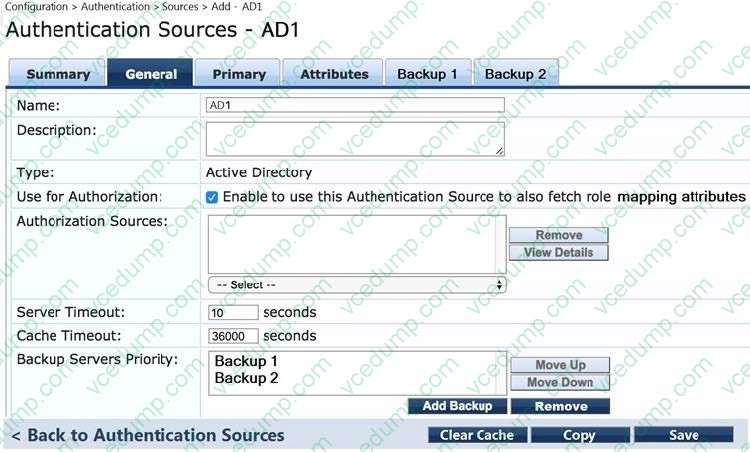
What are two consequences of the Cache Timeout being set to 36000 seconds? (Choose two.)
A. ClearPass will cache all user and machine attributes from AD every 10 hours in anticipation of one of those users or machines attempting to authenticate.
B. Less traffic is required between ClearPass and the AD server when re-authenticating within a 10 hour period.
C. The Cache Timeout is designed to reduce the amount of traffic between ClearPass and the AD server by caching user credentials for a 10 hour period.
D. A user changing departments may not see their Department attribute change in AD reflected while authenticating until the Cache Timeout period has ended.
E. On a failed authentication attempt, ClearPass will consider any subsequent attempts within 10 hours as total failed attempts before blacklisting the client.
Related Exams:
-
HP0-003
HP OpenView Service Desk 5.x -
HP0-045
Supporting the ESL E-Series Lobraries -
HP0-052
Planning and Design of HP 9000/HP Integrity Server Solutions -
HP0-053
Enterprise Integration and Management of HP ProLiant Servers -
HP0-054
Compaq/Oracle 8i I and P with Windows NT -
HP0-055
Implementing HP ProLiant Servers -
HP0-058
Configuration and Management of HP Integrity Mid-Range Servers -
HP0-063
LF PROFESSIONAL COLOR WORKFLOW MANAGEMENT -
HP0-064
HP BladeSystems C-Class Solutions 1 -
HP0-065
Planning and Designing ProLiant Solutions for the Enterprise
Tips on How to Prepare for the Exams
Nowadays, the certification exams become more and more important and required by more and more enterprises when applying for a job. But how to prepare for the exam effectively? How to prepare for the exam in a short time with less efforts? How to get a ideal result and how to find the most reliable resources? Here on Vcedump.com, you will find all the answers. Vcedump.com provide not only HP exam questions, answers and explanations but also complete assistance on your exam preparation and certification application. If you are confused on your HPE6-A82 exam preparations and HP certification application, do not hesitate to visit our Vcedump.com to find your solutions here.