HPE6-A45 Exam Details
-
Exam Code
:HPE6-A45 -
Exam Name
:Implementing Aruba Campus Switching solutions -
Certification
:HP Certifications -
Vendor
:HP -
Total Questions
:168 Q&As -
Last Updated
:May 30, 2026
HP HPE6-A45 Online Questions & Answers
-
Question 101:
Network administrators decide to change OSPF Area 1 to a stub area in order to solve some performance issues. No routes are redistributed into area 1. What is one implication of making this change?
A. Endpoints in Area 1 will no longer be able to reach external networks.
B. Routing devices in area 1 will no longer exchange Type 1 and Type 2 LSAs with each other.
C. Endpoints in Area 1 will no longer be able to reach endpoints in other areas.
D. Routing devices in area 1 will temporarily lose adjacency while the change is made. -
Question 102:
A company has a Unified Communications and Collaboration (UCC) solution.
Users run softphones on their desktops and laptops.
The UCC solution is configured to use a certain range of Layer 4 ports for VoIP traffic.
The user devices connect to AOS-Switches.
A network administrator needs to configure the AOS-Switches to prioritize only the VoIP traffic.
Where can the administrator configure a DSCP value to meet this goal?
A. in a global UDP port-based QoS policy
B. on the interfaces through which the VoIP traffic is forwarded
C. on the interfaces that connect to the user devices
D. on the VLAN to which the user devices are assigned -
Question 103:
An AOS-Switch has type of service disabled on it globally. The administrator enters:
AOS-Switch(config)# interface 1 qos trust device aruba-ap
What is the effect of this command?
A. if the AOS-Switch is integrated with an Aruba Mobility Controller, it uses QoS settings send by the controller to prioritize traffic sent on interface 1
B. if interface 1 connects to an Aruba AP, it uses the incoming DSCP and a global DSCP map to prioritize traffic received on this interface
C. if the AOS-Switch is integrated with an Aruba Mobility Controller, it uses QoS settings sent by the controller to classify traffic received on interface 1
D. if interface connects to an Aruba AP, the switch marks all traffic received on the interface with a higher than default priority value -
Question 104:
OSPF is configured on an AOS-Switch, and the network administrator sets the router ID to 10.0.0.1. The administrator wants to be able to reach the switch at this ID from any location throughout the OSPF system. The administrator also needs the router ID to be stable and available, even if some links on the switch fail.
What should the administrator do?
A. Configure 10.0.0.1 as a secondary IP address on the switch OOBM port
B. Configure 10.0.0.1 as a manual OSPF neighbor on each switch in the OSPF system
C. Make sure that 10.0.0.1 is the IP address on the VLAN with the lowest ID
D. Configure 10.0.0.1 on a loopback interface, and enable OSPF on that interface -
Question 105:
Refer to the exhibit.
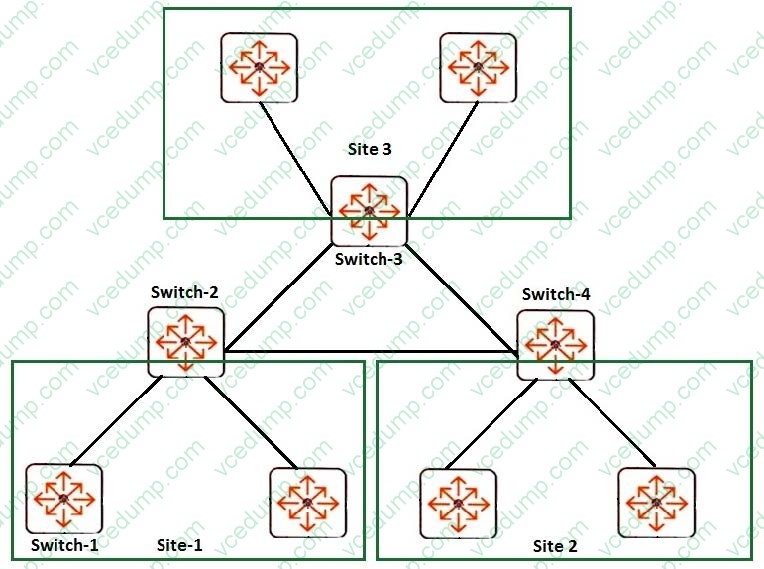
The routing switches shown in the exhibit use OSPF, and all of their interfaces are in Area 1. A faulty link on Switch-1 went up and down many times over the course of several hours. This caused link state updates (LSUs) to flood all of the routing devices in the OSPF AS and reduce performance. The network administrator fixed the faulty link on Switch-1, but the administrator also wants to mitigate the effects if a similar issue occurs in the future.
Which design improvement would help?
A. Configure Area 1 as a stub area on all routers except Switch-2, Switch-3, and Switch-4
B. Divide the AS into different areas, and aggregate routes between them
C. Divide the AS into different areas, and configure the backbone area as an NSSA
D. Decrease the LSA generation timer, and make sure to set the same value on all routers -
Question 106:
A network administrator enters this command: Switch(config)# aaa authorization user-role enable How does this affect device authentication?
A. The local manager and operator accounts will no longer work unless they are associated with a user role on the switch.
B. Authenticated devices must receive their dynamic settings, such as VLAN ID and ACLs, from the RADIUS server Access-Accept.
C. Authenticated devices will be defined proper access if the RADIUS server sends any VSA except the user-role VSA
D. Role-based mode will no longer be available with tunneled node to prevent conflicts with the AAA user roles. -
Question 107:
Network administrators need to track when traffic matches deny entry in an ACL applied to a port. They want the alert to be sent to a syslog server that is already set up to send logs. What should administrators do to enable alerts?
A. Specify the log option for the ACL entry, and enable ACL debugging.
B. Set the debug destination to session, and enable ACL debugging.
C. Enable ACL debugging, and enable SNMP port security traps.
D. Specify the log option for the ACL entry, and enable SNMP port security traps. -
Question 108:
Refer to the exhibit.
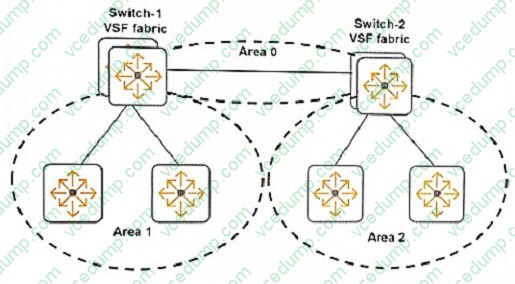
The routing switches shown in the exhibit run OSPF on the links between each other. The commander in the Switch-1 VSF fabric goes down. Traffic is disrupted for several seconds. What should a network administrator do to support a faster failover in a similar situation?
A. Configure echo mode BFD on the VLAN that connects Switch-1 and Switch-2.
B. Add VRRP on the VLAN between Switch-1 and Switch-2.
C. Configure graceful restart, or nonstop OSPF, on Switch-1 and Switch-2, with a proper timer.
D. Create a redundant virtual link between Switch-1 and Switch-2. -
Question 109:
Refer to the exhibits. Exhibit 1
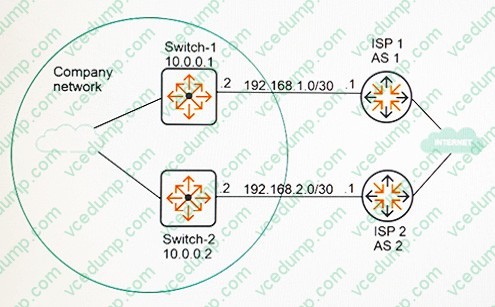
Exhibit 2
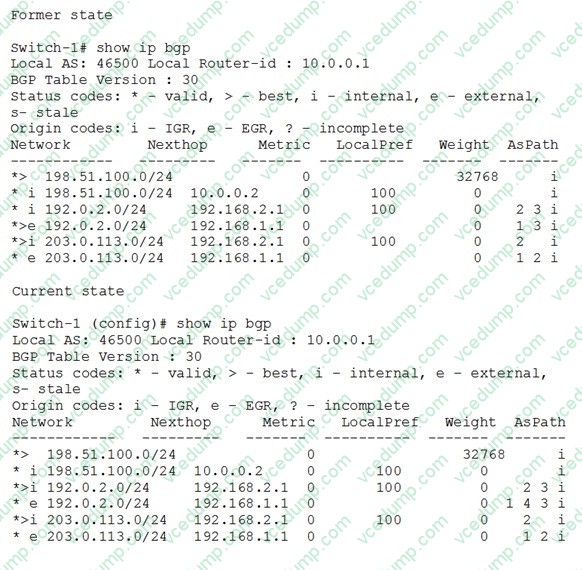
Exhibit 1 shows a portion of the BGP routing table when the BGP solution was first deployed. Exhibit 2 shows the same portion at the current time. What can explain the current state?
A. Due to changes in the private network, Switch-1 can no longer reach 192.168.2.1.
B. Switch-1 can no longer reach ISP 1 at 192.168.1.1.
C. Due to changes at ISP 1, Switch-1 now selects a different best route.
D. An administrator has applied a route map on Switch-1 that filters advertised routes. -
Question 110:
Refer to the exhibit.
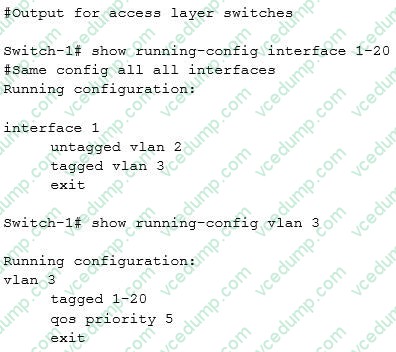
A company has IP phones that are LLDP-MED capable. The exhibit shows the configuration for the VLAN to which IP phones belong, as well as the configuration for ports to which phones will connect. AOS-Switches at the access layer are set up to use LLDP-MED. The administrator wants to automatically provision the phones to send traffic with the right VLAN tag and priority.
Which additional configuration step must the administrator complete?
A. Specify LLDP-MED as the global LLDP mode
B. Specify the voice setting in VLAN 3
C. Enable LMA and configure the proper LMA profiles
D. Enable 802.1X and MAC-based VLANs on the ports
Related Exams:
-
HP0-003
HP OpenView Service Desk 5.x -
HP0-045
Supporting the ESL E-Series Lobraries -
HP0-052
Planning and Design of HP 9000/HP Integrity Server Solutions -
HP0-053
Enterprise Integration and Management of HP ProLiant Servers -
HP0-054
Compaq/Oracle 8i I and P with Windows NT -
HP0-055
Implementing HP ProLiant Servers -
HP0-058
Configuration and Management of HP Integrity Mid-Range Servers -
HP0-063
LF PROFESSIONAL COLOR WORKFLOW MANAGEMENT -
HP0-064
HP BladeSystems C-Class Solutions 1 -
HP0-065
Planning and Designing ProLiant Solutions for the Enterprise
Tips on How to Prepare for the Exams
Nowadays, the certification exams become more and more important and required by more and more enterprises when applying for a job. But how to prepare for the exam effectively? How to prepare for the exam in a short time with less efforts? How to get a ideal result and how to find the most reliable resources? Here on Vcedump.com, you will find all the answers. Vcedump.com provide not only HP exam questions, answers and explanations but also complete assistance on your exam preparation and certification application. If you are confused on your HPE6-A45 exam preparations and HP certification application, do not hesitate to visit our Vcedump.com to find your solutions here.