HP HPE2-W09 Online Practice
Questions and Exam Preparation
HPE2-W09 Exam Details
Exam Code
:HPE2-W09
Exam Name
:Aruba Data Center Network Specialist
Certification
:HP Certifications
Vendor
:HP
Total Questions
:129 Q&As
Last Updated
:Jan 08, 2026
HP HPE2-W09 Online Questions &
Answers
Question 1:
You plan to use multi-protocol BGP to implement dynamic VRF route leaking on an ArubaOS-CX switch.
Is this a rule for the setup?
Solution: You cannot leak multicast routes.
A. Yes B. No
A. Yes explanation:
Explanation/Reference:
You cannot leak multicast routes is a rule for the setup of multi-protocol BGP to implement dynamic VRF route leaking on an ArubaOS-CX switch. Multi-protocol BGP only supports unicast routes for route leaking, and multicast routes are not leaked between VRFs1.
Question 2:
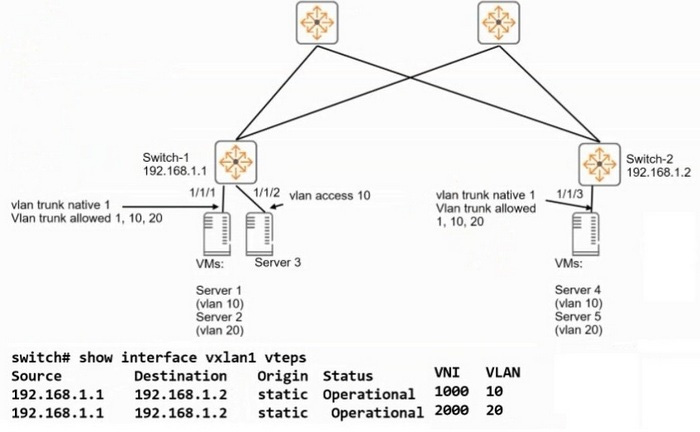
Refer to the exhibits.
Is this how the switch handles the traffic?
Solution: A frame with destination MAC address, 00:50:56:00:00:03 arrives with a VLAN 10 tag on 1/1//1 on Switch-1. Switch-1 switches the frame out interface 1/1/2 without VXLAN.
A. Yes B. No
B. No explanation:
Explanation/Reference:
VXLAN is a tunneling protocol that encapsulates layer 2 traffic over an IP network using VXLAN Network Identifiers (VNIs) to identify different layer 2 segments. VXLAN Tunnel Endpoints (VTEPs) are devices that perform the encapsulation and decapsulation of VXLAN packets. According to the exhibit, Switch-1 and Switch-2 are VTEPs that use VNI 10010 to map VLAN 10 traffic. Therefore, when Switch-1 receives a frame with destination MAC address 00:50:56:00:00:03 and VLAN 10 tag on interface 1/1/1, it should encapsulate the frame with a VXLAN header that contains VNI 10010 and send it as a unicast packet to Switch-2's loopback address (10.1.1.2) over the IP network1. Switch-1 should not switch the frame out interface 1/1/2 without VXLAN, as this would violate the VNI mapping and cause layer 2 loops. Therefore, this is not how the switch handles the traffic. https://networklessons.com/cisco/ccnp-encor-350-401/introduction-to- virtualextensible-lan-vxlan
Question 3:
You want to use NetEdit to configure an AtubaOS-CX switch.
Is this a minimum requirement for setting up communications between the switch and NetEdit?
Solution: Make sure that the SSH server is enabled.
A. Yes B. No
A. Yes explanation:
Explanation/Reference:
The solution is correct because making sure that the SSH server is enabled is a minimum requirement for setting up communications between the switch and NetEdit. NetEdit uses SSH to establish a secure connection to the switch and execute commands on it. Therefore, making sure that the SSH server is enabled is necessary for setting up communications between the switch and NetEdit.
Question 4:
Does this correctly describe how the Virtual Switching Extension (VSX) fabric reacts to various component failure scenarios?
Solution: The ISL goes down, and after a few seconds, the keepalive link goes down too. Switch-1 and Switch-2 remains up.
The Split-recovery mode is enabled. In this case the secondary switch first shutdowns and then enables SVis.
A. Yes B. No
B. No explanation:
Explanation/Reference:
The Virtual Switching Extension (VSX) fabric is a high availability solution that provides industry-leading performance and simplicity for campus and data center networks1. When the ISL goes down, and after a few seconds, the keepalive link goes down too, the VSX fabric reacts differently depending on the split-recovery mode setting. If the split-recovery mode is enabled, the secondary switch shuts down all its SVIs and waits for the ISL to come back up2. If the split-recovery mode is disabled, both switches keep their SVIs up and continue to forward traffic2. Therefore, this does not correctly describe how the VSX fabric reacts to various component failure scenarios. Reference:https://www.arubanetworks.com/assets/tg/TB_VSX.pdf
Question 5:
Refer to the exhibits.
Is this how the switch handles the traffic?
Solution: A broadcast arrives in VLAN 10 on Switch-1. Switch 1 forwards the frame on all interfaces assigned to VLAN10, except the incoming interface. It encapsulates the broadcast with VXIAN and sends it to 192.168.1.2. but not
192.168.1.3.
A. Yes B. No
B. No explanation:
Explanation/Reference:
A broadcast arrives in VLAN 10 on Switch-1. Switch 1 forwards the frame on all interfaces assigned to VLAN10, except the incoming interface. It encapsulates the broadcast with VXLAN and sends it to 192.168.1.2, but not 192.168.1.3 is not a correct explanation of how the switch handles the traffic. Switch-1, Switch-2, and Switch-3 are ArubaOS-CX switches that use VXLAN and EVPN to provide Layer 2 extension over Layer 3 networks. VXLAN is a feature that uses UDP encapsulation to tunnel Layer 2 frames over Layer 3 networks using VNIs. EVPN is a feature that uses BGP to advertise multicast information for VXLAN networks using IMET routes. Switch-1 receives a broadcast in VLAN 10, which belongs to VNI 5010. Switch-1 forwards the frame on all interfaces assigned to VLAN 10, except the incoming interface, as per normal Layer 2 switching behavior. However, Switch-1 does not encapsulate the broadcast with VXLAN and send it only to 192.168.1.2, which is Switch-3's loopback interface, but rather replicates the broadcast, encapsulates each broadcast with VXLAN, and sends the VXLAN traffic to both 192.168.1.2 and 192.168.1.3, which are Switch-3's and Switch-2's loopback interfaces respectively1.
Question 6:
Refer to the exhibit.
You are adding a VLAN 30, subnet 10.0.30.0/24 to the network shown in the exhibit. (This network is simplified to just the relevant switches for this item.) This subnet belongs in VRF A, and you have added a Layer 3 VLAN 30 interface
attached to this VRF on Switch-1. You want to make the services in this VLAN available to devices in 10.1.20.0/24 in VRF B.
Is this part of a valid setup for meeting these requirements?
Solution: Add a route with this command: ip route 10.1.20.0/24 vlan20 vrf A
A. Yes B. No
B. No explanation:
Explanation/Reference:
Adding a route with this command: ip route 10.1.20.0/24 vlan20 vrf A is not part of a valid setup for meeting these requirements. This command would add a static route for 10.1.20.0/24 in VRF A, but it would not be able to reach VLAN 20 on Switch-2 because Switch-2 does not have a VLAN interface for VLAN 20 in VRF A. To make the services in VLAN 30 available to devices in 10.1.20.0/24 in VRF B, you need to use inter- VRF routing or route leaking between VRF A and VRF B on Switch-11.
Question 7:
Refer to the exhibit.
Switch-1, Switch-2, and the router run OSPF on LAG 100, which is a Layer 3 LAG. Does this correctly explain how to control how core-to-access traffic Is forwarded? Solution: To reduce the amount of traffic sent over the ISL between Switch-1 and Switch-2. enable Equal Cost Multi Path (ECMP) on both Switch-1 and Switch-2.
A. Yes B. No
B. No explanation:
Explanation/Reference:
To reduce the amount of traffic sent over the ISL between Switch-1 and Switch-2, enable Equal Cost Multi Path (ECMP) on both Switch-1 and Switch-2 is not a correct explanation of how to control how core-to-access traffic is forwarded. Switch-1, Switch-2, and the router run OSPF on LAG 100, which is a Layer 3 LAG. ECMP is a feature that allows a router to load balance traffic destined to some network that is reachable through multiple equal cost route nexthops. Enabling ECMP on Switch-1 and Switch-2 would not reduce the amount of traffic sent over the ISL, but rather increase it by sending traffic over both links instead of one. A better way to reduce the amount of traffic sent over the ISL would be to enable active forwarding on LAG 100 on both Switch-1 and Switch-2, which would make one link active and one link standby for each direction of traffic 1.
Question 8:
Switch-1 and Switch-2 are AruDaOS-CX switches, which are part of a Virtual Switching Extension (VSX) fabric. Switch-2 is the primary member. Switch-2 experiences a power failure while Switch-1 remains up. Switch-2's power recovers, and Switch-2 reboots.
Is this one of the things that happens when Switch-2 finishes booting?
Solution: Switch-1 downloads its MAC forwarding table from Switch-2.
A. Yes B. No
B. No explanation:
Explanation/Reference:
Switch-1 does not download its MAC forwarding table from Switch-2 when Switch-2 finishes booting. Switch-1 and Switch-2 are part of a VSX fabric, which is a high availability solution that provides redundancy and load balancing across a pair of switches1 . When Switch-2 experiences a power failure, Switch-1 takes over the role of the primary member and continues to forward traffic1. When Switch-2 recovers, it synchronizes its configuration and state information from Switch1, not the other way around1. The MAC forwarding table is part of the state information that is synchronized from the primary to the secondary member1.
Question 9:
Does this correctly describe the ArubaOS-CX architecture?
Solution: The Aruba0S-CX Network Analytics Engine (NAE) helps admins to manage multiple Aruba0S-CX switches together using familiar CLI commands.
A. Yes B. No
B. No explanation:
Explanation/Reference:
ArubaOS-CX is a modern operating system for Aruba switches that provides automation, programmability, and analytics capabilities. The ArubaOS-CX Network Analytics Engine (NAE) is a built-in analytics framework for network assurance and remediation, that allows monitoring, troubleshooting, and proactive network management using scripts and agents1. The NAE does not help admins to manage multiple ArubaOS- CX switches together using familiar CLI commands. That is the function of the ArubaOS- CX Fabric Composer (AFC), which is a software-defined orchestration tool that simplifies data center fabric management. Therefore, this does not correctly describe the ArubaOS- CX architecture.
Question 10:
Is this statement about ARP and ND Suppression true?
Solution: ARP-Suppression and ND-Suppression must be enabled together.
A. Yes B. No
B. No explanation:
Explanation/Reference:
ARP and ND Suppression are features of ArubaOS-CX that reduce the broadcast traffic on EVPN VXLAN networks1. ARP and ND Suppression enable the switch to reply to ARP and ND requests with information present in the local ARP and neighbor cache, instead of flooding them to all VTEPs1. This reduces the bandwidth consumption and improves the network performance1. ARP-Suppression and ND-Suppression can be enabled or disabled independently1. They do not have to be enabled together1. Therefore, this statement about ARP and ND Suppression is false, and the correct answer is no. For more information on ARP and ND Suppression, refer to the Aruba Data Center Network Specialist (ADCNS) certification datasheet3 and the EVPN VXLAN Guide for your switch model1.
Nowadays, the certification exams become more and more important and required by more and more
enterprises when applying for a job. But how to prepare for the exam effectively? How to prepare
for the exam in a short time with less efforts? How to get a ideal result and how to find the
most reliable resources? Here on Vcedump.com, you will find all the answers.
Vcedump.com provide not only HP exam questions,
answers and explanations but also complete assistance on your exam preparation and certification
application. If you are confused on your HPE2-W09 exam preparations
and HP certification application, do not hesitate to visit our
Vcedump.com to find your solutions here.