HP0-M49 Exam Details
-
Exam Code
:HP0-M49 -
Exam Name
:HP Virtual User Generator 11.x Software -
Certification
:HP Certifications -
Vendor
:HP -
Total Questions
:63 Q&As -
Last Updated
:Apr 01, 2020
HP HP0-M49 Online Questions & Answers
-
Question 31:
What is the purpose of capturing think times?
A. It simulates the keyboard entry time of an end user on a system.
B. It is necessary to make VuGen pause long enough to capture the server responses.
C. It prevents excessive CPU consumption for virtual users on the load generators.
D. It is necessary to make VuGen pause to reduce the amount of data required during testing. -
Question 32:
Where should you add a web_reg_save_param function to a script?
A. in the global.h section
B. before the step that contains the dynamic value
C. before the step that generates a response from the server containing the value
D. at the beginning of the action section that contains the dynamic value -
Question 33:
Click the Exhibit button The screenshot shown in the exhibit is showing a default view from what?
A. Run-time Settings: General: Miscellaneous
B. Run-time Settings: General: Log
C. Run-time Settings: General: Pacing
D. Run-time Settings: General: Run Logic -
Question 34:
In HTML-based and URL-based recording modes, user steps are recorded at different layers. They differ in the layer where the user steps are recorded. Why is the HTML recording name also named as "context sensitive"?
A. because every UI object is recognized in the context of the page/window to which it belongs
B. because the browser cache stores a copy of the page, in the context of which user actions are performed
C. because the playback engine cache stores a copy of the page, in the context of which user actions are performed
D. because context sensitive help suggestions are available in HTML mode only -
Question 35:
Which formats contain valid VuGen built-in DFEs?
A. Base64, Base 32, XMI
B. JSON, XML, Base64
C. URI, XML, VDI
D. SOAP, URL, JSON -
Question 36:
Click the Exhibit button.
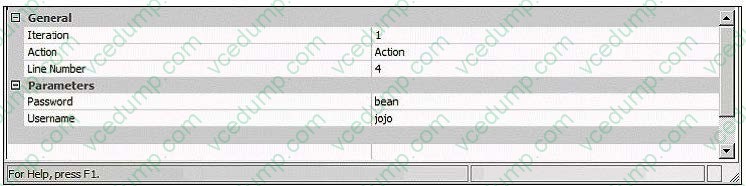
Which tab is shown in the VuGen Output window?
A. Run-time Data
B. Generation Log
C. Parameter Simulator
D. Replay Log -
Question 37:
What is a data parameter type?
A. Sequential Number
B. Scenario ID
C. Rendezvous
D. File -
Question 38:
You add the logic lr_message("the message"); to your script but you do not see any messages in the Output window while running the scenario in the Controller. What should you do?
A. Add the code lr_start_messages(1); before the lr_message("the message");
B. Change the logging options in the Controller's Run-time Settings from "only when an error occurs" to "Always Send" and "Standard Log."
C. Add the code lr_set_debug_message(LR_MSG_CLASS_EXTENDED_LOG | LR_MSG_CLASS_FULL_TRACE, LR_SWITCH_ON ); to the line before the lr_message("the message");
D. Highlight the script in the Controller, click Details, and click Refresh Log Options.
E. Because only 10% of the messages are logged, wait for the test to run longer. -
Question 39:
What happens when you set the animated run delay to 5,000 milliseconds?
A. When replaying the script, the Run-time Viewer pauses for 5 seconds when an error has occurred.
B. When replaying the script, the Replay Log only displays the last 5 seconds of logging information.
C. When the script is replayed, the Run-time Viewer displays 5 seconds behind the current line being executed.
D. When replaying the script, a line executes and then pauses for 5 seconds, executes the next line of code and pauses for 5 seconds, and continues with this pattern. -
Question 40:
You encounter a situation where the applications communicate via Web Services server-to-server. Both servers are running on Linux. What is the best way to simulate the load on the second server?
A. Launch VuGen on the first server and record the process using SOA Protocol.
B. Get the code of the application and create a Java web service call to the second server.
C. Record two scripts and merge them.
D. Use tcpdump and capture the communication, and import using Analyze Traffic.
Related Exams:
-
HP0-003
HP OpenView Service Desk 5.x -
HP0-045
Supporting the ESL E-Series Lobraries -
HP0-052
Planning and Design of HP 9000/HP Integrity Server Solutions -
HP0-053
Enterprise Integration and Management of HP ProLiant Servers -
HP0-054
Compaq/Oracle 8i I and P with Windows NT -
HP0-055
Implementing HP ProLiant Servers -
HP0-058
Configuration and Management of HP Integrity Mid-Range Servers -
HP0-063
LF PROFESSIONAL COLOR WORKFLOW MANAGEMENT -
HP0-064
HP BladeSystems C-Class Solutions 1 -
HP0-065
Planning and Designing ProLiant Solutions for the Enterprise
Tips on How to Prepare for the Exams
Nowadays, the certification exams become more and more important and required by more and more enterprises when applying for a job. But how to prepare for the exam effectively? How to prepare for the exam in a short time with less efforts? How to get a ideal result and how to find the most reliable resources? Here on Vcedump.com, you will find all the answers. Vcedump.com provide not only HP exam questions, answers and explanations but also complete assistance on your exam preparation and certification application. If you are confused on your HP0-M49 exam preparations and HP certification application, do not hesitate to visit our Vcedump.com to find your solutions here.