H12-891 Exam Details
-
Exam Code
:H12-891 -
Exam Name
:HCIE-Datacom V1.0 -
Certification
:Huawei Certifications -
Vendor
:Huawei -
Total Questions
:923 Q&As -
Last Updated
:May 27, 2026
Huawei H12-891 Online Questions & Answers
-
Question 771:
Which of the following information about BGP4+ is correct? (Choose two)
A. BGP4 can use dampening commands to suppress oscillations on IBGP routes.
B. Modifying the Router ID of BGP causes the BGP connection between routers to be re-established.
C. The Next Hop attribute in BGP4+ is represented by an IPv6 address, which can be the link-local address of the next hop.
D. BGP4+ does not support route auto-aggregate. -
Question 772:
OSPFv2 is an IGP running on IPv4 networks, whereas OSPFv3 is an IGP running on IPv6 networks. OSPFv2 and OSPFv3 have similar LSA types, but their LSA functions are slightly different. Which of the following is not an OSPFv3 LSA type?
A. ASBR-Summary-LSA
B. AS-External-LSA
C. Router-LSA
D. Network-LSA -
Question 773:
To reduce the number of OSPF routes in certain areas, the OSPF protocol has developed special area functions. Which of the following statements correctly describes the characteristics of OSPF special areas?
A. ASBR-Summary-LSA is allowed to be published to the NSSA (Not-So-Stubby Area) region.
B. AS-External-LSA is allowed to be published to the Stub region.
C. Any OSPF area can be configured as a special area.
D. An area can be configured with only one type of special area designation. -
Question 774:
The following is a description of how BFD sessions are established; which one is incorrect?
A. The system distinguishes between static BFD sessions and dynamic BFD sessions by dividing the identifier area and dynamically assigning this identifier
B. BFD sessions can only be established dynamically
C. Static configuration of a BFD session refers to manually configuring BFD session parameters through the command line, including local identifiers and remote identifiers -
Question 775:
LDP and IGP linkage refers to the synchronization of IGP and TE routes to ensure that LDP and IGP linkage enhances network efficiency, so that IGP and LDP maintain a consistent path, minimizing traffic loss and thereby improving the reliability of the entire network.
A. True
B. False -
Question 776:
Which of the following scenarios is not suitable for deploying interface policy routing?
A. In the scenario of multiple ISP egresses of enterprise networks, different network segments of the intranet access the Internet through different ISP egresses
B. The traffic accessed by the intranet and the extranet to the side-mounted security detection device is pulled on the core switch
C. Modify the next hop of locally originating traffic
D. Pull the traffic of the intranet and the Internet accessing each other on the core switch to the side-mounted AC device -
Question 777:
RD is used to distinguish the same IP address in different VPNs, how many bits does RD contain?
A. 64
B. 32
C. 16
D. 128 -
Question 778:
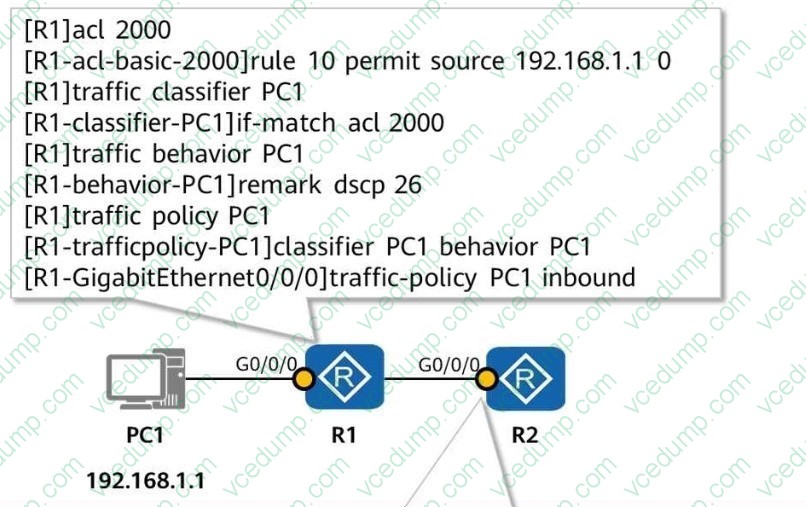
Refer to the configuration in the exhibit. Which queue on R2 do packets of PC1 enter by default?
A. AF4
B. AF2
C. AF3
D. EF -
Question 779:
Without dividing the network into areas, which of the following statements about link-state routing protocols are correct? (Choose three)
A. Each router establishes a topology database of the entire flooding domain.
B. Each router learns route entries directly from route updates and adds them to the routing table.
C. Routers in the flooding domain may receive the same link-state information repeatedly.
D. Routers throughout the flooding domain have the same link-state database.
E. The router forwards all link-state information received from one neighbor to all other neighbors to ensure database synchronization. -
Question 780:
When MPLS/BGP IP VPN is deployed, which of the following statements is incorrect about BGP route exchange between PEs and CEs?
A. When PEs and CEs use BGP to exchange routing information, you do not need to import private network routes into BGP on PEs.
B. In a Hub and Spoke scenario, when the Hub-CE and Hub-PE run an IGP for communication, EBGP cannot be configured on the Spoke-PE or Spoke-CE.
C. In a scenario where PEs and CEs use BGP to exchange routing information, if two VPN sites have the same private AS number, the AS number replacement function can replace the AS number in a received private network route with any specified AS number to prevent routes from being discarded due to repeated AS numbers.
D. In a CE multi-homing scenario, the BGP AS number replacement function may cause routing loops. BGP SoO can be used to prevent routing loops at a VPN site.
Related Exams:
-
H11-821
HCNP-UC-HIPT (Implementing Huawei IP Telephony Solutions) -
H11-828
HCNP-UC(Fast Track)(Unified Communication (Fast Track)) -
H11-851
HCIA-Video Conference V3.0 -
H11-861
HCIP-Video Conference V2.0 -
H11-868
HCNP- VC(Fast Track)-(Video Conference (Fast Track)) -
H12-111
HCIA-IoT V3.0 -
H12-224
HCIP-Routing & Switching (Fast Track) V2.0 -
H12-311
HCIA-WLAN V3.0 -
H12-351
HCIE-WLAN (Written) V1.0 -
H12-411
HCIA-Data Center Facility V2.0
Tips on How to Prepare for the Exams
Nowadays, the certification exams become more and more important and required by more and more enterprises when applying for a job. But how to prepare for the exam effectively? How to prepare for the exam in a short time with less efforts? How to get a ideal result and how to find the most reliable resources? Here on Vcedump.com, you will find all the answers. Vcedump.com provide not only Huawei exam questions, answers and explanations but also complete assistance on your exam preparation and certification application. If you are confused on your H12-891 exam preparations and Huawei certification application, do not hesitate to visit our Vcedump.com to find your solutions here.