FCSS_SDW_AR-7.4 Exam Details
-
Exam Code
:FCSS_SDW_AR-7.4 -
Exam Name
:FCSS - SD-WAN 7.4 Architect -
Certification
:Fortinet Certifications -
Vendor
:Fortinet -
Total Questions
:91 Q&As -
Last Updated
:Jul 11, 2026
Fortinet FCSS_SDW_AR-7.4 Online Questions & Answers
-
Question 1:
You are planning a new SD-WAN deployment with the following criteria:
1.Two regions
2.Most of the traffic is expected to remain within its region
3.No requirement for inter-region ADVPN
To remain within the recommended best practices, which routing protocol should you select for the overlays?
A. OSPF for the routing within each region and EBGP between the regions.
B. IBGP with BGP on loopback within each region and EBGP between the regions.
C. IBGP with BGP per overlays within each region and IBGP with BGP on loopback between the regions.
D. IBGP within each region and between the regions. -
Question 2:
What are three key routing principles of SD-WAN? (Choose three.)
A. Directly connected routes have precedence over SD-WAN rules.
B. Policy routes have precedence over SD-WAN rules.
C. SD-WAN rules are skipped if the best route to the destination is a static route
D. SD-WAN rules are skipped if the best route to the destination is not an SD-WAN member.
E. SD-WAN members are skipped if they do not have a valid route to the destination. -
Question 3:
Refer to the exhibit.
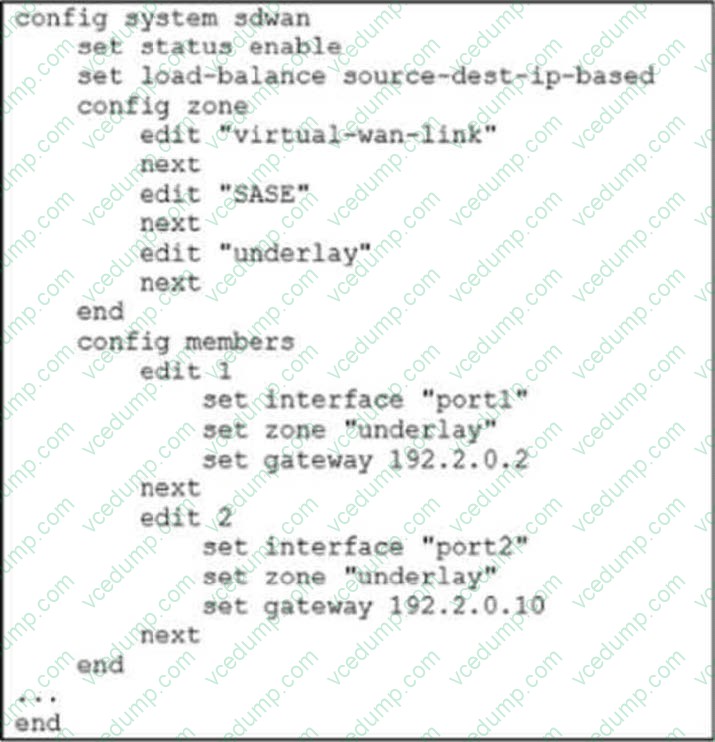
Which algorithm does SD-WAN use to distribute traffic that does not match any of the SD-WAN rules?
A. All traffic from a source IP to a destination IP is sent to the same interface.
B. All traffic from a source IP is sent to the same interface.
C. All traffic from a source IP is sent to the most used interface.
D. All traffic from a source IP to a destination IP is sent to the least used interface. -
Question 4:
In a Fortinet SD-WAN dual-hub design, what is the role of the minimum-sla-meet-members setting?
A. It defines the minimum number of tunnels required for active-active operation.
B. It specifies the number of SD-WAN members that must meet the SLA before traffic is forwarded.
C. It defines the number of backup tunnels required for redundancy.
D. It determines the number of hubs that can participate in ADVPN shortcuts. -
Question 5:
You are tasked with configuring ADVPN 2.0 on an SD-WAN topology already configured for ADVPN. What should you do to implement ADVPN 2.0 in this scenario?
A. Update the IPsec tunnel configurations on the hub.
B. Update the SD-WAN configuration on the branches.
C. Update the IPsec tunnel configuration on the branches.
D. Delete the existing ADVPN configuration and configure ADVPN 2.0. -
Question 6:
You have configured the performance SLA with the probe mode as Prefer Passive. What are two observable impacts of this configuration? (Choose two.)
A. FortiGate passively monitors the member if TCP traffic is passing through the member.
B. After FortiGate switches to active mode, the SLA performance rule falls back to passive monitoring after 3 minutes.
C. FortiGate passively monitors the member if ICMP traffic is passing through the member.
D. During passive monitoring, the SLA performance rule cannot detect dead members.
E. FortiGate can offload the traffic that is subject to passive monitoring to hardware. -
Question 7:
Exhibit A shows the system interface with the static routes and exhibit B shows the firewall policies on the managed FortiGate.
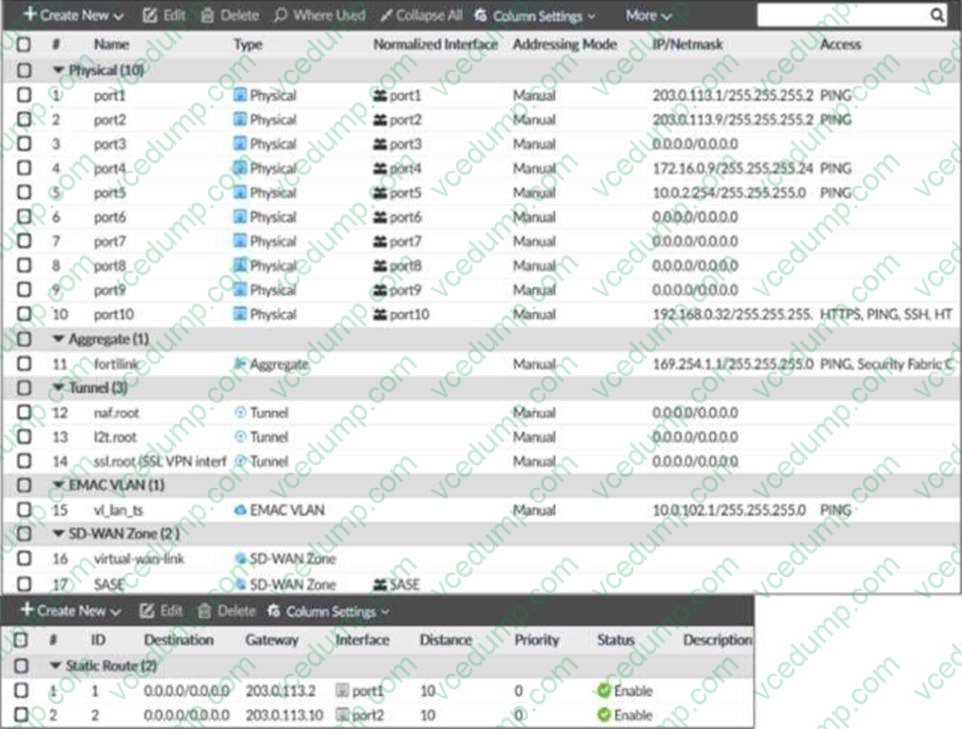
Exhibit B C

Based on the FortiGate configuration shown in the exhibits, what issue might you encounter when creating an SD-WAN zone for port1 and port2?
A. port1 is assigned a manual IP address.
B. port1 is referenced in a firewall policy.
C. port2 is referenced in a static route.
D. port1 and port2 are not administratively down. -
Question 8:
When you use the command diagnose sys session list, how do you identify the sessions that correspond to traffic steered according to SD-WAN rules?
A. You identify sessions steered according to SD-WAN rules with the flag vwl.
B. You cannot identify SD-WAN sessions. You must use the sdwar. session filter.
C. You identify sessions steered according to SD-WAN rules with the data vwl_mbr_seq.
D. You identify sessions steered according to SD-WAN rules with the data 3dwan_service_id. -
Question 9:
Refer to the exhibits.
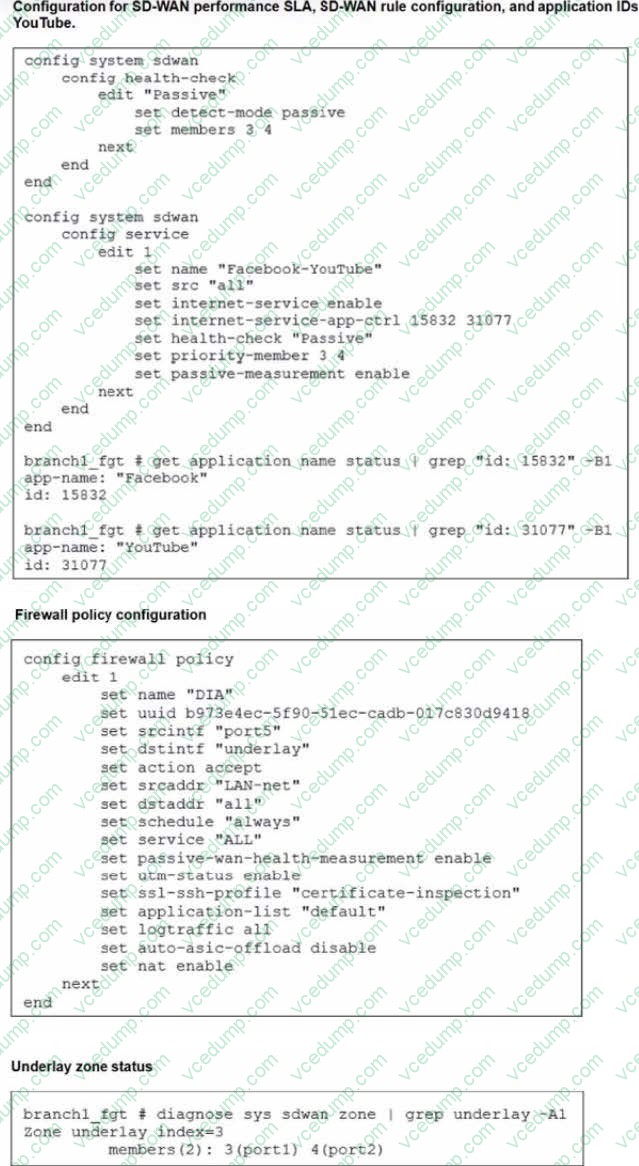
The exhibits show the configuration for SD-WAN performance. SD-WAN rule, the application IDs of Facebook and YouTube along with the firewall policy configuration and the underlay zone status. Which two statements are true about the health and performance of SD-WAN members 3 and 4? (Choose two.)
A. Only related TCP traffic is used for performance measurement.
B. The performance is an average of the metrics measured for Facebook and YouTube traffic passing through the member.
C. Encrypted traffic is not used for the performance measurement.
D. FortiGate identifies the member as dead when there is no Facebook and YouTube traffic passing through the member. -
Question 10:
Which two interfaces are considered overlay links? (Choose two.)
A. LAG
B. IPsec
C. Physical
D. GRE
Related Exams:
-
EMEA-ADVANCED-SUPPORT
Fortinet EMEA Advanced Support -
FCP_FAC_AD-6.5
FCP - FortiAuthenticator 6.5 Administrator -
FCP_FAZ_AD-7.4
FCP - FortiAnalyzer 7.4 Administrator -
FCP_FAZ_AN-7.4
FCP - FortiAnalyzer 7.4 Analyst -
FCP_FAZ_AN-7.6
Fortinet NSE 5 - FortiAnalyzer 7.6 Analyst -
FCP_FCT_AD-7.2
FCP - Forti Client EMS 7.2 Administrator -
FCP_FCT_AD-7.4
Fortinet NSE 6 - FortiClient EMS 7.4 Administrator -
FCP_FGT_AD-7.4
FCP - FortiGate 7.4 Administrator -
FCP_FGT_AD-7.6
FortiGate 7.6 Administrator FCP_FGT_AD-7.6 -
FCP_FMG_AD-7.4
FCP - FortiManager 7.4 Administrator
Tips on How to Prepare for the Exams
Nowadays, the certification exams become more and more important and required by more and more enterprises when applying for a job. But how to prepare for the exam effectively? How to prepare for the exam in a short time with less efforts? How to get a ideal result and how to find the most reliable resources? Here on Vcedump.com, you will find all the answers. Vcedump.com provide not only Fortinet exam questions, answers and explanations but also complete assistance on your exam preparation and certification application. If you are confused on your FCSS_SDW_AR-7.4 exam preparations and Fortinet certification application, do not hesitate to visit our Vcedump.com to find your solutions here.