FCSS_EFW_AD-7.6 Exam Details
-
Exam Code
:FCSS_EFW_AD-7.6 -
Exam Name
:FCSS - Enterprise Firewall 7.6 Administrator -
Certification
:Fortinet Certifications -
Vendor
:Fortinet -
Total Questions
:70 Q&As -
Last Updated
:Jul 14, 2026
Fortinet FCSS_EFW_AD-7.6 Online Questions & Answers
-
Question 1:
Refer to the exhibit, which shows the VDOM section of a FortiGate device.
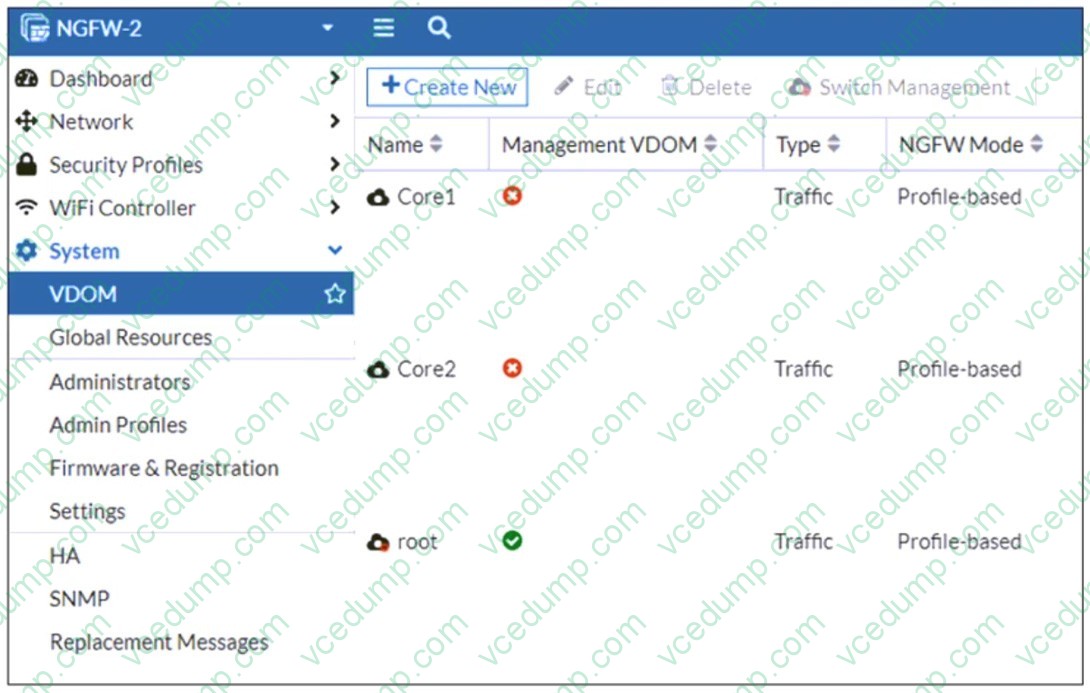
An administrator discovers that webfilter stopped working in Core1 and Core2 after a maintenance window. Which two reasons could explain why webfilter stopped working? (Choose two.)
A. The root VDOM does not have access to FortiManager in a closed network.
B. The root VDOM does not have a VDOM link to connect with the Corel and Core2 VDOMs.
C. The Core1 and Core2 VDOMs must also be enabled as Management VDOMs to receive FortiGuard updates
D. The root VDOM does not have access to any valid public FDN. -
Question 2:
An administrator configures OSPF between two FortiGate devices. However, the OSPF neighbor relationship remains in the INIT state. What is the most likely reason?
A. The OSPF interfaces are configured in different areas.
B. The network type on one side is broadcast and on the other side is point-to-point.
C. OSPF authentication keys are mismatched.
D. The OSPF priority on both sides is zero. -
Question 3:
Refer to the exhibit.
A pre-run CLI template that is used in zero-touch provisioning (ZTP) and low-touch provisioning (LTP) with FortiManager is shown.
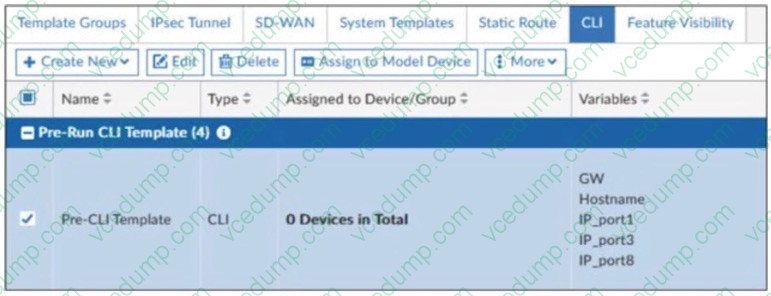
The template is not assigned even though the configuration has already been installed on FortiGate. What is true about this scenario?
A. The administrator did not assign the template correctly when adding the model device because pre-CLI templates remain permanently assigned to the firewall
B. Pre-run CLI templates are automatically unassigned after their initial installation
C. Pre-run CLI templates for ZTP and LTP must be unassigned manually after the first installation to avoid conflicting error objects when importing a policy package
D. The administrator must use post-run CLI templates that are designed for ZTP and LTP -
Question 4:
Refer to the exhibit, which contains the partial output of an OSPF command.
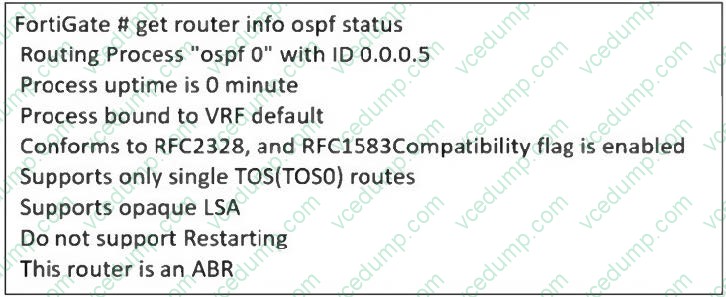
An administrator is checking the OSPF status of a FortiGate device and receives the output shown in the exhibit. What two conclusions can the administrator draw? (Choose two.)
A. The FortiGate device is a backup designated router
B. The FortiGate device is connected to multiple areas
C. The FortiGate device injects external routing information
D. The FortiGate device has OSPF ECMP enabled -
Question 5:
An administrator received a FortiAnalyzer alert that a 1 ## disk filled up in a day. Upon investigation, they found thousands of unusual DNS log requests, such as JHCMQK.website.com, with no answers. They later discovered that DNS exfiltration was occurring through both UDP and TLS.
How can the administrator prevent this data theft technique?
A. Create an inline-CASB to protect against DNS exfiltration.
B. Configure a File Filter profile to prevent DNS exfiltration.
C. Enable DNS Filter to protect against DNS exfiltration.
D. Use an IPS profile and DNS exfiltration-related signatures. -
Question 6:
A company's users on an IPsec VPN between FortiGate A and B have experienced intermittent issues since implementing VXLAN. The administrator suspects that packets exceeding the 1500-byte default MTU are causing the problems. In which situation would adjusting the interface's maximum MTU value help resolve issues caused by protocols that add extra headers to IP packets?
A. Adjust the MTU on interfaces only if FortiGate has the FortiGuard enterprise bundle, which allows MTU modification.
B. Adjust the MTU on interfaces in all FortiGate devices that support the latest family of Fortinet SPUs: NP7, CP9 and SP5.
C. Adjust the MTU on interfaces in controlled environments where all devices along the path allow MTU interface changes.
D. Adjust the MTU on interfaces only in wired connections like PPPoE, optic fiber, and ethernet cable. -
Question 7:
Refer to the exhibit, which shows an ADVPN network An administrator must configure an ADVPN using IBGP and EBGP to connect overlay network 1 with 2. What two options must the administrator configure in BGP? (Choose two.)
A. set ebgp-enforce-multrhop enable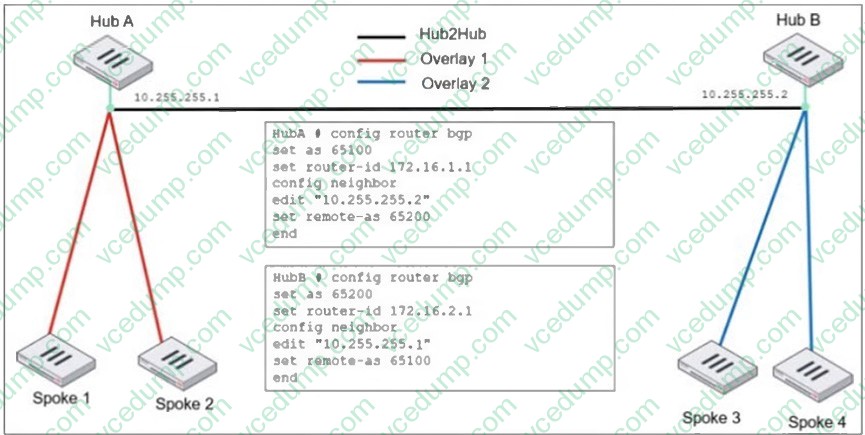
B. set next-hop-self enable
C. set ibgp-enforce-multihop advpn
D. set attribute-unchanged next-hop -
Question 8:
An administrator configured a firewall policy with IPS, Application Control, and Web Filter. Users report slower browsing performance. Which configuration change can optimize performance without compromising security?
A. Switch inspection mode from proxy to flow.
B. Disable all SSL inspection profiles.
C. Enable only antivirus in the policy.
D. Disable session TTL checks. -
Question 9:
Refer to the exhibit, which shows an enterprise network connected to an internet service provider.
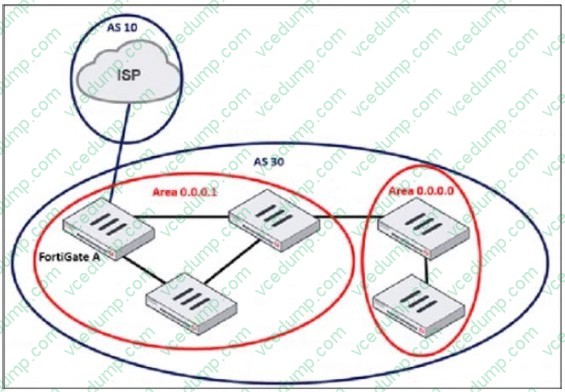
The administrator must configure the BGP section of FortiGate A to give internet access to the enterprise network. Which command must the administrator use to establish a connection with the internet service provider?
A. config neighbor
B. config redistribute bgp
C. config router route-map
D. config redistribute ospf -
Question 10:
What action can be taken on a FortiGate to block traffic using IPS protocol decoders, focusing on network transmission patterns and application signatures?
A. Use the DNS filter to block application signatures and protocol decoders.
B. Use application control to limit non-URL-based software handling.
C. Enable application detection-based SD-WAN rules.
D. Configure a web filter profile in flow mode.
Related Exams:
-
EMEA-ADVANCED-SUPPORT
Fortinet EMEA Advanced Support -
FCP_FAC_AD-6.5
FCP - FortiAuthenticator 6.5 Administrator -
FCP_FAZ_AD-7.4
FCP - FortiAnalyzer 7.4 Administrator -
FCP_FAZ_AN-7.4
FCP - FortiAnalyzer 7.4 Analyst -
FCP_FAZ_AN-7.6
Fortinet NSE 5 - FortiAnalyzer 7.6 Analyst -
FCP_FCT_AD-7.2
FCP - Forti Client EMS 7.2 Administrator -
FCP_FCT_AD-7.4
Fortinet NSE 6 - FortiClient EMS 7.4 Administrator -
FCP_FGT_AD-7.4
FCP - FortiGate 7.4 Administrator -
FCP_FGT_AD-7.6
FortiGate 7.6 Administrator FCP_FGT_AD-7.6 -
FCP_FMG_AD-7.4
FCP - FortiManager 7.4 Administrator
Tips on How to Prepare for the Exams
Nowadays, the certification exams become more and more important and required by more and more enterprises when applying for a job. But how to prepare for the exam effectively? How to prepare for the exam in a short time with less efforts? How to get a ideal result and how to find the most reliable resources? Here on Vcedump.com, you will find all the answers. Vcedump.com provide not only Fortinet exam questions, answers and explanations but also complete assistance on your exam preparation and certification application. If you are confused on your FCSS_EFW_AD-7.6 exam preparations and Fortinet certification application, do not hesitate to visit our Vcedump.com to find your solutions here.