FCSS_EFW_AD-7.4 Exam Details
-
Exam Code
:FCSS_EFW_AD-7.4 -
Exam Name
:FCSS - Enterprise Firewall 7.4 Administrator -
Certification
:Fortinet Certifications -
Vendor
:Fortinet -
Total Questions
:57 Q&As -
Last Updated
:Jul 14, 2026
Fortinet FCSS_EFW_AD-7.4 Online Questions & Answers
-
Question 1:
A company's guest internet policy, operating in proxy mode, blocks access to Artificial Intelligence Technology sites using FortiGuard. However, a guest user accessed a page in this category using port 8443. Which configuration changes are required for FortiGate to analyze HTTPS traffic on nonstandard ports like 8443 when full SSL inspection is active in the guest policy?
A. Add a URL wildcard domain to the website CA certificate and use it in the SSL/SSH Inspection Profile.
B. In the Protocol Port Mapping section of the SSL/SSH Inspection Profile, enter 443, 8443 to analyze both standard (443) and non-standard (8443) HTTPS ports.
C. To analyze nonstandard ports in web filter profiles, use TLSv1.3 in the SSL/SSH Inspection Profile.
D. Administrators can block traffic on nonstandard ports by enabling the SNI check in the SSL/SSH Inspection Profile. -
Question 2:
Refer to the exhibit, which shows a physical topology and a traffic log.
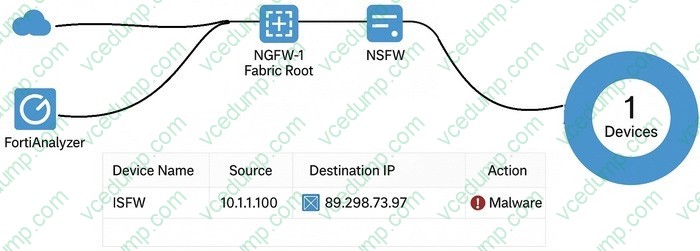
The administrator is checking on FortiAnalyzer traffic from the device with IP address10.1.10.1, located behind the FortiGate ISFW device.
The firewall policy in on the ISFW device does not have UTM enabled and the administrator is surprised to see a log with the action Malware , as shown in the exhibit. What are the two reasons FortiAnalyzer would display this log? (Choose two.)
A. Security rating is enabled in ISFW.
B. ISFW is in a Security Fabric environment.
C. ISFW is not connected to FortiAnalyzer and must go through NGFW-1.
D. The firewall policy in NGFW-1 has UTM enabled. -
Question 3:
Refer to the exhibit, which shows an OSPF network.
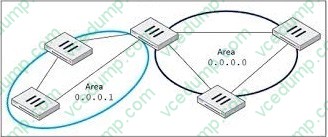
Which configuration must the administrator apply to optimize the OSPF database?
A. Set a route map in the AS boundary FortiGate.
B. Set the area 0.0.0.1 to the type STUB in the area border FortiGate.
C. Set an access list in the AS boundary FortiGate.
D. Set the area 0.0.0.1 to the type NSSA in the area border FortiGate. -
Question 4:
An administrator applied a block-all IPS profile for client and server targets to secure the server, but the database team reported the application stopped working immediately after. How can an administrator apply IPS in a way that ensures it does not disrupt existing applications in the network?
A. Use an IPS profile with all signatures in monitor mode and verify patterns before blocking.
B. Limit the IPS profile to server targets only to avoid blocking connections from the server to clients.
C. Select flow mode in the IPS profile to accurately analyze application patterns.
D. Set the IPS profile signature action to default to discard all possible false positives. -
Question 5:
Refer to the exhibit, which shows the ADVPN network topology and partial BGP configuration.
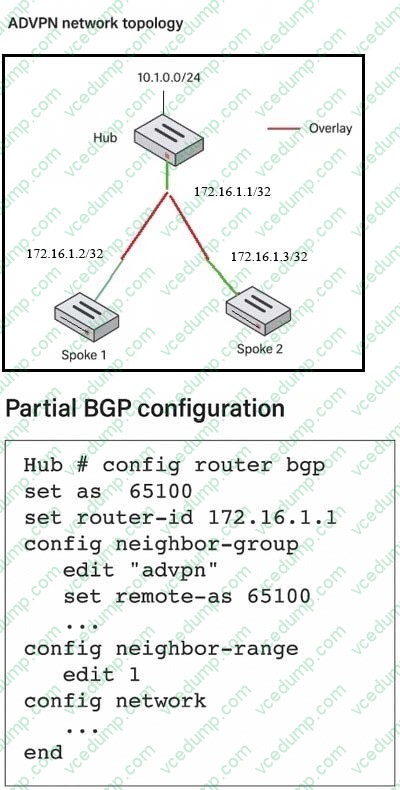
Which two parameters must an administrator configure in the config neighbor range for spokes shown in the exhibit? (Choose two.)
A. set max-neighbor-num 2
B. set neighbor-group advpn
C. set route-reflector-client enable
D. set prefix 172.16.1.0 255.255.255.0 -
Question 6:
Refer to the exhibit, which shows a revision history window in the FortiManager device layer.
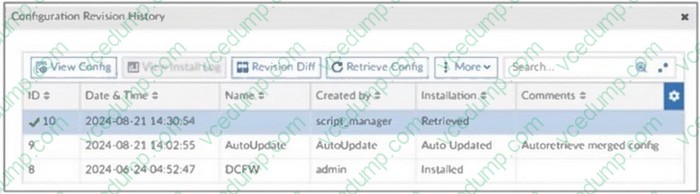
The IT team is trying to identify the administrator responsible for the most recent update in the FortiGate device database. Which conclusion can you draw about this scenario?
A. This retrieved process was automatically triggered by a Remote FortiGate Directly (via CLI) script.
B. The user script_manager is an API user from the Fortinet Developer Network (FDN) retrieving a configuration.
C. To identify the user who created the event, check it on the Configuration and Installation widget on FortiGate within the FortiManager device layer.
D. Find the user in the FortiManager system logs and use the type=script command to find the administrator user in the user field. -
Question 7:
Refer to the exhibit, which contains a partial VPN configuration.
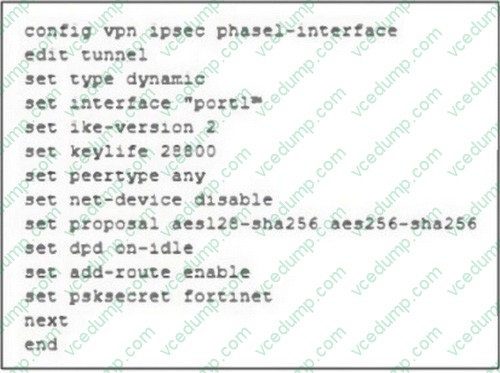
What can you conclude from this VPN IPsec phase 1 configuration?
A. This configuration is the best for networks with regular traffic intervals, providing a balance between connectivity assurance and resource utilization.
B. Peer IDs are unencrypted and exposed, creating a security risk.
C. FortiGate will not add a route to its routing or forwarding information base when the dynamic tunnel is negotiated.
D. A separate interface is created for each dial-up tunnel, which can be slower and more resource intensive, especially in large networks. -
Question 8:
Refer to the exhibit, which contains a partial command output.
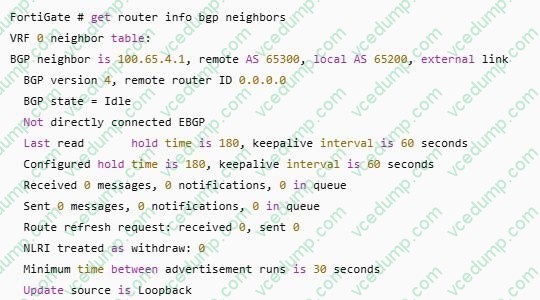
The administrator has configured BGP on FortiGate. The status of this new BGP configuration is shown in the exhibit. What configuration must the administrator consider next?
A. Configure a static route to 100.65.4.1.
B. Configure the local AS to 65300.
C. Contact the remote peer administrator to enable BGP
D. Enable ebgp-enforce-multihop. -
Question 9:
What does the command set forward-domain
A. It configures the interface to prioritize traffic based on the domain ID, enhancing quality of service for specified VLANs.in a transparent VDOM interface do?
B. It isolates traffic within a specific VLAN by assigning a broadcast domain to an interface based on the VLAN ID.
C. It restricts the interface to managing traffic only from the specified VLAN, effectively segregating network traffic.
D. It assigns a unique domain ID to the interface, allowing it to operate across multiple VLANs within the same VDOM. -
Question 10:
Refer to the exhibits.
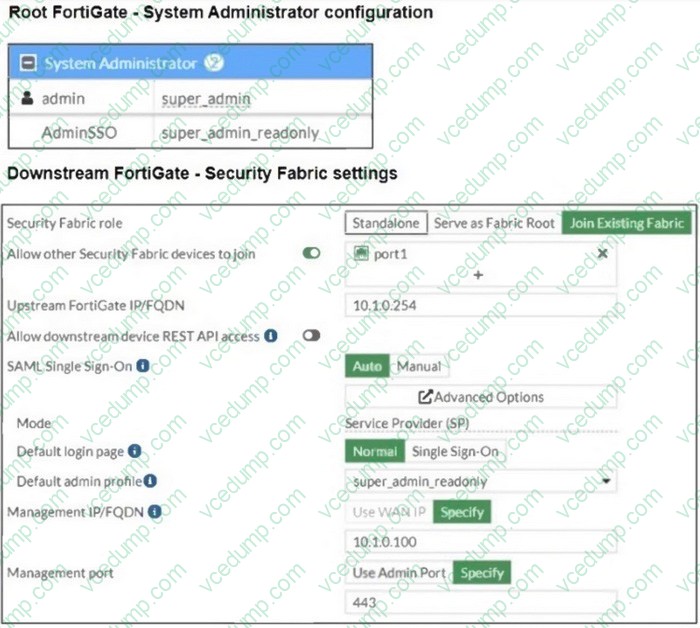
The Administrators section of a root FortiGate device and the Security Fabric Settings section of a downstream FortiGate device are shown.
When prompted to sign in with Security Fabric in the downstream FortiGate device, a user enters the AdminSSO credentials.
What is the next status for the user?
A. The user is prompted to create an SSO administrator account for AdminSSO.
B. The user receives an authentication failure message.
C. The user accesses the downstream FortiGate with super_admin_readonly privileges.
D. The user accesses the downstream FortiGate with super_admin privileges.
Related Exams:
-
EMEA-ADVANCED-SUPPORT
Fortinet EMEA Advanced Support -
FCP_FAC_AD-6.5
FCP - FortiAuthenticator 6.5 Administrator -
FCP_FAZ_AD-7.4
FCP - FortiAnalyzer 7.4 Administrator -
FCP_FAZ_AN-7.4
FCP - FortiAnalyzer 7.4 Analyst -
FCP_FAZ_AN-7.6
Fortinet NSE 5 - FortiAnalyzer 7.6 Analyst -
FCP_FCT_AD-7.2
FCP - Forti Client EMS 7.2 Administrator -
FCP_FCT_AD-7.4
Fortinet NSE 6 - FortiClient EMS 7.4 Administrator -
FCP_FGT_AD-7.4
FCP - FortiGate 7.4 Administrator -
FCP_FGT_AD-7.6
FortiGate 7.6 Administrator FCP_FGT_AD-7.6 -
FCP_FMG_AD-7.4
FCP - FortiManager 7.4 Administrator
Tips on How to Prepare for the Exams
Nowadays, the certification exams become more and more important and required by more and more enterprises when applying for a job. But how to prepare for the exam effectively? How to prepare for the exam in a short time with less efforts? How to get a ideal result and how to find the most reliable resources? Here on Vcedump.com, you will find all the answers. Vcedump.com provide not only Fortinet exam questions, answers and explanations but also complete assistance on your exam preparation and certification application. If you are confused on your FCSS_EFW_AD-7.4 exam preparations and Fortinet certification application, do not hesitate to visit our Vcedump.com to find your solutions here.